
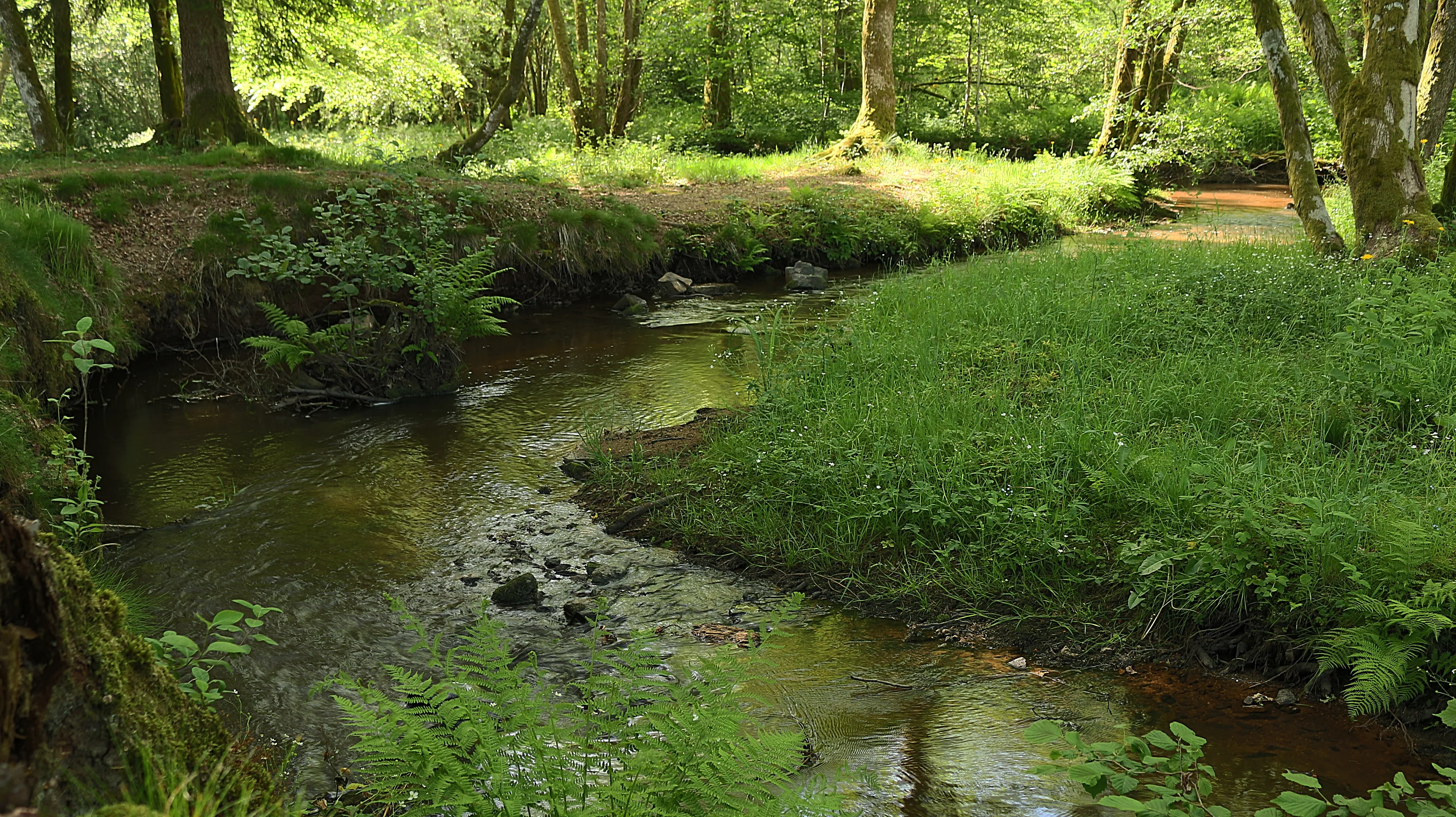
If I mention "vast pine forests, large lakes, waterfalls, mountains, endless valleys, trout or carp fishing, hiking, biking, or horseback riding, and breathtaking views," you’ll almost certainly think of Canada or Alaska...
Well, think again, dear readers, that’s not the destination on our itinerary! Contrary to what you might expect, I’m not taking you to some remote land across the Atlantic where you might hope (or fear?) to come face-to-face with a grizzly. I’m taking you to France, to a region that is little-known yet incredibly rich in resources and color: the Morvan, or more specifically, the Morvan Regional Natural Park, where you’re much more likely to come face-to-face with a lovely little deer!

Admittedly, we are far from the trendy beaches of the French Riviera, the glamorous seaside resorts of Brittany, or the upscale ski slopes of Courchevel or Méribel. But believe me, if you’re a nature lover in search of wide-open spaces, culture, and outdoor activities, there is no doubt that the Morvan will win you over. It remains a true earthly paradise that you absolutely must discover, no matter the season, spring, summer, autumn, or winter!
I’ve selected the "must-dos" and essential visits for this mystical region, which is packed with tourist and cultural gems. So, lace up your shoes and follow me for a breath of fresh air!
What is the Morvan, where is it, and how do you get there?
Once upon a time, there was a vast granite massif in the heart of Burgundy, alternating between gigantic forests of pine and deciduous trees, mountains and rocky escarpments, large lakes and rushing streams, and a thousand and one shades that change with the seasons, reminiscent of the great Irish or Canadian landscapes... well, there you have it, now you know what the Morvan is! A true natural jewel that has managed to preserve its authenticity while protecting and promoting its natural, rural, and cultural heritage, which earned it the Regional Natural Park label in 1970.
But where exactly is this treasure hidden, which so many of you struggle to locate on a map?

Well, you won't have to go far! This territory, which some aficionados call the "Morvan island," is located in the center of the Burgundy region, straddling four departments: the Nièvre, Saône-et-Loire, Yonne, and Côte d’Or. It’s only a 2.5-hour drive from Paris or Lyon! It’s the closest mountain range to the capital, what more could you ask for?
If you are coming from Paris, take the A6 motorway (heading toward Lyon) and exit at Avallon (exit 22), then follow the signs for "Parc naturel régional du Morvan."
From Lyon, take the A6 motorway (in the opposite direction) and exit at Chalon-sur-Saône, then head toward Autun and follow the signs for "Parc naturel régional du Morvan."
It just goes to show that you don't need to travel far to get a complete change of scenery and disconnect from the daily grind!
Top 6 sites and activities you can't miss
1, Discovering the Morvan lakes: a lake for everyone...
While the first thing that strikes visitors upon arriving in the Morvan is the dominance of green stretching over miles and miles of forest, you should know that behind this gigantic green curtain lie 6 large artificial lakes of relatively recent origin (built during the 19th century and up to the mid-1960s), including:
- Lac des Settons;
- Lac de Pannecière;
- Lac de Chaumeçon;
- Lac du Crescent;
- Lac de Saint-Agnan;
- Lac de Chamboux.
Artificial, yes, but each is very different, with its own unique personality and character, meaning everyone can find something to suit their mood. So, dear readers, which lake is right for you? Let's take a closer look at 4 of them.
Lac des Settons, for families and sports enthusiasts

If you're in a family-friendly, sporty mood and love water activities, then Lac des Settons is undoubtedly the lake for you!
Whether it's a catamaran trip, a "fun boat" ride, balancing on a stand-up paddleboard, a pedal boat ride with a slide, gliding across the water in a kayak, a miniature port with electric boats, mini-golf, crayfish fishing, or a scenic boat tour, the fingers on one hand aren't enough to count the countless activities awaiting you at Lac des Settons that will delight both young and old. Not to mention the option to walk or bike around the lake and discover its most intimate corners on an intense 15 km loop that is sure to keep you warm, I promise!
By the way, after all that effort, why not head to the Plage du Midi (a "Blue Flag" beach for its high water quality) for an invigorating picnic, a refreshing swim, or simply to "lizard out" on the fine sand, fully embracing the true meaning of the word "farniente"...?
One thing is certain: no matter which activity you choose, it would be a shame to leave Lac des Settons without seeing the splendid sunset that plunges the waters of this peaceful soul into flamboyant, breathtaking colors!
It’s the perfect way to create memorable moments for families looking to escape the hectic, exhausting life of big cities, which are yet so close geographically...
Lac de Pannecière, for nature lovers

For those with a quieter soul who love nature, head to Lac de Pannecière, the largest lake in the Morvan and the Burgundy region. Wilder than its neighbor, Les Settons, this lake is dedicated to fishing, and some areas are only accessible by boat. It is clearly the ideal spot to relax and enjoy some one-on-one time with yourself, or perhaps with one of the countless birds that have claimed the area as their own and will let you know with their intoxicating, persistent songs. By the way, to admire these masters of the place with complete discretion, the Montigny-en-Morvan bird observatory is at your disposal.
But while this zen and relaxing lake seems to have been created by man to escape time, know that it also has another mission: to control the flooding of the Seine and reduce flood risks.
A function it took on following the great Seine flood of 1910, when many riverside neighborhoods were completely flooded and economic activity was totally devastated. This disaster triggered a vast reflection on flooding and, more generally, on the management of water supplying Paris and its region. This led to a major program of digging retention lakes, including Lac de Pannecière.

So, we can remember Lac de Pannecière as a wild and peaceful lake, but that's not all...
Lac de Saint-Agnan, for its forest and colors
Now, let's head to "Canada" or "Ireland," depending on your perspective...

Whether some see a little Irish touch or others nickname it "little Canada," it’s clear that with its maze of forests and large meadows turning warm, incandescent colors in autumn and a flamboyant green in spring and summer, Lac de Saint-Agnan is undeniably reminiscent of its wild, wooded cousins across the Atlantic and the English Channel! To see for yourself, there's nothing better than walking around the lake via a 9 km "discovery" trail specially designed for this purpose.
And for those in a less sporty mood, why not enjoy a good fishing session or simply sit back and recharge by the lake, which is so renowned and appreciated for its lack of housing and motorized boats?
Lac de Chaumeçon, for thrills
Finally, if you want to reveal your adventurous and "daredevil" side, then welcome to Lac de Chaumeçon. Crossed from north to south by the famous Le Chalaux river (a deceptive river with calm edges that leads to agitated and tumultuous waters), it is the premier spot in the Morvan for white-water sports.

Between rafting, "hot dogging," or "air boating," you won't know what to choose to experience big thrills and challenge the river's hottest passages, such as "the bubble pool" or "the calf loss" (very evocative names...!).
For others who are less daring but just as eager for beautiful emotions, canoeing or kayaking will be an excellent alternative, promising an experience and memories of a lifetime!
Now that our tour of the 4 major lakes worth visiting is complete, let's head without further delay to follow in the footsteps of Vercingetorix and Julius Caesar by visiting the Bibracte archaeological site in the south of the Park.
2, Bibracte/Mont Beuvray archaeological site
Close your eyes and imagine yourself 2,000 years back in time, in the days of the Gauls and in the heart of Celtic civilization...
Well, dear readers, you aren't dreaming! Here, at Bibracte, you are indeed on the marked trails of the former capital of the Aedui, an ancient Gaulish people allied with Rome. The city was founded in the 2nd century BC. It was here that Vercingetorix was named leader of the coalition against the Romans and that Julius Caesar finished writing his collection on the "Gallic Wars."
On-site, you can discover historical remains, such as the ruins of fortifications, public buildings, and the ancient homes of this legendary people. For history buffs, a museum dedicated to Celtic civilization and the history of Bibracte, the Museum of Celtic Civilization, will immerse you in the heart of history and take you back to the time of the Gauls.

The experience continues at the "Chaudron," a restaurant serving typically Gaulish cuisine that will delight your taste buds with dishes concocted from ingredients known to the Gauls, served on tableware identical to that of the inhabitants of Bibracte. All accompanied not by a magic potion, but by a cervoise (beer) brewed exclusively for the site. It’s enough to make you feel like Asterix and Obelix for the duration of a meal!
After your meal, why not go digest peacefully on the heights and in the undergrowth of Mont Beuvray? The high-altitude mist and the many "queules" (beech trees braided by the Gauls) with their twisted shapes, encircled by a long belt of ramparts, immerse you in an almost mystical and spiritual atmosphere, letting you imagine the daily life of this ancient Gaulish village...
No matter what you decide, know that the natural and archaeological site of Bibracte is open for self-guided tours all year round. However, please note that in July and August, the road leading up to the site is closed to traffic. But don't panic, a free shuttle bus running approximately every 20 minutes is available for tourists, or for the more courageous among you, walking to the site is perfectly possible! As for the Museum, it is open from mid-May to mid-November, every day from 10 am to 6 pm and until 7 pm in July and August.
Let's abandon our breastplates and sandals now and head to Gouloux to find a good pair of clogs that will also give us the impression of being in a completely different time...
3, Gouloux or the world's largest clog...
While most guidebooks will invite you to Gouloux to discover its legendary waterfall, the "Saut du Gouloux," a famous 10-meter-high waterfall in the heart of lush vegetation, next to which you can see the ruins of two old mills (one for flour, the other for oil), my motivation is quite different.
Indeed, if I chose to have you discover this place, it is primarily for the Gouloux Clog Factory. This artisanal know-how is perpetuated by Alain Marchand, the last representative of wooden clog making who, in the 1950s, produced up to 27,000 pairs of clogs!
At his place in Gouloux, using ancestral and traditional methods, a log of wood becomes a clog before your eyes in a matter of minutes, under the hands and tools of seasoned clog makers. It’s enough to leave you speechless and full of admiration for this renowned artisan, who further cemented his fame by crafting the world's largest clog, certified by the Guinness Book of Records in 1989!

This gargantuan clog (weighing 2.5 tons and 3.80 meters long) was carved right here in the Morvan from a giant sequoia from the Bresse region. Believe it or not, it was made in just 15 days!
So, if you were planning to leave the site with a pair of clogs specially fitted for your feet, know that for this master of the wooden log, it will be a mere formality!
- Site address: le Meix Garnier - 58230 Gouloux
- Opening hours: open from April 1 to September 30, from 8 am to 12 pm and from 1:30 pm to 5:30 pm
4, The Château de Bazoches or the home of Marshal Vauban
Let's continue our journey through time by putting on our finest lordly costume and heading to the Château de Bazoches, a magnificent medieval building built in the 12th century at the gateway to the Morvan, halfway up a wooded hill on the site of an old Roman outpost.

While it was successively the property of the lords of Bazoches, Chastellux, Montmorillon, and la Perrière, it later fell into the hands of the famous and great man, Marshal Vauban, who acquired this little stone jewel with its four towers and keep surrounding an inner courtyard in 1675, thanks to a gratuity granted to him by Louis XIV, whom he served faithfully for over fifty years.
It was notably at Bazoches, after having converted the place into a true military garrison, that Marshal Vauban carried out the studies and plans for more than 300 works and strongholds, and where he developed the methods of attack and defense of fortifications that made him THE undisputed master of siege strategy and military architecture.
In fact, it was said at the time: "A place besieged by Vauban is a taken place, a place defended by him is impregnable"... Which speaks volumes about this illustrious figure whose descendants have remained owners of the Château de Bazoches. They carefully preserve many souvenirs accessible to the public, including: a suit of armor, a bedroom, a study, a library containing a collection of nearly 5,000 books, a huge family tree, etc., which plunge you directly into the atmosphere of the 17th century.


Not to mention the splendid exterior where, as witnesses to that distant era, finely manicured gardens, a footbath, and sumptuous stables that once housed the horses of engineers and messengers stand proudly. So, for those who dreamed of a castle life, you just need to go to Bazoches to immerse yourself in what a lord's life might have been like!
On that note, for this dream to become a reality, know that the Château is open every day from mid-February to mid-November. The price is around ten euros for an adult ticket, around 8 euros for students, and 5 euros for children aged 7 to 14. Entry is free for children under 7.
As for access to the site, it can be reached by car or bus at the following address:
Château de Bazoches
58190 Bazoches du Morvan.
5, The Haut-Folin
Did you know it's possible to go skiing just 2.5 hours by car from Paris?
Admittedly, at 901 meters high, the Haut-Folin isn't big enough to compete with the high Alpine peaks. Nevertheless, with its 5 cross-country ski trails totaling 40 kilometers, there is still plenty to enjoy. You can practice skiing, sledding, and snowshoeing at the closest ski resort to Paris. And did you know that access to the trails is free!
The trails are open and groomed as soon as there is a 20-centimeter layer of snow. As for their starting point, it is located at a place called Préperny, where there are two chalets, a parking lot, and a pond, accessible by driving up the RD 500 from Arleuf (5 km from Arleuf).
In terms of difficulty, there is something for every level. You can choose between a very easy trail (the 3 km "Relais"), two easy trails (the 5 km "Grand Montarnu" and the 6 km "Proie"), and two difficult trails (the 12 km "Carnés" and the 14 km "Reuchemin"). There is something to delight everyone, child or adult, beginner or experienced!

Finally, have no worries: if like me you don't own ski equipment, know that it is perfectly possible to rent it on-site, whether it's cross-country skis, snowshoes, or sleds, at the following rates (indicative prices noted in 2020):
- Skis + poles + boots (sizes 30 to 47): 15 euros/day and 10 euros/half-day*;
- Snowshoes (sizes 26 to 50): 15 euros/day and 10 euros/half-day*;
- Sleds (for children only): 10 euros/day and 5 euros/half-day*.
*half-day = 9 am, 1 pm or 1 pm, 5 pm
So, no more excuses for not going skiing, especially since in winter, with its thick blanket of snow and thousands of pine trees all dressed in white, the Haut-Folin takes on the air of Canada or Lapland, promising a guaranteed change of scenery and wonder! It’s enough to make the chic and upscale resorts of Chamonix turn pale, they’d better watch out!
6 - 100% unusual accommodations
Who hasn't dreamed of sleeping in a tree or a tipi? Well, in the Morvan, it's possible and much more...
Between perched cabins (Montsauche-les-Settons, Saint-Hilaire-en-Morvan, Beaulieu), lake cabins (Domaine du Château d’Ettevaux), yurts (Domaine de la Pierre Ronde, Corvol-d’embernard), Hobbit houses (Domaine de la Pierre Ronde), gypsy caravans (Moux-en-Morvan, Donzy, Chatillon-en-Bazois), tipis (Montsauche-les-Settons, Moux-en-Morvan), safari tents (Colmery), and perched nests (Saint-Verain), you won't know what to choose among all these unusual and incredible accommodations that will make your stay in the Morvan unforgettable!

So, who said the Morvan was boring?
And so, on this picturesque and original note, our little tour of the Morvan comes to an end. Far from preconceived ideas, it is actually a warm and friendly land that offers as many confusingly beautiful proposals as it does timeless experiences to anyone willing to venture there.
Of course, the Morvan is not limited to just the activities I have proposed throughout this article. It is indeed full of many other experiences, but for the moment, I have restricted myself to those I preferred, and who knows, perhaps this natural treasure with a thousand and one facets will be the subject of a future story...
One thing is certain: I could not finish this article without sharing some juicy anecdotes about this mystical and unique place. Let's zoom in on those.
5 anecdotes about the Morvan
You certainly didn't know that...
1. The "queules" of Mont Beuvray are remains of hedges.
Do you remember those strangely shaped trees I mentioned a few lines ago that make Mont Beuvray famous? These beech trees, which the locals (Morvandiaux) are accustomed to calling "queules," are actually the remains of hedges, braided by 19th-century peasants to fence in their fields. Once the peasants left, the trees continued to grow freely, taking on curious and outlandish shapes.
2. In the 16th century, it was the Morvan that heated Paris.
In winter, the forests of the Morvan were cut into logs, then thrown into the water until they reached Clamecy, where they were finally assembled into large rafts called "Trains de Bois" (wood trains). For 10 to 15 days, men standing on these floating trains, the "wood floaters," were responsible for guiding and transporting them to the docks of the Seine to heat the capital.
3. 2 submerged villages are hiding under Lac de Pannecière.
During the creation and filling of this artificial dam lake, 2 hamlets, "Blaisy" and "Pélus," were submerged. During the lake's draining every 10 or 20 years, these ancient villages reappear, and one can discover the remains of houses, the alleys once used by the inhabitants, the village bell tower, as well as the ports that connected the Yonne and the Houssière.
4. From the Haut-Folin, you can see Mont Blanc.
Remember the Haut-Folin, the highest point of the Morvan, peaking at 901 meters. Well, when the weather is clear and sufficiently bright, you can see Mont Blanc, even though it is 250 kilometers away!
5. The Élysée Palace Christmas tree comes from the Morvan.
With its immense coniferous forests, the Morvan is the main producer of Christmas trees in France. You can find spruces and the famous Nordmann firs, so dear to our hearts. Well, you probably won't believe me, but every year for over 10 years, it is a Nordmann fir from the Morvan that is installed in the main courtyard of the Élysée Palace, making an entire region proud!
In short, these are all anecdotes that prove once again that the Morvan has plenty to surprise us!


Comments (0)
No comments yet. Be the first!