
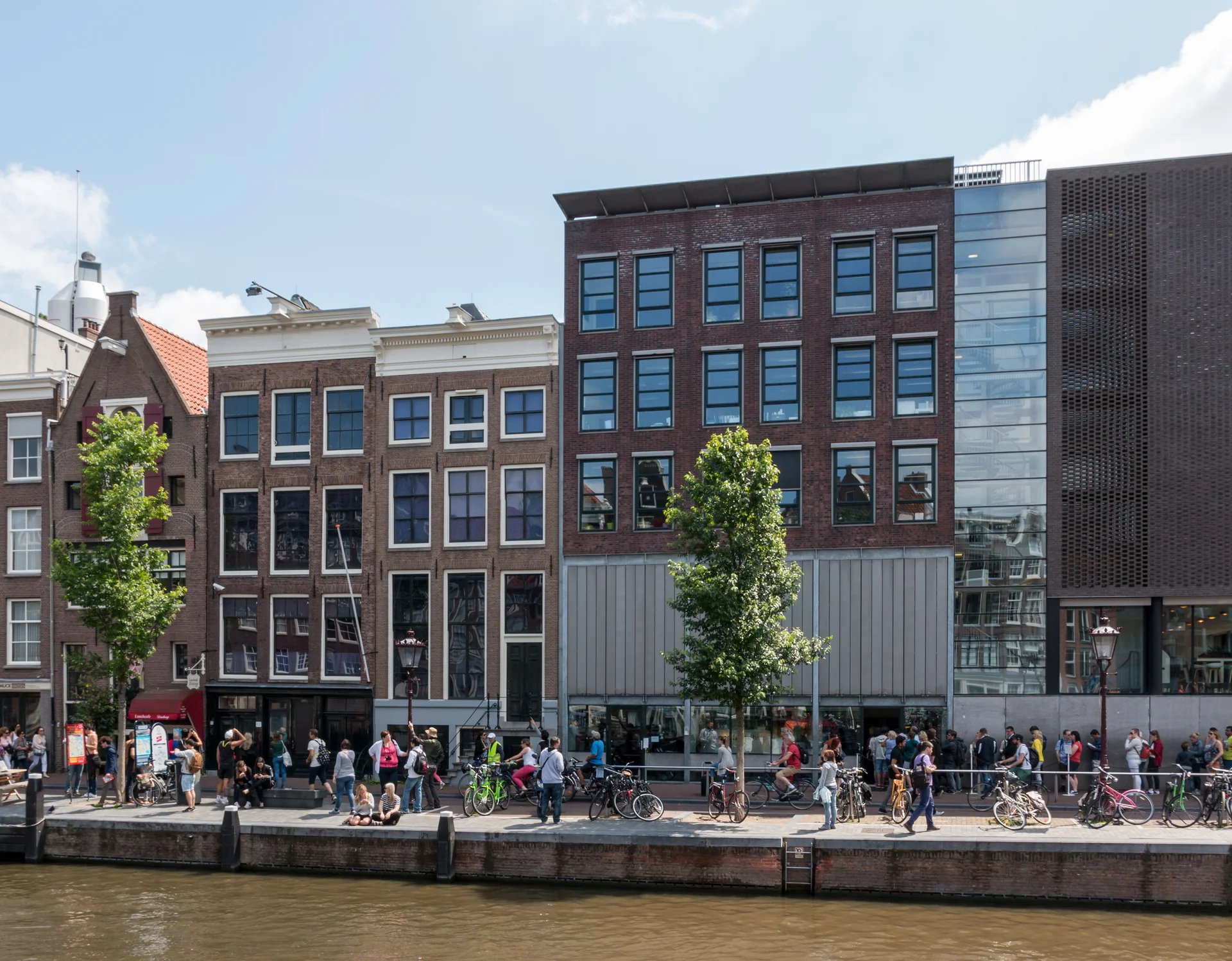
Visiting the Anne Frank House
This building serves today as a museum where the young writer lived during World War II. Alongside her family and four others, she hid in the rear annex of the house for two years to escape Nazi persecution.
A museum, a history
The Anne Frank House (Anne Frank Huis) is a site defined by its emotional weight. A visit immerses you in the reality of the Jewish teenager forced to live in cramped, hidden quarters during the German occupation. The family relied on associates of Otto Frank, her father, for supplies. They were eventually betrayed to the German police and deported to Nazi concentration camps, including Bergen-Belsen in Germany.
It was here in this hiding place that Anne wrote The Diary of a Young Girl, the personal journal where she recorded her daily life in hiding, her fears, and her dreams with striking honesty and simplicity. The work was published in 1947 and has since been translated into 60 languages.
Saved from demolition
After the family was deported, the house remained largely as it was. Her father, Otto Frank, was the sole survivor. He fought to prevent the building, which had fallen into disrepair, from being demolished by the Berghaus textile factory that sought to build on the site. In 1957, the Anne Frank Stichting (Anne Frank Foundation) was established to allow the public to visit the building and to preserve Anne Frank's ideals. The museum opened its doors to visitors in the early 1960s.
The site has undergone several phases of renovation. The first involved rehabilitating the secret annex to maintain its original condition. The second, during the 1990s, involved the demolition of a student residence built in the 1950s to make room for expanded museum galleries, staff offices, and new student housing.
A moving experience
Imagining eight people living for more than two years in such a restricted space, without any contact with the outside world, is a profound experience. Throughout the rooms, excerpts from the diary are displayed. You will find historical documents, photographs, and personal effects from the family, as well as the posters and clippings of idols that Anne Frank collected, reflecting her teenage dreams. The visit concludes with a video that invites reflection on freedom of expression and discrimination.
Opening hours
*Information subject to change

The tour lets you discover how Anne Frank and her family lived in hiding for more than two years and realize the horror they went through during this dark period of history. A very moving and memorable visit.