
Wasi Pillpi: Inside the secrets of the cloud forest
Editor's note, published 10/28/2025
A fifteen minute walk from Machu Picchu Pueblo, along the road that winds toward the Inca citadel, a wooden gate opens into a world of color. The Machu Picchu Butterfly House, known as Wasi Pillpi in Quechua, holds one of the most remarkable living butterfly collections in the Americas. Here, in the heart of the natural sanctuary, more than 400 species flutter between the branches, including about 100 that exist nowhere else on Earth.
Why this sanctuary is worth the stop
Founded in 2006 by the local association Hijos del Sol de Machupicchu (Children of the Sun of Machu Picchu) and led by biologist Leonardo Serrano Gutiérrez, this research and breeding center is more than just a tourist stop. It is a living laboratory where science meets conservation. Butterflies born in captivity are released into the sanctuary to bolster wild populations.
Every visit helps fund this preservation work for threatened species, including the famous Battus Madyes Monteban, a black endemic butterfly that feeds exclusively on a rare local plant, the Aristolochia Killipiana.
For families traveling with children, this is a fascinating educational experience that serves as a perfect complement to an archaeological tour of Machu Picchu.
The complete metamorphosis cycle before your eyes
The twenty minute guided tour reveals the mechanics of metamorphosis. In the interpretation room, colorful infographics set the stage, covering Peruvian biodiversity, the ecological role of lepidoptera, and the threats they face. A collection of over 100 mounted specimens prepares you for what comes next.
The breeding laboratory
Behind glass, caterpillars show off their survival strategies. Some sport venomous spines, while others mimic bird droppings to evade predators. Chrysalises hang like organic jewels, some golden and others translucent. With a bit of luck, you will witness a butterfly emerging, a moment where crumpled wings slowly unfold.
The free flight area
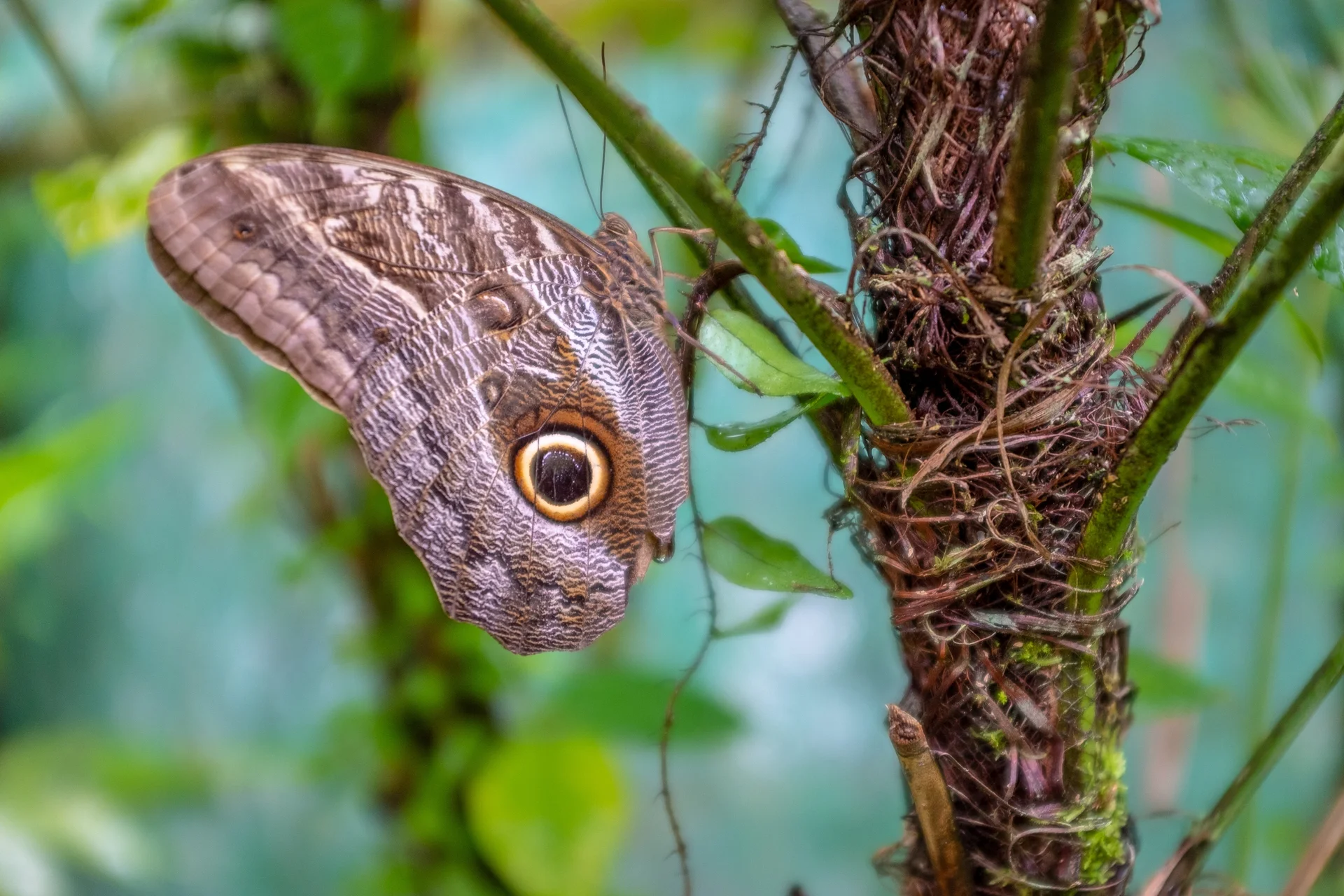
The highlight arrives in the tropical greenhouse where butterflies fly freely. Dozens of species zip between flowers, including the majestic owl butterfly (Caligo) with its eyespots that mimic a raptor, morphos with a dazzling electric blue, and heliconius with red and black geometric patterns. Stand still for a few moments and they might just land on your shoulder or hand.
Pro tip: Schedule your visit between 8 AM and 11 AM, when the butterflies are most active and the light filters beautifully through the canopy. Avoid the rainy season (October through March) when the butterflies are less active.
A peaceful haven by the Vilcanota
After the guided tour, linger in the thematic cafeteria perched above the Vilcanota River. The sound of water cascading over rocks accompanies a fresh tropical juice. It is a prime birdwatching spot, with giant hummingbirds, multicolored tanagers, and if you are lucky, the tunki, the iconic orange Andean cock-of-the-rock of Peru.
A path runs along the river, allowing for a short walk through the lush vegetation. Wear long pants, as mosquitoes are hungry in this humid area.