
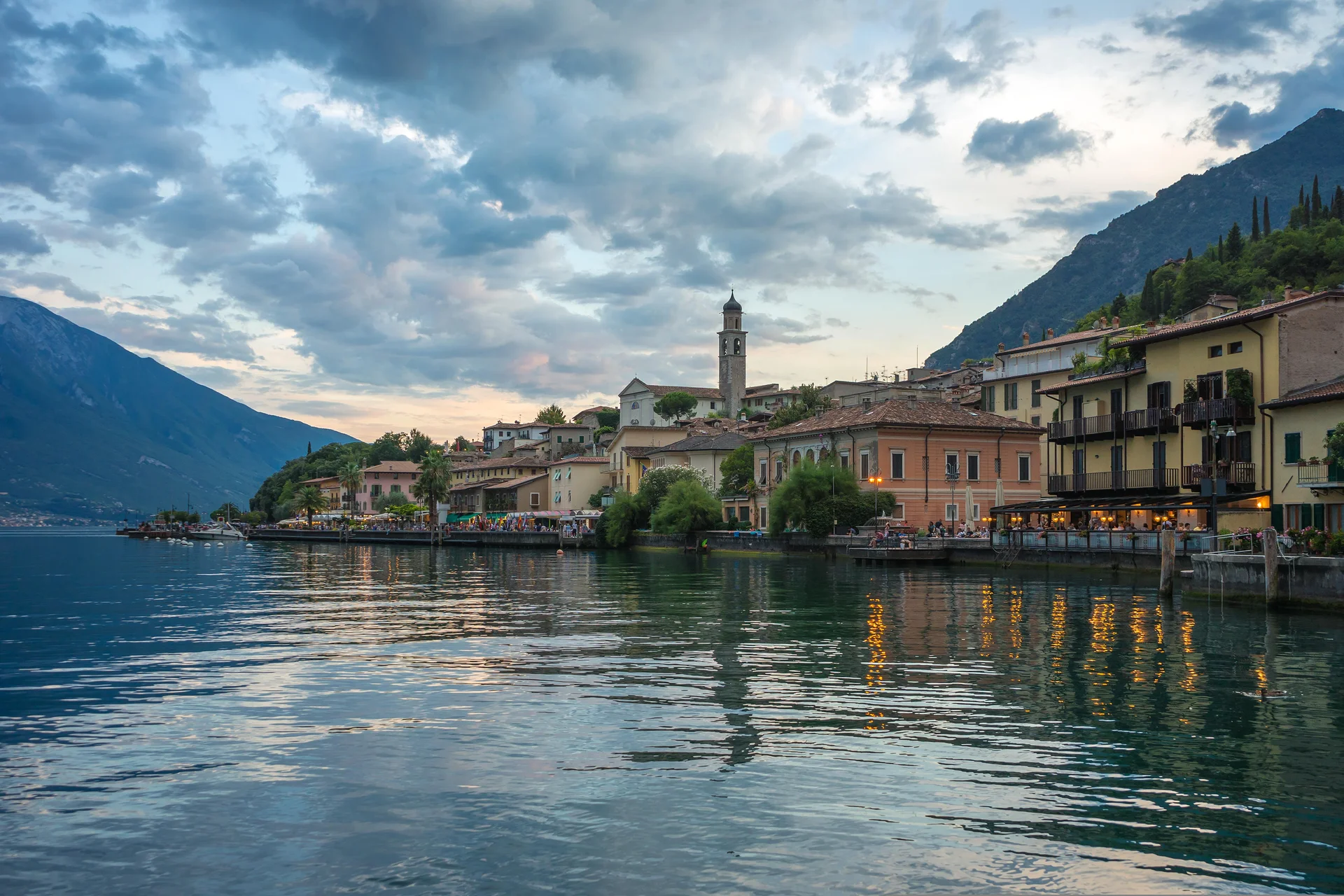
Visiting Lake Garda
Spanning 367 square kilometers, Lake Garda stands as the largest lake in Italy. Situated in the north, where it borders the regions of Lombardy, Trentino, and Veneto, the area enjoys a warm, humid climate that supports a Mediterranean landscape. You will find palms, cypress trees, and lemon groves thriving here. It is a striking contrast to have one foot in the Alps while enjoying the pleasures of the Dolce Vita.
A lake with ancient roots
Lake Garda has been documented since Antiquity, notably by Virgil, and was the site of the Battle of Benacus in 268 AD. The lake retains traces of the Roman era, most famously the ruins of an ancient villa known as the Grotte di Catullo (Caves of Catullus). By the 13th century, the lake remained a significant site, as evidenced when Saint Francis of Assisi founded a monastery on the Isola del Garda, though the structure has since been lost.
The southern shore
Start your visit in the town of Sirmione. Despite the heavy crowds, its unique location at the tip of a narrow peninsula and its impressive medieval fortress, the Rocca Scaligera, make it a must-see. Nearby, Peschiera del Garda is a fortified town home to landmarks like the Forte Ardietti and the Santuario della Madonna del Frassino (Sanctuary of Our Lady of the Ash Tree). You should also explore Lazise and Bardolino, two charming towns featuring traditional harbors and distinct Venetian-style architecture.
The northern shore
The northern end of the lake is where the terrain becomes much more rugged. Malcesine, shadowed by a 13th-century castle, sits at the base of Monte Baldo, the highest peak in the immediate area. You can reach the summit by cable car. Tucked into the mountainside, Limone sul Garda is also worth a stop.

Lake Garda is one of those places you absolutely have to see in Italy. I recommend spending at least three days there. The setting is exceptional, with mountains and plenty of nature. The villages around the lake are pretty authentic and very nice. It is truly refreshing and relaxing.