
Zagreb Cathedral: When stone tells a thousand years of Croatian history
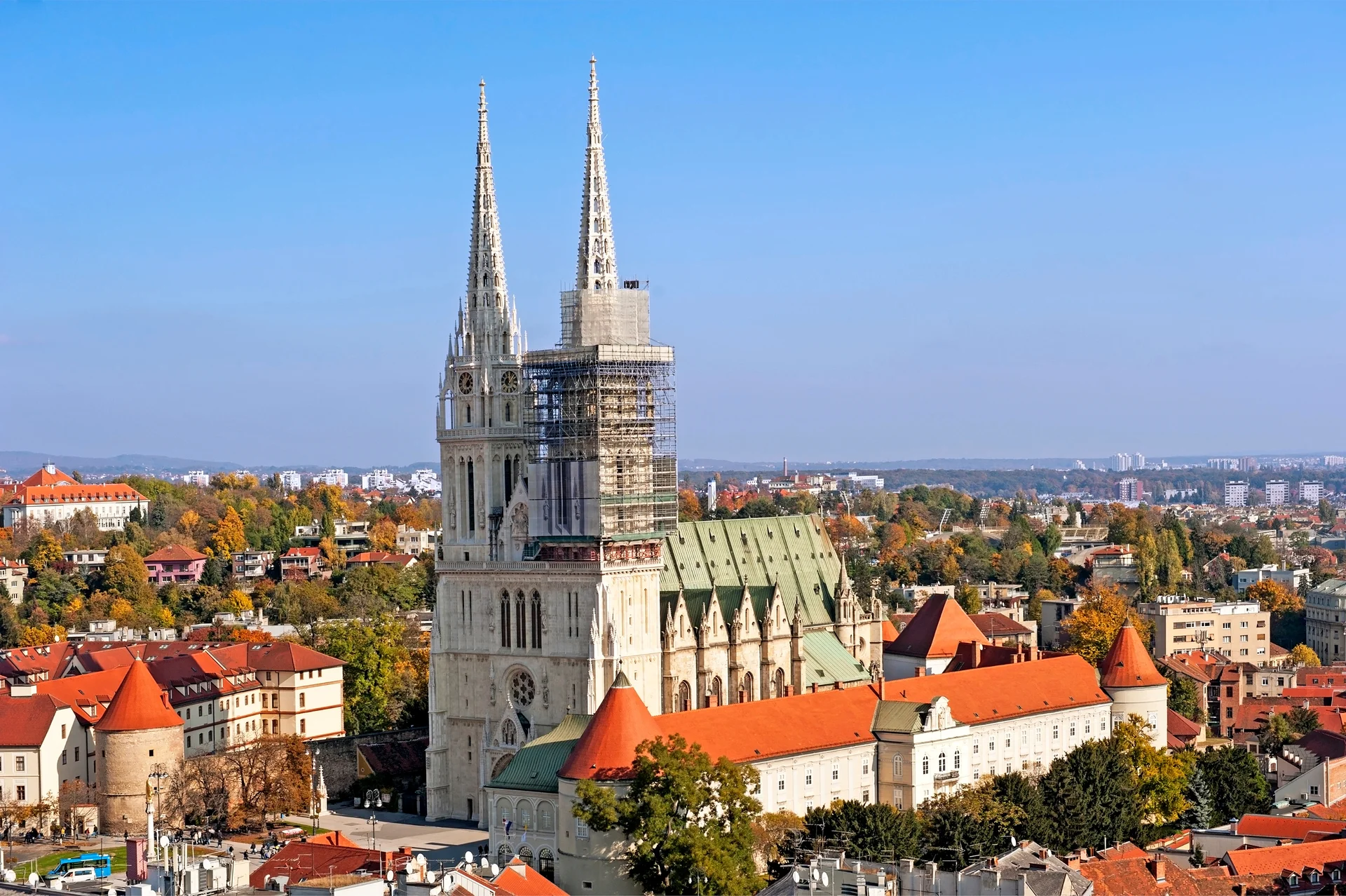
From Kaptol square, the neogothic spires of the cathedral reach toward the sky like two stone sentinels. Standing over 100 meters tall before the 2020 earthquake, this giant has dominated Zagreb since the 11th century. The scaffolding that wraps around it today is a testament to centuries of resilience. It was rebuilt after the Mongol invasion of 1242 and again following the 1880 earthquake, and it is rising once more before our eyes.
A national symbol that never gives in
The Cathedral of the Assumption of the Virgin Mary carries the DNA of Croatia within its walls. This is the resting place for the country's major figures, including Cardinal Alojzije Stepinac, whose tomb sculpted by Ivan Meštrović draws thousands of visitors, as well as heroes Petar Zrinski and Fran Krsto Frankopan, symbols of the Croatian resistance. Founded in 1094 by King Ladislas of Hungary, the site has weathered Tatar invasions, Ottoman threats, fires, and earthquakes.
In March 2020, a new blow struck when a 5.5 magnitude earthquake caused the top of the south tower to collapse. Five years later, after 42 million EUR in investments, it partially reopened for the 2025 Christmas mass.
The mark of Hermann Bollé
The current face of the cathedral bears the signature of one man, the German architect Hermann Bollé. Following the devastating 1880 earthquake, he redesigned the building in the neogothic style that defines its reputation today. The two twin towers he erected between 1889 and 1899 stood at 108 meters, with a difference of only 4 centimeters between them. The north tower measures 108.20 meters, while the south tower is 108.16 meters. This level of precision speaks to the skill of the local Zagreb craftsmen of that era.
Impressive proportions
The interior can hold 5,000 people. The main nave, the side aisles, and the raised choir create a monumental volume. Gothic vaults soar toward the ceiling, punctuated by exterior flying buttresses that support the entire structure.
Hidden treasures inside
The sacristy houses an exceptional piece, the triptych of the Golgotha altar painted by Albrecht Dürer. This work by the German Renaissance master is among the most precious collections in Croatia. In the central nave, attention shifts to the baroque marble altars, which are intricately carved, and the pulpit adorned with refined details. The 19th-century stained glass windows filter the light, bathing the space in a spiritual atmosphere.
An organ among the best in the world
The cathedral organ is worth a visit on its own. Ranked among the ten most prestigious concert organs in the world, it features more than 6,000 pipes, 78 stops, and four manual keyboards. Registered as a protected cultural asset by the Ministarstvo kulture i medija (Croatian Ministry of Culture and Media), it resonates during the Organ Festival at Zagreb Cathedral every summer. The central chandeliers add an unusual touch, as they are said to have come from a Las Vegas casino.
Reconstruction after 2020
The current construction site is one of the most complex sacred heritage restoration projects in Europe. Teams removed nearly 4,000 stone blocks from the towers, each weighing between 100 and 1,200 kilograms. These stones are 3D scanned, barcoded, and then replaced with new travertine blocks. The towers, shortened by 30 meters, will be fitted with a steel frame to withstand future earthquakes.
The primary difficulty stems from the original stone. Lithothamnion limestone, litavac, and other local materials can no longer be extracted from the historic quarries, which are now protected.
Friendly tip: As you exit, look at the clock on the facade. It still shows 7:03, the exact time of the great 1880 earthquake. This detail serves as a reminder that the cathedral carries the memory of the catastrophes it has overcome within its stones.
Renaissance fortifications
Surrounding the cathedral are walls and round towers built in the 16th century to protect the Kaptol neighborhood from Ottoman invasions. These defenses are among the best preserved examples of Renaissance-style fortification in Europe. The south tower, built in the 17th century, served as a military observation point. Today, these ramparts form a unique architectural ensemble with the Archiepiscopal Palace that surrounds the cathedral on three sides.
Opening hours
The interior partially reopened in late December 2025 for religious services.
Masses are held Monday through Saturday at 7:00 AM, 9:00 AM, and 6:00 PM (7:00 PM in summer), and on Sundays and holidays at 7:00 AM, 9:00 AM, 10:00 AM, 11:30 AM, and 6:00 PM (7:00 PM in summer).
For tourist access, check locally or with the tourist office, as hours may shift based on the progress of renovations.

The cathedral is one of the must-see spots in Zagreb. The exterior is truly magnificent with so many details. I was pretty disappointed not to be able to go inside because the cathedral is under renovation. Check ahead of time, but it will likely be that way for a while.