
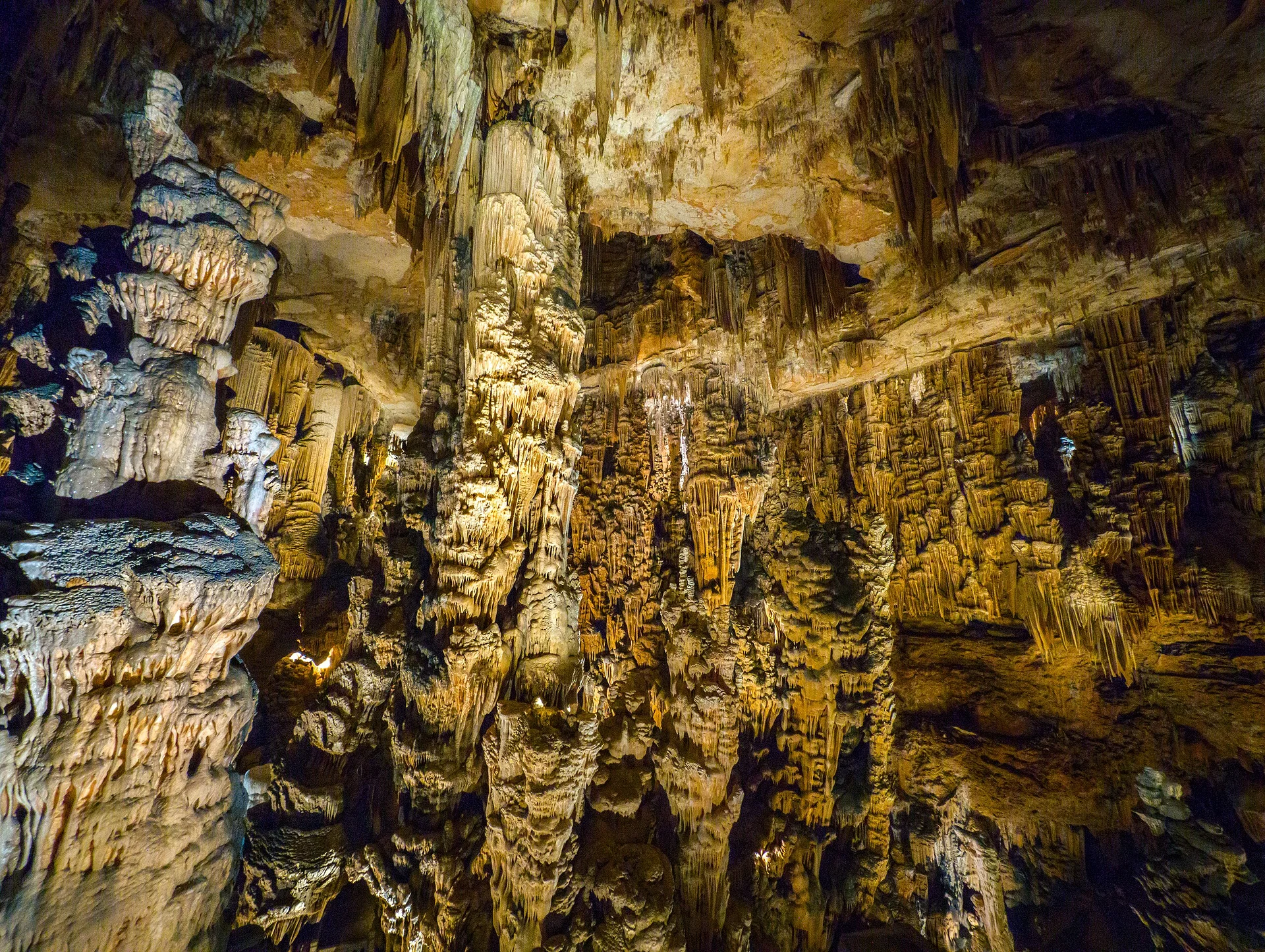
Visiting the Grotte des Demoiselles: the secret cathedral of the Cevennes
The adventure starts well before you head underground. A funicular, the first of its kind in Europe, hauls you up the cliffside to the entrance of the Grotte des Demoiselles. This is where, inside the massif du Thaurac (Thaurac mountain range), a doorway opens to a subterranean world of unexpected scale, a landscape carved by water over millions of years.
Why head underground?
Nicknamed the cathedral of the abyss by speleologist Édouard-Alfred Martel, who explored it in the late 19th century, the cave lives up to its reputation. Beyond its geological appeal, it serves as a piece of history for both cave exploration and tourism, having been among the first caverns in France opened to the public starting in 1931. Visiting means walking in the footsteps of early pioneers within a space that defies expectations.
Geological features on a massive scale
The path reveals a series of chambers and galleries filled with a profusion of formations. Stalactites, stalagmites, translucent draperies, and massive columns create a varied mineral landscape, highlighted by a lighting system that emphasizes every detail.
The Cathedral of the Abyss, a colossal volume
The highlight of the visit is undoubtedly the main chamber, known as the Cathedral. Its dimensions are huge, with a ceiling over 50 meters high and a width of 80 meters. In the center of this monumental space, nature has crafted its most impressive work.
- La Vierge à l'Enfant (The Virgin and Child): an immense stalagmite nearly 10 meters tall, whose silhouette suggests a mother holding her child, which has become the emblem of the cave.
- Le Grand Orgue (The Grand Organ): calcite draperies and flows that drape from the walls like the pipes of a cathedral organ.
- Le Manteau Royal (The Royal Cloak): another spectacular formation that resembles the rich fabric of a court garment.
Friendly tip: definitely bring closed-toe shoes and warm layers. No matter how hot it is outside, the temperature inside the cave stays constant all year round at about 15°C (59°F). A sweater or fleece will let you enjoy the visit without shivering, so you can focus on the surroundings.
Between legend and history
The name of the cave comes from a local legend. A young shepherd, lost while looking for his lamb, reportedly fell into the cavity and saw, before fainting, a circle of young girls dressed in white, the demoiselles. Known in local folklore as the cave of the fairies, it has been a place of mystery and curiosity long before its official opening.

There are lots of beautiful caves in the region. I recommend visiting them in the summer (it is cool inside). The advantage of this one is its funicular, which you board for a unique adventure. I was truly amazed by this other world that lives and evolves at its own pace. A gigantic place that really earns its nickname of cathedral. I will not tell you everything so I can let you discover the rest!