
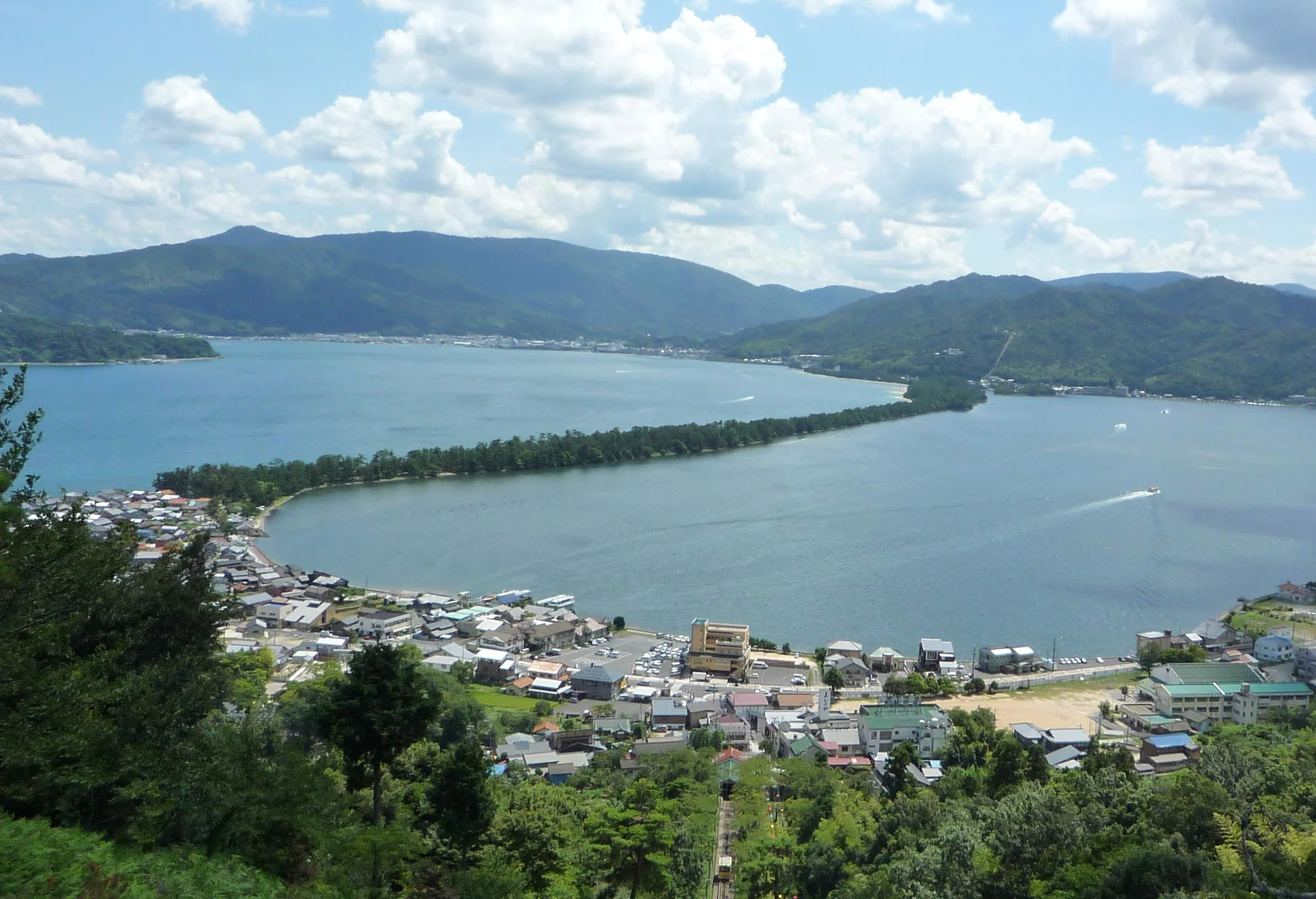
Amanohashidate, the sandbar that defies perspective
It is 6:30 AM. A light mist drifts over the bay of Miyazu, and the pine trees slowly emerge from the gloom. In less than an hour, the first visitors will lean over to look at the landscape between their legs. This unconventional posture, the matanozoki, has been part of the ritual for over a millennium.
Why visit Amanohashidate?
This 3.6 kilometer (2.2 mile) sandbar cutting across the bay of Miyazu is one of the Nihon Sankei, the three most famous views in Japan, alongside Miyajima and Matsushima. The Confucian scholar Hayashi Gaho added it to this list in the 17th century. More than 8,000 Japanese pine trees stand here, their silhouettes etched against the blue of the Aso Sea.
According to Shinto mythology, the deities Izanagi and Izanami used this strip of land as a ladder to descend from the heavens. While Izanagi slept, the ladder collapsed into the sea. Its name, meaning bridge to paradise, keeps this legend alive.
The viewpoints and the matanozoki tradition
Two lookouts offer radically different perspectives. To the south, Amanohashidate View Land sits at the summit of Mount Monju. You can reach it by chairlift or monorail in a few minutes from the station. The view is called Hiryukan, or flying dragon, because the sandbar looks like it is rising toward the clouds when you stare at it upside down.
Kasamatsu Park on the north side
On the other side of the bay, Kasamatsu Park offers the reverse perspective, the Shoryukan, or ascending dragon. This is where the matanozoki tradition reportedly began. The Sky Deck, a reinforced glass-floor walkway, adds a touch of vertigo to the experience. Physicist Atsuki Higashiyama actually received an Ig Nobel Prize in 2016 for scientifically studying how this posture alters the perception of distance.
Crossing the sandbar on foot or by bike
Walking this pine-lined ribbon of sand takes about 45 minutes. Bike rentals at both ends can cut that time to 15 minutes, but the slow pace is worth it. The path winds between gnarled trunks, with the calm waters of the Aso Sea on one side and the bay of Miyazu opening toward the Sea of Japan on the other.
Do not miss these spots along the way:
- The Isoshimizu spring, ranked among the hundred best waters in Japan, where fresh water paradoxically bubbles up in the middle of a salt-water zone
- The small Amanohashidate-jinja shrine, known for granting wishes to lovers
- The Kaisenkyo, a 36-meter rotating bridge that swivels 90 degrees to let boats pass
The temples at both ends
Chion-ji and the wisdom of Monju Bosatsu
On the south side, just a few steps from the station, the Chion-ji temple houses one of the three great statues of Monju Bosatsu, the bodhisattva of wisdom. Founded in 808, it attracts students who come to pray before their exams. Its omikuji take the original form of fans that visitors hang on the branches of nearby pine trees. The two-story pagoda, built in 1501, is the oldest wooden structure in Miyazu. It appears in the famous ink painting by Sesshu, which is preserved at the Kyoto National Museum.
Friendly tip: Try the chie no mochi sold at the four shops in front of the temple. This small rice cake stuffed with red bean paste is said to pass on the wisdom of Monju. The tradition dates back to the 14th century.
The Motoise Kono-jinja shrine
At the north end, the Motoise Kono-jinja shrine claims a link to the Ise Grand Shrine. According to tradition, the deities Amaterasu and Toyoukehime stayed here before heading to the Shima Peninsula. The Nariai-ji temple, accessible by shuttle bus from Kasamatsu, offers an additional panorama over the sandbar from its 300-meter altitude.
Opening hours
*Information subject to change

And I agree with that ranking! A dream spot to discover the seaside side of Japan. The pine trees, the beaches, the crisp sea air… It is magnificent. It is a walk that I invite you to take at a leisurely pace, while enjoying the panorama. It takes about an hour on foot to cross this “bridge in the sky.” You can also do it by bike, and there is no particular difficulty to it.