
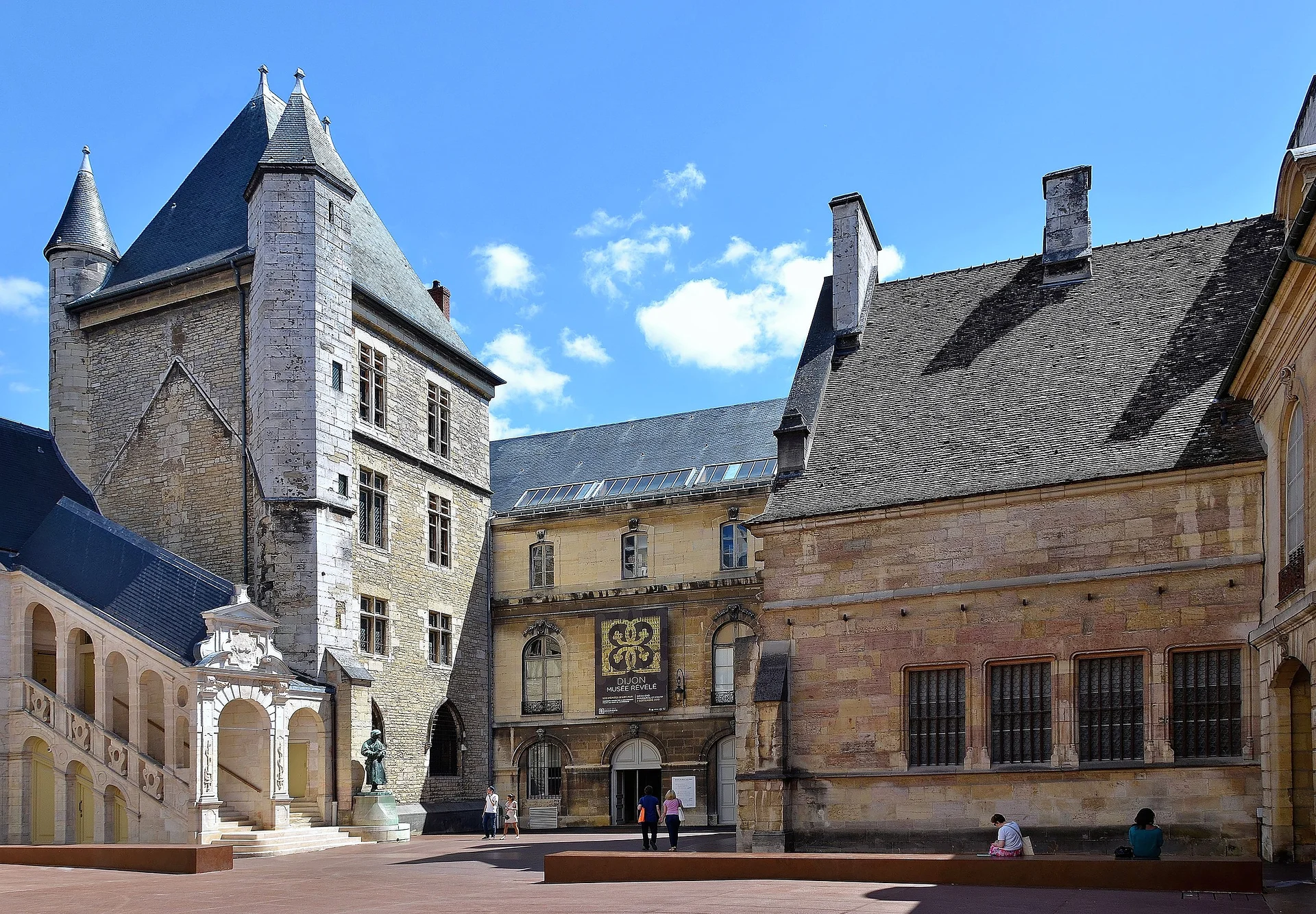
The ducal palace turned art cathedral
The stone mourners have been staring at you for six centuries. Lined up under black marble slabs, these forty-one hooded monks carry the grief of the most powerful princes of the West. At the Museum of Fine Arts Dijon, housed in the former palace of the Dukes of Burgundy, history radiates from every stone, every vaulted ceiling, and every gallery. This is not a standard museum. It is a palatial setting where fifteen centuries of art and architecture coexist.
Why this museum is essential
Opened in 1799, the museum is one of the oldest in France after the Louvre. Its status relies as much on its collections as its setting: the Palais des Ducs et des États de Bourgogne (Palace of the Dukes and States of Burgundy), an architectural ensemble built between the 14th and 19th centuries that blends flamboyant Gothic style with classical elegance. For a century, this palace served as the beating heart of a Burgundian state that rivaled the kingdom of France.
Following a decade of massive construction and 60 million EUR (about $65 million) in investment, the renovated museum reopened in May 2019. Fifty rooms now showcase 1,500 works, ranging from an Egyptian funerary mask to contemporary installations. The best part: admission to the permanent collections is free.
The ducal tombs, jewels of international Gothic
The palace's great hall houses the two most famous tombs from the late Middle Ages. Philippe le Hardi (Philip the Bold) and his son Jean sans Peur (John the Fearless) rest under sumptuous effigies, surrounded by a procession of mourners with striking expressiveness. Each displays a unique pose: one veils his face, another wipes away tears, and a third reads his breviary.
These sculptures come from the Chartreuse de Champmol (Charterhouse of Champmol), a necropolis founded by Philip the Bold in 1383 just outside Dijon. Philip's tomb was crafted by Claus Sluter and his workshop between 1384 and 1410, while the tomb of John the Fearless and his wife Margaret of Bavaria was created between 1443 and 1470. Author George R. R. Martin himself crossed the Atlantic to see them and draw inspiration from the tumultuous history of the Dukes of Burgundy.
Encyclopedic collections to explore by era
Egyptian and Greco-Roman antiquity
Eleven Fayum mummy portraits greet you at the start of the tour. These faces painted on wood covered mummies in Roman Egypt during the 1st and 2nd centuries. Their unsettling realism captures the gaze of the deceased with rare intensity. The museum also holds Greek ceramics, Gallic coins, and Roman statuettes.
The Middle Ages and the Renaissance
Beyond the ducal tombs, the museum presents an exceptional ensemble of medieval paintings. Italian primitives like Pietro Lorenzetti and Taddeo Gaddi sit alongside Flemish masters such as the Maître de Flémalle (Master of Flémalle). The collection of Swiss and German paintings, featuring Konrad Witz, is unique in France.
The Renaissance shines through big names: Titian, Veronese, and Guido Reni. The Salon Condé, with its gilded woodwork, celebrates the glory of the Condé family, who served as governors of Burgundy. The Hall of Statues, adorned with a ceiling painted by Pierre-Paul Prud'hon, a local native, provides a monumental backdrop for the sculptures.
From the 17th to the 21st century
The following centuries unfold with coherence. Philippe de Champaigne, Le Brun, and Charles de La Fosse represent the Grand Siècle. The 19th century brings the romanticism of Delacroix and Géricault, followed by impressionism with Manet, Monet, and Boudin. Burgundian artists, often overlooked outside the region, shine in dedicated galleries: the sculptor François Rude, Jean-Baptiste Lallemand, or Félix Trutat, a prodigy portraitist who died at twenty-four.
The 20th century is well represented with a room devoted to Cubism and canvases by Nicolas de Staël. Two contemporary extensions, including a golden roof that overlooks the palace, integrate the 21st century into the ducal architecture.
Insider tip: Do not miss the recently restored Galerie Bellegarde. Its windows, walled up for decades, have been reopened and now offer a bright view of the city. It is one of the most photogenic spaces in the museum and is rarely crowded in the mid-afternoon.
Visiting the entire ducal palace
The museum occupies only part of the palace. The Tour Philippe le Bon (Philip the Good Tower), standing 46 meters (151 feet) tall, can be visited with a guide. Its 316 steps lead to a terrace where the panorama over the slate roofs of Dijon is breathtaking. The Cour de Flore, the grand staircase by Gabriel, and the Hall of the Guards with its fireplace carved like stone lace: every corner tells the story of Burgundy.
The museum path follows a chronological logic through eight sequences. The works are presented in rooms dating from their own period, creating a remarkable harmony between the setting and the art. This modern staging within a historic shell makes the MBA, as the locals in Dijon call it, one of the finest regional museums in the country.

Located in the sumptuous Palace of the Dukes of Burgundy, this museum is a must-see when visiting Dijon. The layout is divided by historical periods, from antiquity to contemporary art. I spent an entire afternoon there and loved the whole section dedicated to the Middle Ages, which features real treasures, especially the beautiful altarpieces and the room with the tombs of the Dukes of Burgundy. I also really liked the paintings. Delacroix, Monet, Veronese, de la Tour, the works are very rich. Plus, access to the permanent collections is free.