
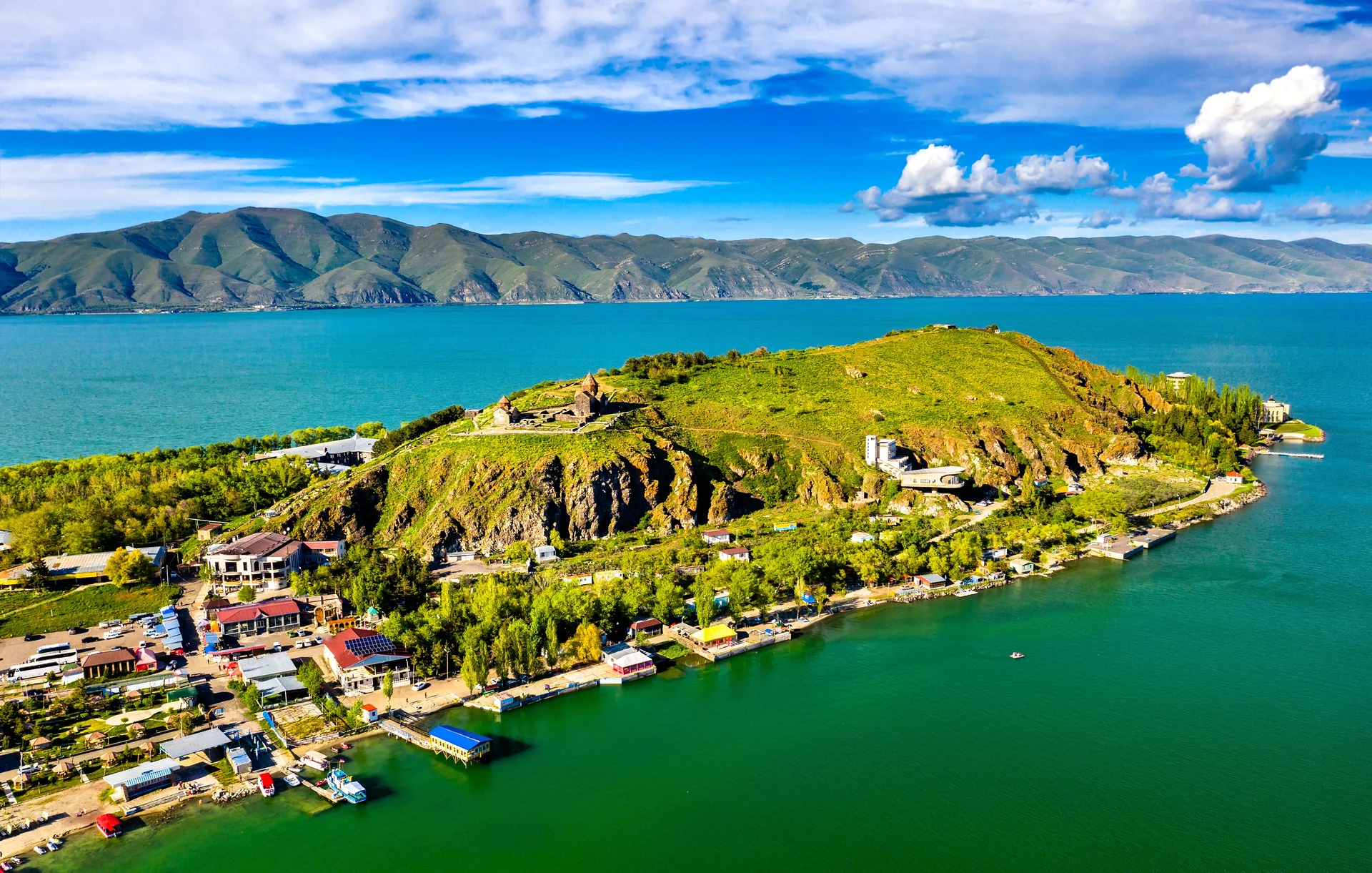
Lake Sevan: Where Armenia gazes at the sky from its mountains
At an altitude of 1,900 meters (6,233 feet), the water of Lake Sevan is unlike anything else. On clear days, it reflects an ultramarine blue so saturated it looks like a filtered photo. When the weather turns, it shifts to a slate gray and churns with waves that crash with the intensity of an ocean shoreline.
The writer Maxim Gorky, passing through in the last century, called it a piece of the sky that fell to earth among the mountains. The description remains as accurate today as it was then.
Why visit Lake Sevan?
Sevan is more than just the largest lake in the Caucasus. It is a vital resource for all of Armenia. It feeds 28 rivers in the surrounding mountains, provides drinking water, regulates irrigation, and supports a fishery that has existed for millennia. Armenians call it their inland sea, and when you realize it covers one-sixth of the national territory, the term stops being a metaphor.
The lake nearly vanished, however. During the Soviet era, its waters were diverted for irrigation and power generation, causing the level to drop by nearly 20 meters (65 feet) between the 1940s and 1960s. This ecological catastrophe triggered a long-term restoration effort. By the end of 2025, the water level has stabilized around 1,900 meters.
A national ecosystem restoration strategy, adopted for the 2024-2030 period, continues to guide this balance.
Sevanavank, the black monastery on the peninsula
On the northwest shore, a rocky peninsula juts into the lake. At the summit, after 230 steps carved into the rock, two churches made of dark tuff overlook the water from every angle. It was an island until the 20th century. The same drop in lake levels that threatened the ecosystem transformed this isolated piece of land into an appendage of the mainland.
Its history
The Sevanavank monastery (literally the black monastery, from sev, black in Armenian, and vank, monastery) was founded in 874 by Princess Mariam Bagratuni, daughter of King Ashot I. It was intended for monks from Etchmiadzin who had committed a transgression, serving as a place of penance facing the waters, surrounded by the Gegham and Areguni mountains.
What remains to be seen today
Two of the three original churches survive: Surp Arakelots (Holy Apostles) and Surp Astvatsatsin (Holy Mother of God). Their basalt stone has the color of graphite, appearing almost black in the rain, and the dark green andesite khachkars (cross-stones) that dot the courtyard add to the austere atmosphere. Inside Surp Arakelots, the acoustics amplify the hymns of the Sevanavank choir with unsettling resonance.
Friendly tip: Head up to Sevanavank early in the morning, before the tour buses arrive. By 7 or 8 AM in summer, the peninsula is nearly empty, the lake is glass-smooth, and the low-angle light gives the dark stones a golden glow. Entry is free, but the souvenir stalls along the stairs can slow your climb.
Beyond the monastery: What the region offers
The royal trout, emblem of the lake
The ischkhan, the endemic trout of Sevan, whose name means prince in Armenian, nearly went extinct in the 1990s. Its population has been recovering since. Restaurants on the peninsula serve it grilled or on skewers, and we frankly consider it one of the best reasons to eat here rather than heading straight back to Yerevan.
Noradouz Cemetery and its khachkars
A few kilometers to the south, the village of Noradouz houses the largest collection of medieval khachkars in Armenia still in their original location. Hundreds of stone stelae from the 13th and 14th centuries, carved with lace-like floral patterns and intertwined crosses, stand in tight rows in a grassy meadow by the lake. It is a quiet site, without an entrance fee or shops.
Beaches and water sports
In summer, the shores come alive. Several beaches, some free and others managed with an entry fee, host Armenian families escaping the 40C (104F) heat of Yerevan. The water stays cool, around 18-20C (64-68F) in mid-summer because of the altitude, which is why almost all lakeside hotels offer a heated pool. Kayaks, jet-skis, and boat rides are available from the docks near the monastery.
Lake Sevan highlights
- High-mountain views reachable in an hour from Yerevan, without difficult roads.
- Access to the Sevanavank monastery is free, and the site is impressive at any time of day.
- The ischkhan trout, served fresh in peninsula restaurants, is a rare culinary experience.
- Diverse ways to visit: beach days, hiking, historical monuments, and bird watching.
- Visible ecological restoration efforts: the lake level is rising, and biodiversity is rebounding.
Limitations to keep in mind
- The area around the monastery is very crowded in July and August, which can detract from the atmosphere.
- Restaurant prices on the peninsula are notoriously inflated compared to the rest of Armenia.
- Wind can be strong and weather changes rapidly, even in summer, so bring a jacket.
- Paid beaches sometimes lack maintenance, so choose based on recent reviews.
Practical tips
- Bring AMD (Armenian Drams) in cash: many vendors and small restaurants around the lake do not accept cards.
- For hiking, the trails of Sevan National Park, specifically the Drakhtik-Kalavan route, are worth an extra half-day.
- A boat trip from the peninsula docks (500 to 1,000 AMD, about $1-2.50) offers a view of Sevanavank you cannot get from the shore.
Opening hours
Lake Sevan and its surrounding shorelines are open to the public at all hours.
The Sevanavank monastery is open daily from approximately 9:00 AM to 7:00 PM during the summer season. Hours are reduced during the off-season, so it is best to check locally. Admission is free.
How long for this activity
*Information subject to change

Being of Armenian descent, I was really looking forward to visiting Armenia. Obviously, I could not miss going to the shores of Lake Sevan, an immense body of water. The lake is surrounded by mountains, which makes the scenery truly magnificent. I loved eating ishkhan, the local trout, freshly grilled at a small restaurant.