
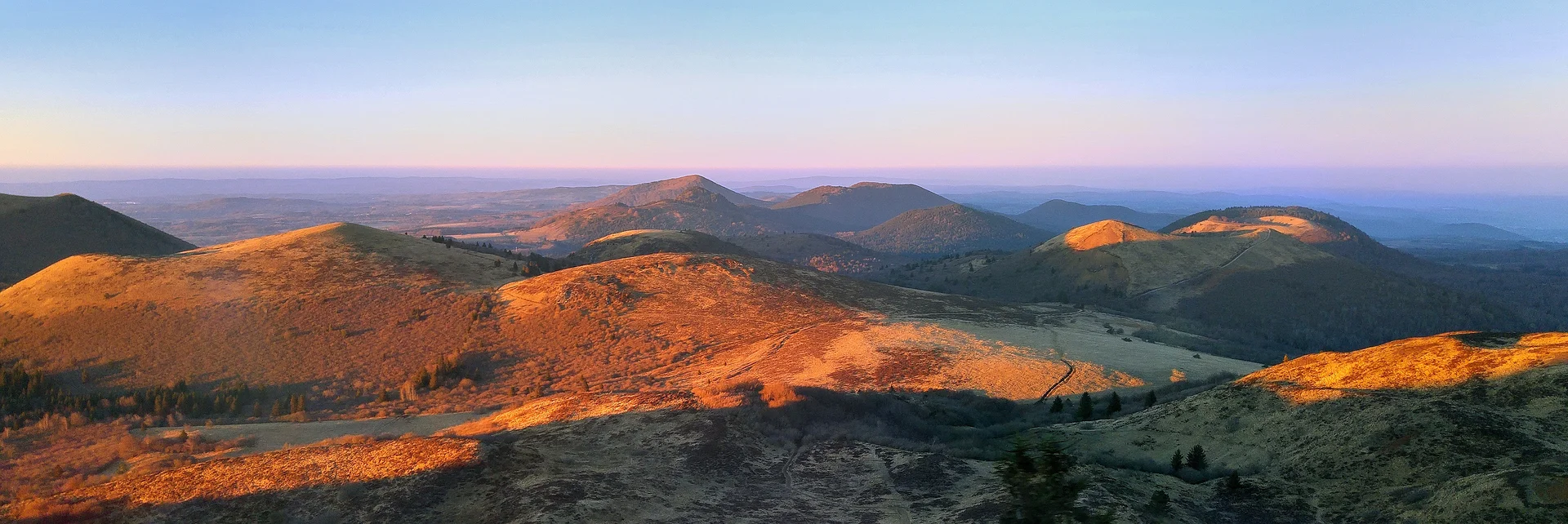


Puy-de-Dôme, sentinel volcano of the Chaîne des Puys
On September 19, 1648, at dawn, Florin Périer left Clermont-Ferrand with a tube of mercury under his arm. His brother-in-law Blaise Pascal had asked him to climb Puy-de-Dôme to prove that air has weight. The mercury dropped by nine centimeters between the plain and the summit. Atmospheric pressure had just been born, and the volcano entered the history of science.
Why visit Puy-de-Dôme?
This Peléan-type volcano, dormant for about 12,000 years, peaks at 1,465 meters. It towers over the chaîne des Puys, an alignment of 80 volcanoes listed as a UNESCO World Heritage site since 2018 under the name "Haut lieu tectonique Chaîne des Puys - faille de Limagne". The inscription, announced on July 2, 2018, recognizes the geological criterion (viii) of UNESCO.
Designated a Grand Site de France since 2008, the summit offers a 360-degree panorama over the volcanoes, the Limagne plain, and Clermont-Ferrand. On a clear day, the Sancy mountains stand out on the horizon. Cones, domes, and maars take shape like a scale model.
Getting to the summit: train or trail?
The Panoramique des Dômes
Since 2012, an electric rack railway has replaced the old toll road. The Panoramique des Dômes climbs the 565-meter elevation gain in 15 minutes, following a route that hugs the curves of the volcano. Its arrival station is entirely subterranean, topped with a subalpine lawn that restores the natural look of the summit.
The Mule Track and the Goat Path
The sentier des Muletiers starts from the col de Ceyssat and climbs in switchbacks for 1.9 km with 350 meters of elevation gain. Plan for 45 minutes to an hour. This path follows the route taken by ancient pilgrims climbing to the temple. The chemin des Chèvres, starting from the Panoramique parking lot, is longer but less crowded, featuring lovely sections through the forest.
Friendly tip: go up via the Mule Track for the panorama and come back down via the Goat Path to mix up the views. Check the summit webcam before heading out: the weather changes quickly between the plain and 1,465 meters.
At the summit: 2,000 years of open-air history
A 3-kilometer walking path, accessible to wheelchairs, circles the summit. The temple of Mercury, built in the 2nd century by the citizens of Augustonemetum, covered 3,600 m². It was one of the largest mountain sanctuaries in the Western Roman Empire. Reopened to the public in June 2024 after over a decade of restoration, the site lets you walk among the ruins and gauge the scale of the structure thanks to partially rebuilt walls.
The Espace temple de Mercure, a free museum at the summit, displays models, videos, and facsimiles of objects found during the excavations. An exhibition also retraces the feat of the aviator Eugène Renaux, who landed his biplane at the summit in 1911 to win a prize of 100,000 francs. In good weather, the ballet of paragliders floating above the volcanoes completes the experience.
Take flight from the summit by paraglider
Puy-de-Dôme features eight paragliding takeoff zones facing every direction, a setup considered unique in Europe. Several schools certified by the FFVL offer tandem introductory flights year-round, ranging from a 15-minute discovery flight to a 40-minute long-duration flight that harnesses thermal updrafts to get close to neighboring volcanoes.
Prices range from $110 to $270* depending on the option chosen, with a video option to keep a record of your flight over the chaîne des Puys.
Opening hours
The Panoramique des Dômes train operates throughout the year, excluding brief periods for maintenance.
High season (July to August): departures every 20 minutes from 9:00 AM to 8:00 PM, with the last descent at 8:20 PM.
Mid-season (April to June, September to October): departures every 40 minutes from 9:00 AM to 7:00 PM.
Winter period: departures every hour from 10:00 AM to 5:00 PM, on select days only.
*Information subject to change

If you have the time, I recommend doing the hike to get up