
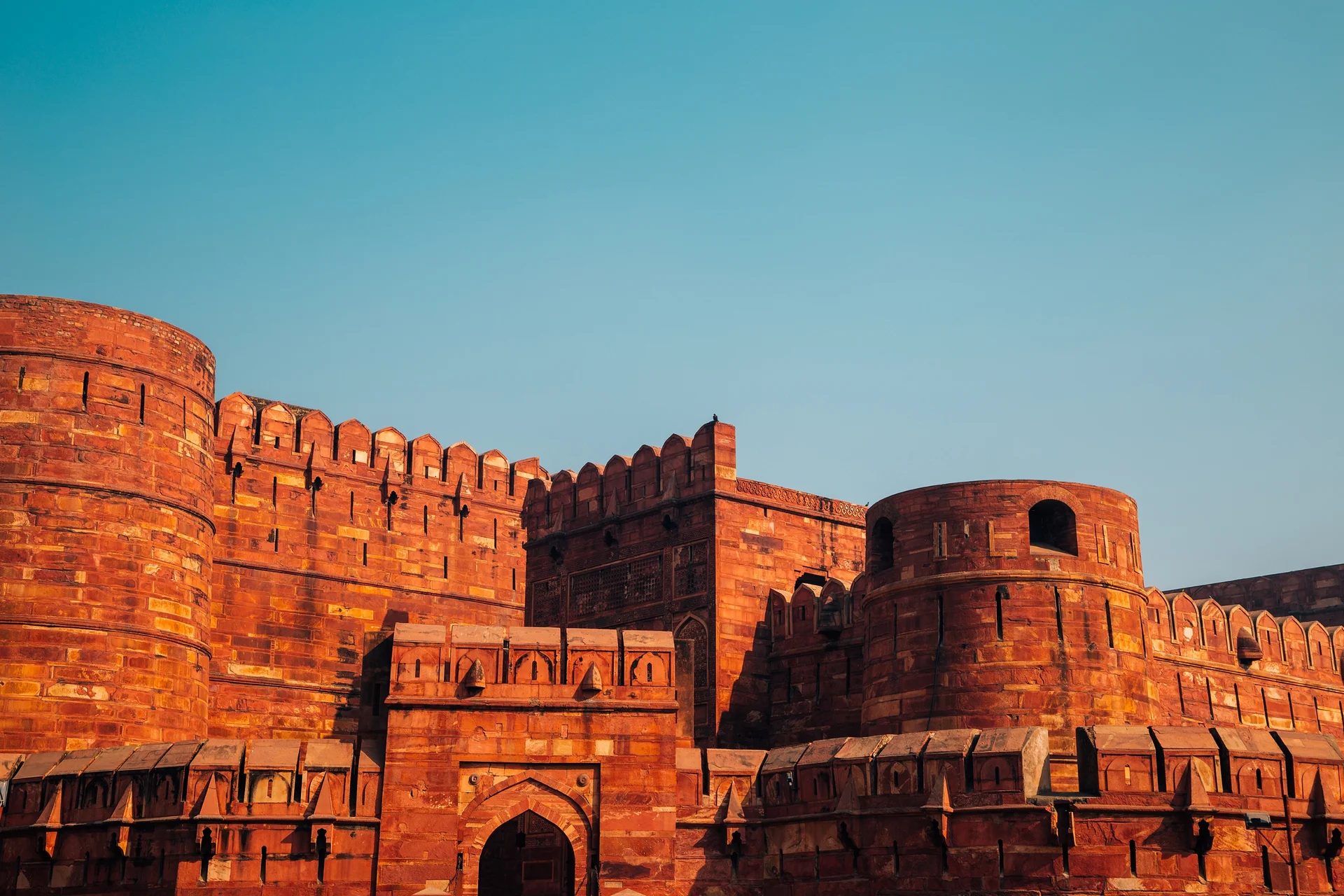
Agra Fort: the citadel where an emperor mourned his masterpiece
Red sandstone rises like a wall of fire under the Indian sun. Two and a half kilometers of massive ramparts enclose a self-contained world where the Mughal emperors once ruled their empire. This fortress also holds the memory of a golden prison, the home of a deposed king who stared at his late wife's mausoleum until his final day.
Why Agra Fort deserves more than a quick visit
A UNESCO World Heritage site, the Agra Fort is far more than just an add-on to the Taj Mahal. Commissioned by Emperor Akbar in 1565, this fortified palace complex represents three generations of Mughal emperors. Each ruler left his mark on the architecture. Akbar established military dominance with 20-meter-high red sandstone walls, while his grandson Shah Jahan later introduced the delicate touch of white marble.
The scale is what hits you first. The citadel covers 38 hectares, housing palaces, private mosques, terrace gardens, audience halls, and imperial apartments. Unlike the Taj Mahal, which is a singular monument, Agra Fort offers a genuine look into the daily lives of the Mughal sovereigns.
Architectural gems you cannot miss
The Jahangiri Mahal and the legacy of Akbar
The Jahangiri Mahal, a palace built by Akbar for his son, represents the peak of 16th-century Indo-Islamic architecture. Its courtyards, carved balconies, and vaulted rooms blend Hindu and Muslim influences. The details chiseled into the sandstone are worth a close look, including floral motifs, Persian calligraphy, and complex geometric patterns.
Nearby, the Diwan-i-Am (Hall of Public Audience) is impressive for its sheer size. Beneath these pillars, the emperor received petitions from his subjects. The elevated throne allowed the crowd to see their sovereign without being able to approach him.
The white marble palaces of Shah Jahan
Shah Jahan transformed the military fortress into a refined residence. The Khas Mahal (private palace), built entirely of white marble, contrasts sharply with the surrounding red sandstone. Its semi-precious stone inlays foreshadow the style of the Taj Mahal.
The Sheesh Mahal (Mirror Palace) dazzles with walls and ceilings covered in tiny mirrors. According to legend, a single candle was enough to illuminate the entire room with a thousand reflections. The Moti Masjid (Pearl Mosque), a small private place of worship in white marble, radiates serenity.
Friendly tip: Hire an official guide at the entrance for about 500 INR (90 minutes). Historical context provides an entirely different layer to the experience and ensures you do not miss significant architectural details.
The Musamman Burj: the tower of melancholy
This is perhaps the most moving part of the fort. The Musamman Burj, an octagonal white marble pavilion adorned with jewels, served as a prison for Shah Jahan during the final eight years of his life. His son Aurangzeb, after seizing the throne in 1658, confined him here with a singular view of the Taj Mahal, the masterpiece he had built for his late wife.
From the pavilion's balconies, the view of the Yamuna river and the white dome of the mausoleum remains striking. It is easy to grasp the refined cruelty of this detention. Shah Jahan spent his days staring, powerless, at the symbol of his love and his lost glory. He died here in 1666, his gaze fixed toward Mumtaz Mahal.
The fort closes around 6:00 PM. Plan for at least two hours for a full visit, or more if you are an architecture enthusiast. Early morning hours offer the best light for photography, and the heat remains manageable.
Opening hours
| Monday | 06:00-18:00 |
|---|---|
| Tuesday | 06:00-18:00 |
| Wednesday | 06:00-18:00 |
| Thursday | 06:00-18:00 |
| Friday | Closed |
| Saturday | 06:00-18:00 |
| Sunday | 06:00-18:00 |
Last entry at 5:30 PM.
*Information subject to change

Agra Fort is a truly memorable visit. The site is vast, impressive, and very well preserved, with stunning views of the Taj Mahal in the distance.
It is common to see monkeys on site, which adds charm to the visit.
The monkeys live in and around the fort and move freely in certain areas, just like at many historical sites in India.
They are not aggressive while you are there, but you have to stay alert, as with any wild animal in a tourist area.
Overall, a very interesting visit, both cultural and lively, which really complements the discovery of Agra.