
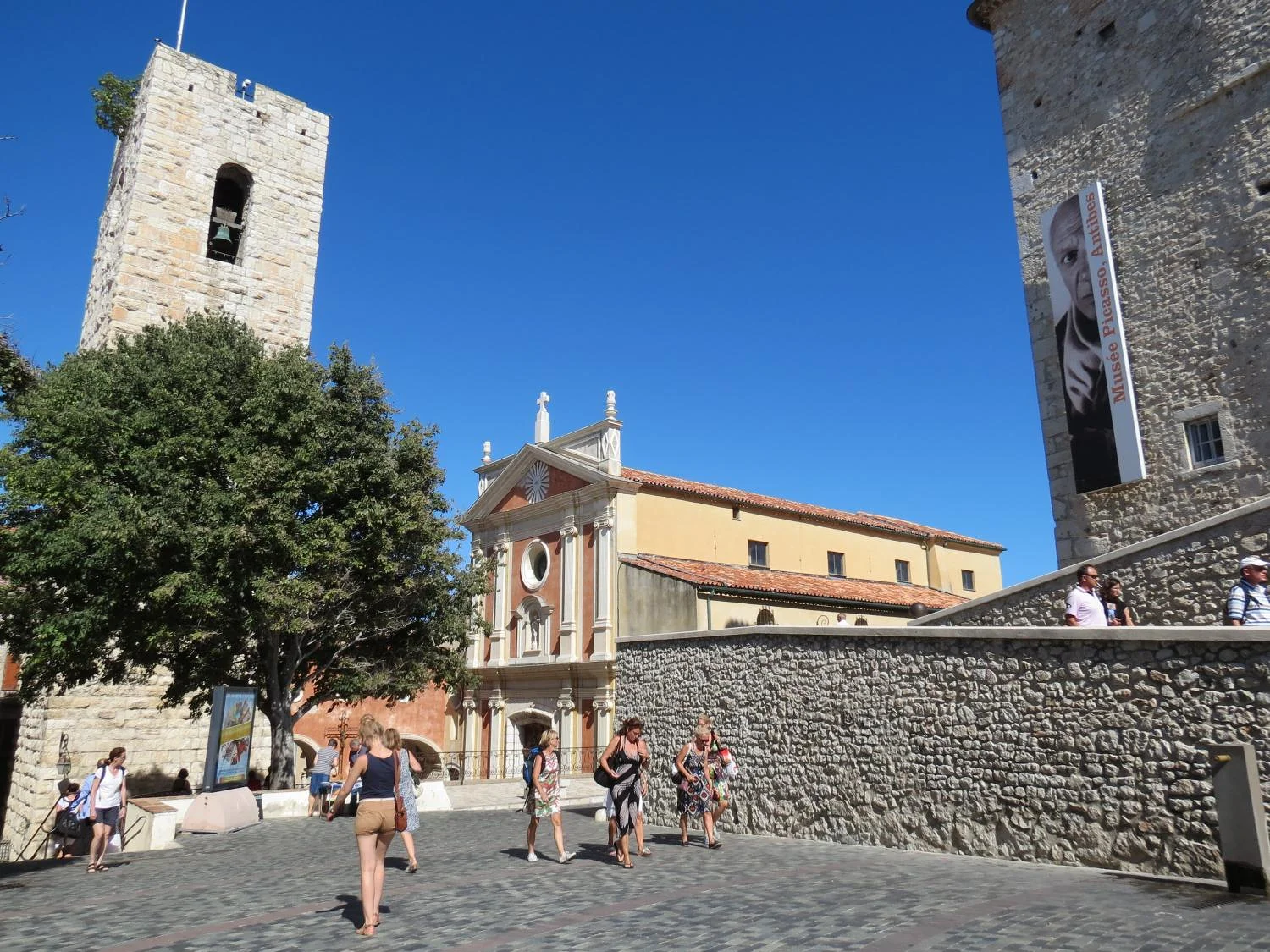
The Cathedral of Notre-Dame-de-la-Platea, fifteen centuries of history facing the Mediterranean
Iron Age remnants lie beneath its foundations. Before a single Christian stone was laid here, a temple dedicated to Diane and Minerve occupied this promontory. Since the year 442, the site has been continuously rebuilt, bombed, and restored, in a succession that feels dizzying.
Why visit the Cathedral of Notre-Dame-de-la-Platea?
This cathedral does not dazzle at first glance. It does not compete with the great basilicas of the French Riviera in terms of size or opulence. Its appeal lies elsewhere, as it is an architectural palimpsest where each era has left its mark, from the 12th-century Romanesque choir to the Baroque facade funded by Louis XV after the bombings of 1746.
As the largest church in Antibes, it served as the seat of the bishopric for eight centuries, from 442 to 1244, before the seat was transferred to Grasse.
Its name is intriguing, as "Platea" simply means "of the square," a reference to the esplanade it overlooks. It is a modest name for a building that has seen some forty bishops pass through and has survived Saracen raids, wars of succession, and the ravages of time.
A Baroque facade with the colors of Provence
The yellow-orange tones of the facade are striking. This chromatic choice, unusual for Antibes at the time, dates back to the reconstruction ordered by Louis XV using funds from the royal purse, after the War of the Austrian Succession had ravaged the building in 1746.
The result contrasts with the sobriety of the surrounding narrow streets. Stucco columns frame doors carved in 1710 by Joseph Dolle, an Antibes craftsman. On the right panel, Saint-Sébastien; on the left, Saint-Roch, the two protectors of the city. Above, a wooden cartouche depicts the adoration of the Eucharist by two angels.
To the left of the cathedral stands the tour Grimaldi (Grimaldi Tower), 30 meters high. Built between the 11th and 13th centuries, long before the arrival of the Grimaldi family, it served as a watchtower against further Saracen incursions. It is also known as the Saracen Tower.
Works to spot inside
The Altarpiece of the Virgin of the Rosary
This is the masterpiece of the cathedral. Painted by Louis Bréa around 1513, this polyptych measuring 2.53 meters by 2.21 meters is the only Virgin of the Rosary by the Nice-based artist to have reached us in its entirety. The central panel shows Mary sheltering humanity under the folds of her cloak, while two cherubs pull it aside. Surrounding her, eighteen smaller panels detail the fifteen mysteries of the Rosary: joyful, sorrowful, and glorious.
This altarpiece was removed in 2020 to be restored at the CICRP de Marseille (Center for the Conservation and Restoration of Heritage in Marseille), a project that allowed for the first detailed study of Bréa's painting technique.
Other remarkable pieces
The interior, which is quite dark, holds other surprises for those who take the time to adjust to the dim light:
- A wooden Christ from 1447, which predates most of the elements visible in the current building
- A 16th-century stoup and baptismal fonts from 1772
- An organ from 1860 signed by the Toulouse master builder De Jungh, which has since been modernized with three keyboards and forty stops
- The remains of the chapelle du Saint-Esprit (Chapel of the Holy Spirit), whose altar dates back to the Merovingian era, between the 6th and 8th centuries
A place of active worship, not a museum
The cathedral is not open continuously to visitors. It functions primarily as a parish church, attached to the paroisse Saint-Armentaire (Saint-Armentaire Parish). Masses are celebrated Monday through Thursday at 8:00 AM, Saturday at 8:30 AM, and Sunday at 11:00 AM and 6:30 PM. As an unusual detail, a mass in English is offered every Saturday at 6:30 PM, organized by the local Filipino community.
Friendly tip: Aim for a Saturday morning for your visit. The cathedral is open for confessions from 10:00 AM to 12:00 PM, which gives you time to admire the interior in peace. On weekdays, the 8:00 AM mass is brief and access remains very limited for the rest of the day.
Every early July, the cathedral hosts the fêtes de Notre-Dame de Bon Port (Festival of Our Lady of Safe Harbor). The statue of the Virgin is carried in procession from the sanctuary of La Garoupe at the Cap d'Antibes by members of the Corporation of Mariners. The songs of the Antibes Mariners then echo under the vaults, perpetuating a maritime tradition deeply rooted in the city.

For a cathedral, you would expect something bigger. Honestly, it is actually quite small. Therefore, it is not worth the trip on its own. Only if you happen to be curious while walking around town. Plus, the interior is very simple. You can find some nice art objects and gilding, but that is about it.