
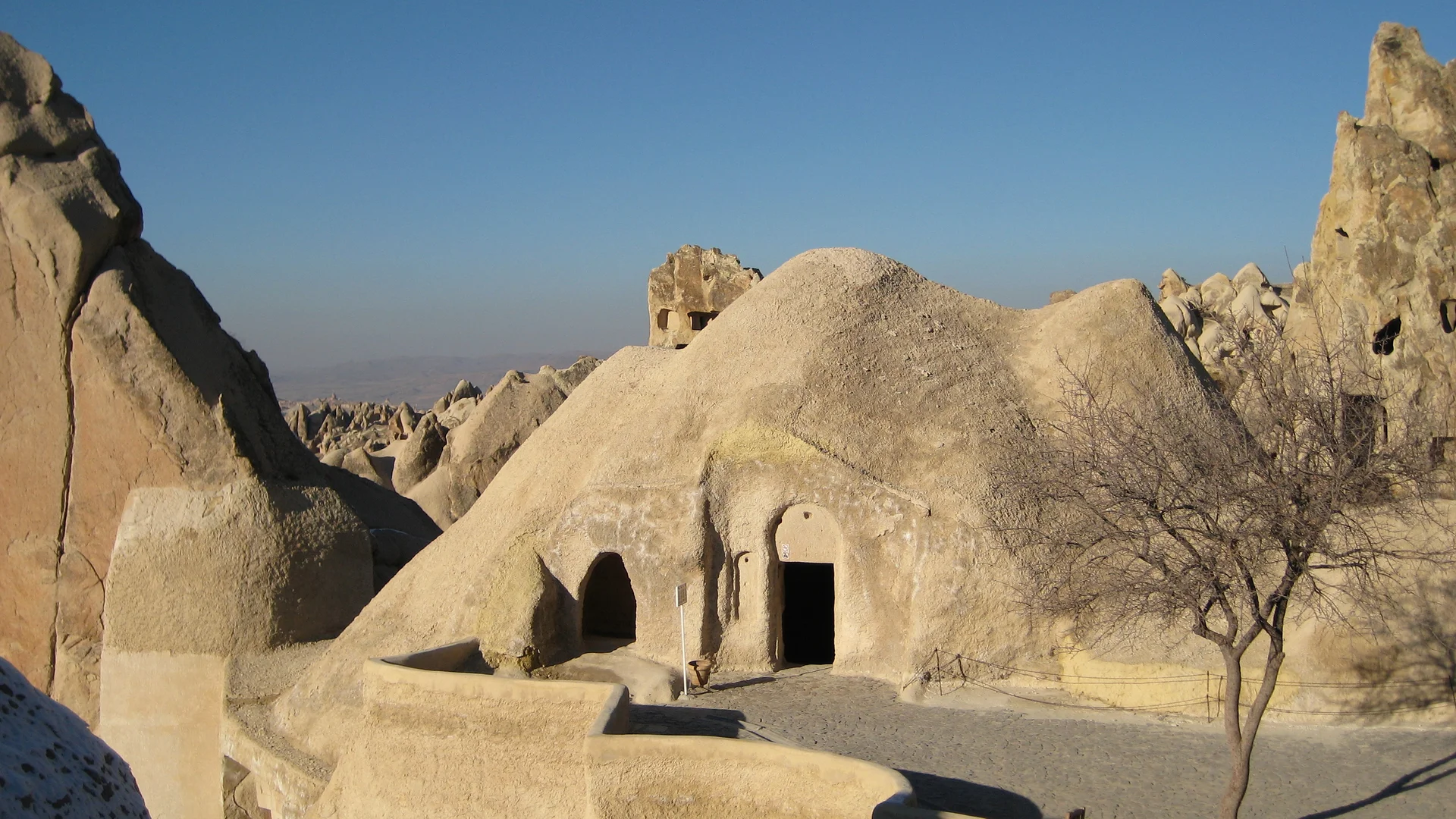
Göreme, where monks carved cathedrals into the rock
The word Göreme means one cannot see. The Byzantine monks who settled here in the 4th century were looking for exactly that: to disappear.
They carved churches, refectories, and dormitories into the soft volcanic tuff of Cappadocia, then covered the walls with pigments so vivid you would think they were painted last week.
Why visit the Göreme Open-Air Museum?
This monastic complex, a UNESCO World Heritage site since 1985 for its cultural and natural significance, packs about 350 churches and chapels into a surprisingly compact area. The site served as a place of worship continuously from the 4th to the 13th century, then as a pilgrimage site until the 17th century.
Christians in Cappadocia held services here until the 1923 population exchange. After decades of abandonment, the site became a museum in 1967.
Saint Basil of Caesarea, a native of nearby Kayseri, was the true founder of this monastic tradition. In the 4th century, he encouraged Anatolia's early Christians to form communities organized around a refectory, dormitories, wine cellars, and a church. This model spread throughout Cappadocia, and the museum is its most complete expression.
The rock-cut churches and their frescoes
The Dark Church, an absolute masterpiece
The Karanlık Kilise (Dark Church) is worth the trip on its own. Its name comes from the single small window that lets in light. Paradoxically, this dimness preserved its 11th-century frescoes in exceptional condition, with lapis lazuli blues and deep reds of rare intensity. The scenes depict the life of Christ, from the Nativity to the Ascension. Before the French-Italian-Turkish restoration finished in 1995, the church served as a pigeon coop and the frescoes were covered in droppings. Visits are limited to 15 people maximum for 3 minutes to protect the pigments from humidity. Photos are prohibited inside. Entry costs an additional $6.80* on top of the main ticket.
Other churches to look for
The walking path loops around about a dozen places of worship. Every name tells a story. The Elmalı Kilise (Apple Church) gets its name from the red globe the archangel Michael holds in his hand, which locals mistook for an apple. The Snake Church owes its name to a depiction of Saint George defeating a dragon that villagers mistook for a reptile. Inside, a rare fresco shows Saint Onuphrius, an Egyptian hermit dressed in a simple fig leaf.
The Çarıklı Kilise (Sandal Church) preserves footprints in its floor attributed to Christ before his ascension. Under its dome, the four evangelists are painted with impressive precision. Do not miss the fresco of the Betrayal of Judas, visible in the arch above the left door.
Friendly tip: When leaving the museum, cross the road and walk 50 meters toward Göreme to find the Tokalı Kilise (Buckle Church). Included in your admission but often ignored by hurried visitors, it is actually the largest and most richly decorated on the site. Its recently restored narrative frescoes tell the life of Christ in a striking cobalt blue. It also has an underground chapel that few people visit.
How to enjoy the site without the crowds
Tour groups arrive between 10 AM and 2 PM, turning the narrow passages between churches into lines. Arrive at 8 AM at opening, or after 4 PM in the summer when the low light turns the fairy chimneys gold. You can walk the site in 90 minutes to 2 hours at a relaxed pace, but there is almost no shade. A hat, water, and sunscreen are essential between May and September.
The terrain is uneven, with steep stairs to access some perched churches. Closed-toe shoes with good grip are recommended. Photography is banned inside most churches to protect the frescoes, and guards strictly enforce this rule. The exterior views of the tuff cones and the valley make up for it.
The audio guide available at the entrance for 150 TRY (about $3.10*) is a useful addition because the signage remains sparse. To go deeper, a local guide can help decode the Byzantine iconography and point out details invisible to the untrained eye, like traces of the iconoclastic period where only crosses were allowed on the walls.
Opening hours
- High season (April to October): 8:00 AM to 7:00 PM, last entry at 6:15 PM.
- Low season (November to March): 8:00 AM to 5:00 PM, last entry at 4:15 PM.
*Information subject to change

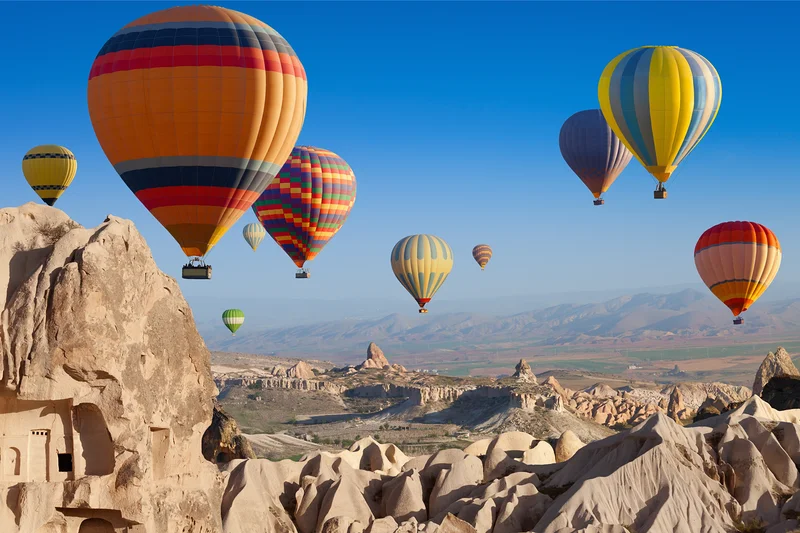
The Göreme Open-Air Museum is the highlight of any trip to Cappadocia. It is an outdoor park with a huge variety of geological formations. You can see cave dwellings and all sorts of rocks like fairy chimneys.
You can scramble around as much as you want in this lunar landscape and take photos. There is even a church with cave paintings that are extremely well preserved. A real treat!