
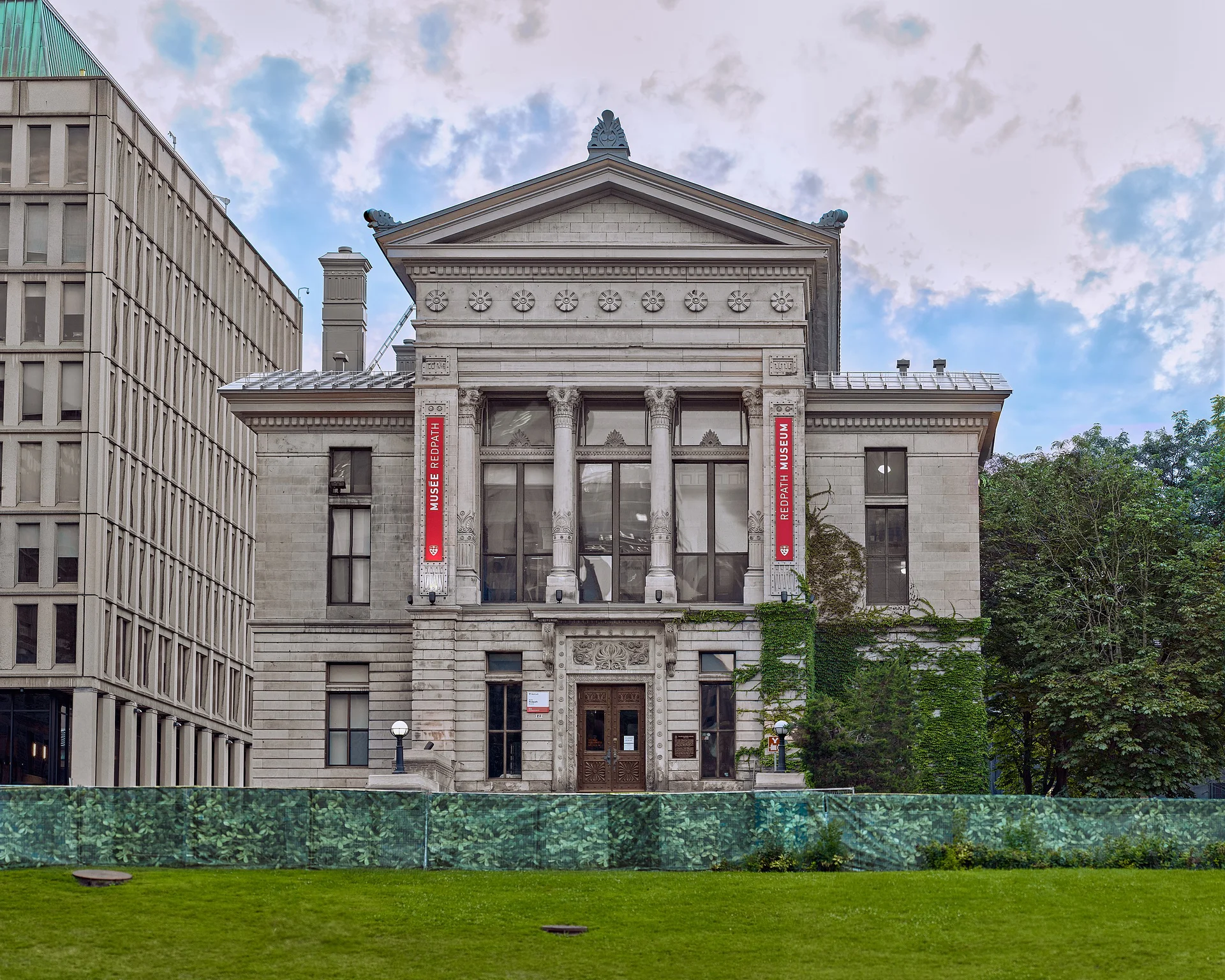
Visiting the Redpath Museum
In Montreal, tucked away on the McGill University campus, sits a natural history museum dating back to the late 19th century. It is, quite simply, the oldest natural history museum in Canada.
History
Built in 1882 thanks to a donation from Peter Redpath, a sugar industry tycoon, the Redpath Museum stands as the oldest of its kind in the country. The project was conceived to mark the 25th anniversary of Sir John William Dawson, a geologist and naturalist, taking the helm as principal of McGill University.
The facility was designed as a teaching resource for students and faculty. Even during periods when the building was closed to the general public, it remained an active space for academic study and research.
The architecture was handled by the firm Alexander Cowper Hutchison & A.D. Steele. Construction broke ground in the summer of 1880 in the northwest section of the university campus, drawing inspiration from classical Greek structures. After two years of work, the museum opened its doors on August 24, 1882.
The museum has undergone three major shifts. In 1950, the interior was completely renovated. By 1970, it transitioned into a dedicated research center with limited space for public exhibits. Finally, in 2003, grants from the Ministère de la Culture du Québec (Quebec Ministry of Culture) allowed for the restoration of several key artifacts.
The Redpath Museum
The collections at the Redpath Museum hold more than 1 million specimens. They encompass items spanning ethnology, biology, paleontology, mineralogy, and geology.
The entrance hall is dedicated to marine vertebrates, featuring a mix of species that still inhabit our oceans today alongside those that vanished millions of years ago.
The second floor houses the mineral collection and an exhibit of 1,200 shells, alongside the skulls of a Triceratops and a Tyrannosaurus.
The most notable pieces remain the 3 mummies, brought back from Egypt in 1859, the oldest of which dates back 3,500 years.
A temple of culture across the ages.
Opening hours
| Monday | Closed |
|---|---|
| Tuesday | 09:30-16:30 |
| Wednesday | 09:30-16:30 |
| Thursday | 09:30-16:30 |
| Friday | 09:30-16:30 |
| Saturday | Closed |
| Sunday | Closed |

This museum is housed in a beautiful, perfectly preserved historic building. I found the visit to be really interesting. The collections are quite rich and varied. It is a museum that you can visit with children without any issues. They will be able to admire the many fossils or the animals on display there. I really liked it.