
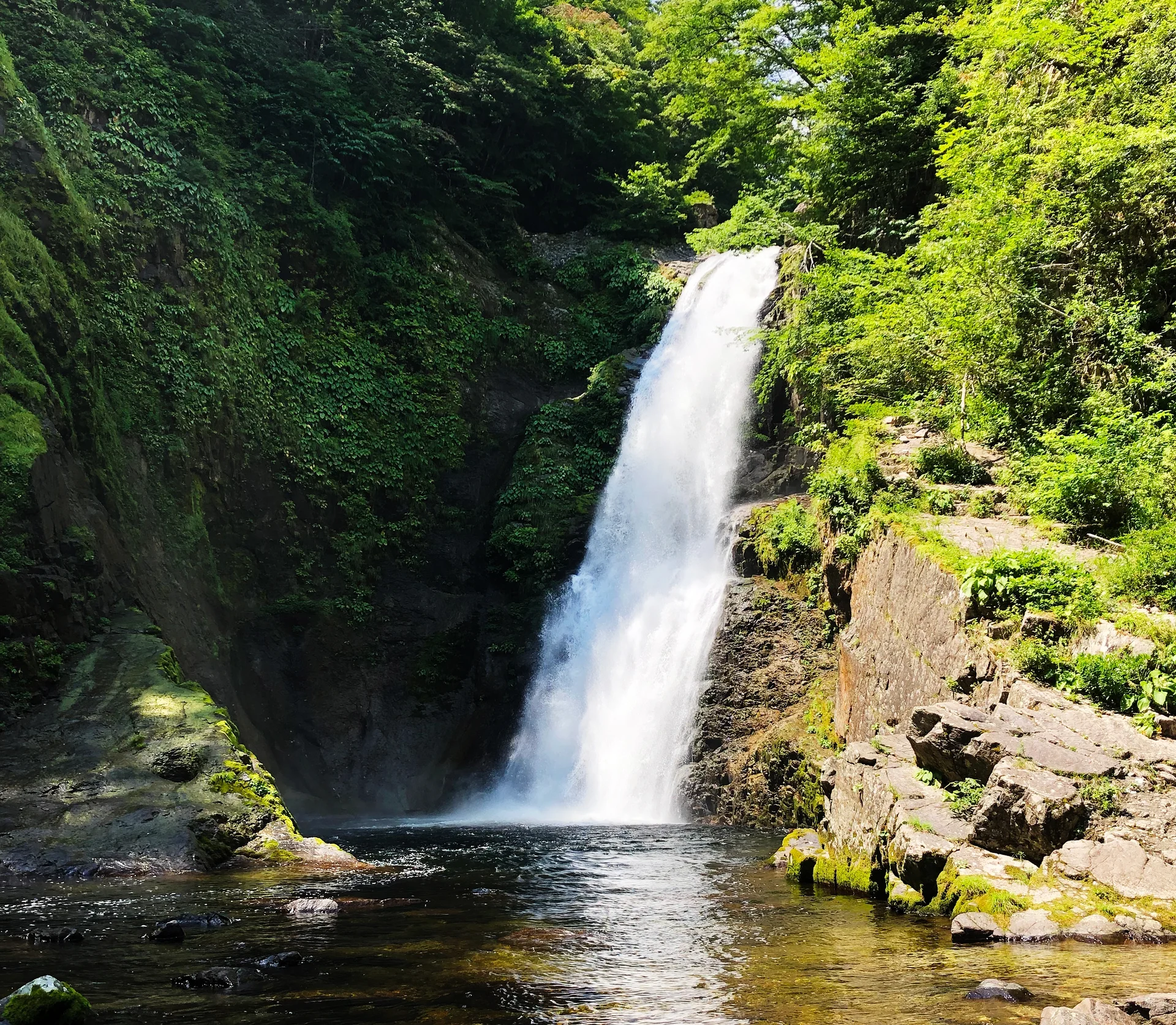
Akiu Otaki Falls: when a 55-meter freefall shakes the volcanic rock
You hear it before you see it. The low rumble of Akiu Otaki Falls carries through the pine forest, climbs the gorge, and resonates in your bones. Then the water appears, white, vertical, and brutal, crashing against dark volcanic tuff walls that have been sculpted to the millimeter over the centuries.
Why visit Akiu Otaki Falls?
Just outside Sendai, less than a 40-minute drive from the city center, this waterfall is recognized as one of the 100 Best Waterfalls in Japan by the Ministry of the Environment and has been designated a National Site of Scenic Beauty since 1942. It drops a full 55 meters while measuring only 6 meters across. It is a concentrated blade of water, with an acoustic power that no photograph can replicate.
Its reputation extends beyond the natural spectacle. The monk Ennin (Jikaku Daishi) is said to have performed 100 days of ascetic practices at the foot of these falls in the 9th century before founding the famous Risshaku-ji temple in Yamadera, in the Yamagata Prefecture. The waterfall has been a site of pilgrimage and a scenic destination ever since.
The route: from the overlook to the basin
The Takimidai platform
From the parking lot, a 5 to 10-minute wooded path leads to the Takimidai overlook, the primary vantage point for the full waterfall. Most visitors stop here, as the view is head-on and unobstructed, and the mist carries all the way to the observatory depending on the current.
The descent to the basin
For those who want to go further, an 800-meter mountain trail drops down to the lower pool. Expect a 20 to 30-minute hike down. The steps are steep and often slippery. At the bottom, the waterfall changes completely. The wall of water seems endless, the noise becomes physical, and the mist will soak your clothes in minutes.
The Fudoson temple, guardian of the site
At the entrance to the site, the Buddhist temple Saikoji, commonly called Akiu Otaki Fudoson, greets visitors under an imposing torii gate. It is considered an annex of the Risshaku-ji. The main object of worship is a 3.3-meter-tall bronze statue of Fudo Myo (a deity of fire), featuring a halo of flames measuring 5 meters.
Legend has it that in 1828, the monk Chisoku-shonin threw himself into the waterfall after completing this statue, praying that every visitor would have their wishes granted.
A curiosity you should not miss on-site: look for a koi carp carved into the temple columns. Finding it is said to bring luck in love.
Four seasons, four faces
We have a clear preference for autumn. The contrast between the red and orange foliage of the maples and the white foam of the falls is of a visual intensity that is hard to describe. The peak generally occurs between late October and early November.
In January and February, part of the waterfall can partially freeze, creating spectacular ice formations. Summer brings dense vegetation and welcome coolness. Spring sees azaleas and rhododendrons bloom in the adjacent botanical garden.
- Free access to the waterfall and the trail
- Two levels of visitation depending on your physical fitness: the overlook or the descent to the basin
- The presence of the Fudoson temple, which anchors the site in local culture
- Superb in every season, with very different atmospheres
- Botanical garden with 900 plant species just a two-minute walk away
- The trail to the basin is steep and slippery: hiking shoes are essential
- Bus service from Sendai operates only on weekends and public holidays (direct to Akiu Otaki)
- The parking lot gets crowded on autumn weekends: arrive early in the morning
Opening hours
Saikoji Temple / Fudoson: 9:00 AM to 5:00 PM.
Botanical Garden: 9:00 AM to 4:30 PM (last entry at 4:00 PM), open from April to November only.

You are guaranteed to be surprised! I recommend this immersion in the wild nature without hesitation. The path is not particularly difficult and offers an observation deck to view the falls. But that is not all: do not miss the magnificent scenery and the small town nearby! You can try out the thermal baths if you feel like it.