
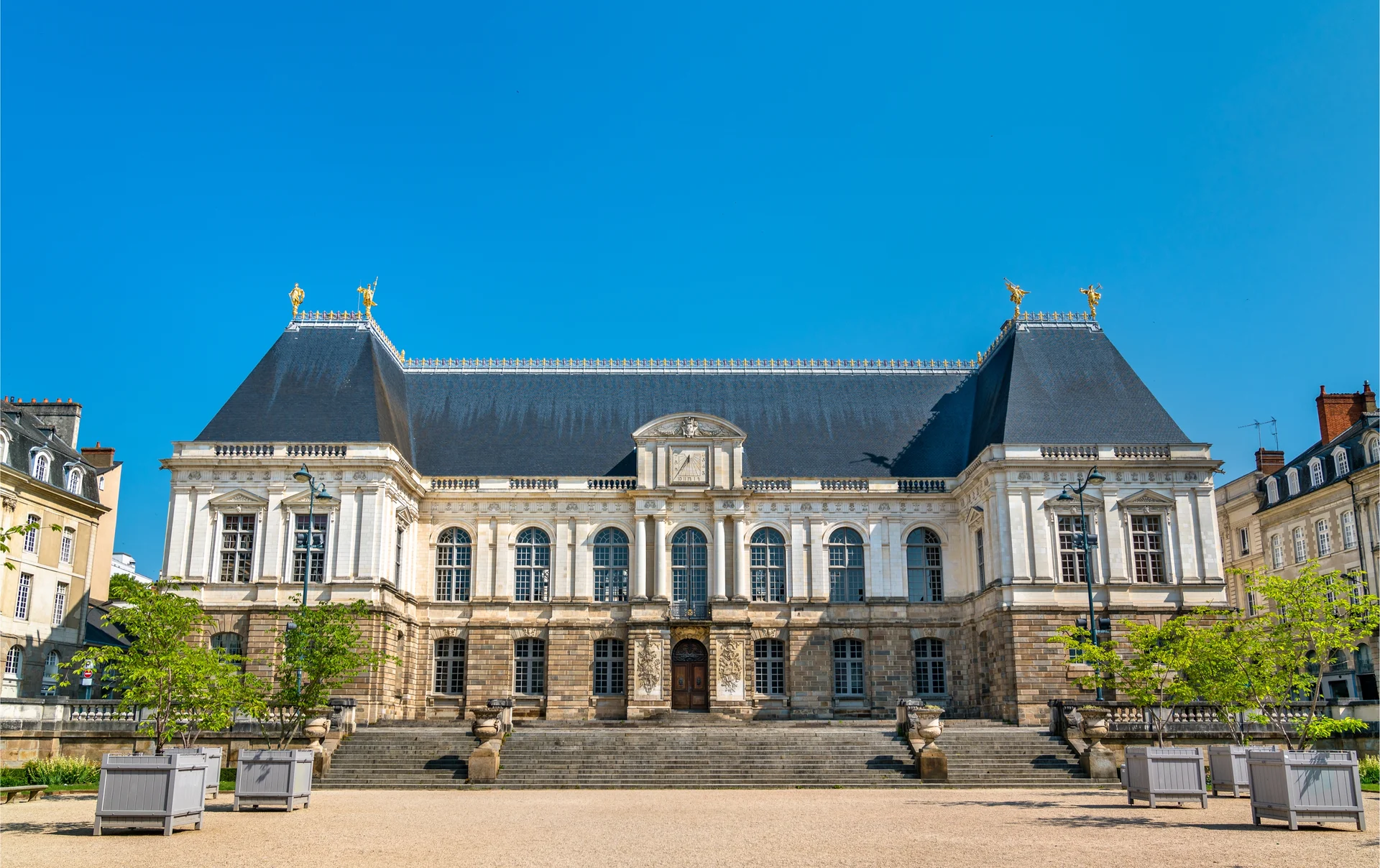


Palais du Parlement de Bretagne: Justice housed in a 17th-century masterpiece
The coffered ceiling of the Grand'Chambre (Great Chamber) glows with intricate gold leaf. Paintings by Noël Coypel depict allegories of justice within sculpted frames. This dramatic interior nearly vanished on the night of February 5, 1994, when a flare launched by protesting fishermen ignited the roof.
Why visit the Palais du Parlement de Bretagne?
This building represents a century of history in the region and master-level craftsmanship. Construction began in 1618 following designs by Salomon de Brosse, the architect behind the Luxembourg Palace in Paris. Parliamentary officials moved in by January 1655, though interior decorations were not fully completed until 1709.
The parliament held significant power in its day. As a sovereign court of justice, it also registered royal edicts and administered the province on behalf of the king. The French Revolution stripped away its political authority in 1790. Since 1804, the building has housed the Cour d'appel de Bretagne (Brittany Court of Appeal) and the Ille-et-Vilaine Assize Court.
A jewel of 17th-century painting
The Grand'Chambre
This room serves as the heart of the palace. Charles Errard, a painter for Louis XIV who worked on early designs for Versailles, handled the layout. A layer of fire-resistant bricks beneath the roof miraculously saved the space during the 1994 fire. The gilded coffered ceilings, carved woodwork, and allegorical canvases remain a rare example of 17th-century French art.
The other rooms on the noble floor
The salle des pas perdus (hall of lost steps) stretches over 60 meters long under a vault rebuilt after the fire. The assize courtroom and the salle Jobbé-Duval, which served as the former chancellery, are also worth a look. A Gobelins tapestry depicting the death of the constable Du Guesclin is on display here.
Friendly tip: Before your tour, watch the film shown at the tourist office. It covers the 1994 fire and the detailed restoration that followed. Seeing these images makes your walk through the rooms much more meaningful.
Exterior architecture and the royal square
The facade combines gray granite, white tuffeau limestone, and blue slate, all sourced from the local soil. Four gilded statues at the top, each nearly two meters tall, represent Law, Force, Eloquence, and Justice. On the roof, a lead gallery alternates French and Breton emblems to symbolize the union of the two territories.
In the 18th century, royal architect Jacques Gabriel designed a royal square around the palace. It once featured an equestrian statue of Louis XIV by Coysevox, which was melted down during the Revolution. The buildings with matching facades surrounding the square reflect this harmonious urban design.
What to look for during your visit
- The coffered ceiling of the Grand'Chambre, a major work by Charles Errard
- Noël Coypel's canvases depicting allegories of justice
- The Gobelins tapestry showing the death of Du Guesclin
- A trace of the 1994 fire, preserved intentionally
- The swords of justice and the clock, both designated as historic monuments

The interior hides many artistic treasures. It would be a shame to miss out on it. I really recommend booking your guided tour in advance online. Nothing is monotonous, but there is plenty of gilding and superb painted ceilings. Plus, it is an important building for the history of Brittany, which always allows you to learn more.