
Bayon, the forest of faces smiling at the heart of Angkor
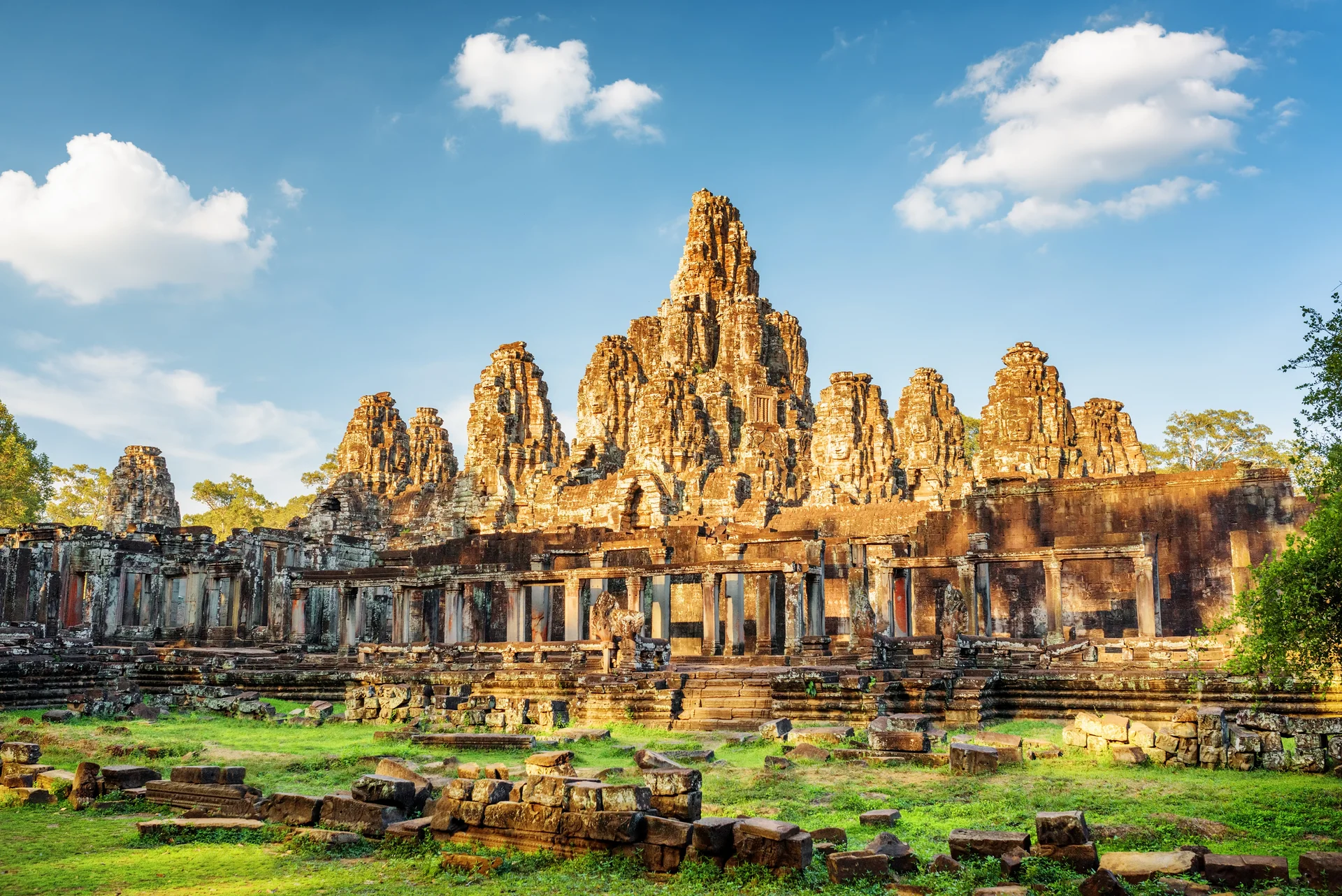
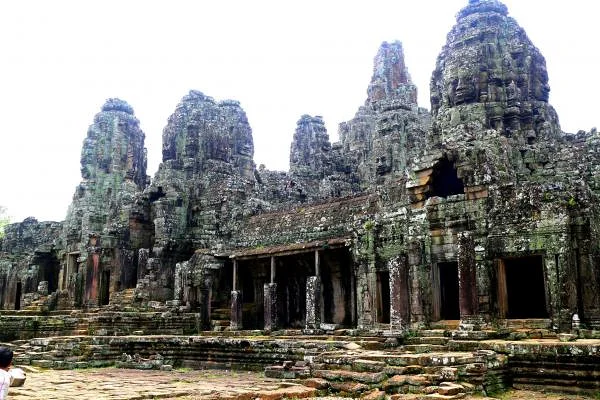
At the exact center of the ancient royal city of Angkor Thom stands a sanctuary like no other. More than two hundred stone faces, each four meters tall, watch you from the temple's towers. Every face wears the same enigmatic smile, eyes half-closed, frozen in a serenity that has endured for centuries. Bayon is unlike any other Khmer temple.
Why does Bayon captivate visitors so deeply?
Built at the end of the 12th century by King Jayavarman VII, Bayon was the last great state temple constructed at Angkor. This Buddhist sovereign, considered the greatest king of the Khmer Empire, built this sanctuary as his personal temple and the spiritual center of his capital. The unique nature of the site stems from its origins. Pressed by time, Jayavarman VII ordered a rapid construction in several successive phases.
The temple was initially Buddhist, later transformed into a Hindu sanctuary during the reign of Jayavarman VIII, before returning to Buddhism. This turbulent history created a unique, labyrinthine architecture where Buddhist and Hindu influences mingle.
The famous faces are thought to represent either the bodhisattva Avalokiteshvara, the incarnation of supreme compassion, or the king himself. Both hypotheses coexist, reflecting the Khmer concept of the god-king. Each tower features four faces turned toward the cardinal points, symbolizing the omnipresence of royal power over the fifty-four provinces of the empire.
A treasure trove of bas-reliefs tells the story of Khmer life
Beyond the monumental faces, Bayon holds an artistic treasure that is often underestimated. Spanning 1.2 kilometers of galleries, more than 11,000 sculpted figures unfold an epic and lively narrative of Khmer civilization in the 13th century. These bas-reliefs serve as an exceptional historical record.
The outer galleries: chronicles of an empire
The external gallery reveals striking historical scenes. You will find the famous naval battle between the Khmer and the Cham people on Tonle Sap lake, depicted with astonishing detail, from the waves and fish to the rowers putting their backs into the effort. Other panels immortalize scenes of daily life, such as bustling markets, fishermen casting their nets, cockfights, street performers, and military preparations. It is a unique window into the ordinary life of the Angkorian era.
The inner galleries: mythology and the divine
The galleries on the second level delve into the mythological universe. The Churning of the Ocean of Milk, the founding legend of Hindu and Buddhist cosmology, unfolds majestically here. Royal processions to the temples, offerings to gods, and complex religious scenes adorn these walls. The attention to detail is remarkable, as every character possesses a distinct facial expression.
Friendly tip: Visit Bayon early in the morning between 7:30 AM and 9:00 AM, or in the late afternoon after 3:30 PM. Not only will you avoid the tour groups, but the low-angle light of the morning and evening beautifully sculpts the reliefs and accentuates the mystery of the faces. Many photographers consider these hours ideal for capturing the iconic angle where two faces seem to kiss.
Exploring the labyrinth of Bayon
Unlike most Khmer temples, Bayon lacks an enclosure wall or a moat. The fortifications of Angkor Thom served as its protection. The architecture of the temple is organized into three levels that form a true maze.
The first level consists of square galleries punctuated by entrance pavilions. This is where you will find the most spectacular historical bas-reliefs. The second level, slightly elevated, houses the mythological scenes. The third level, which is circular, forms the highest point, the upper terrace where the towers with the faces stand. The central tower rises to a height of 43 meters.
Plan for at least two hours to explore the site properly. The stairs are steep, the passages are narrow, and the confusing architecture can disorient you. That complexity is precisely what makes the exploration fascinating. Every corner holds a discovery, whether it is a forgotten chapel, a flower-laden altar, or a fresh photographic angle of the faces.
A few practical tips:
- Wear non-slip shoes: the stone steps can be slippery, especially after the rain
- Cover your shoulders and knees: this is a strict requirement for all Angkor temples
- Bring plenty of water: the temple is largely open to the sky
- Do not touch the sculptures: these ancient works are fragile
Restoration work: a long-term project
Since 1994, an international collaboration between Japan, Cambodia, and UNESCO has worked to safeguard the temple. Major work began in 2020, funded by the Japanese government. The third upper level remains inaccessible during certain phases of restoration, but the two lower levels with their sumptuous bas-reliefs remain open. These massive efforts ensure the preservation of this jewel for future generations. The project, which celebrated its 30th anniversary in 2024, is considered a model for heritage conservation.
Opening hours
| Monday | 05:00-17:30 |
|---|---|
| Tuesday | 05:00-17:30 |
| Wednesday | 05:00-17:30 |
| Thursday | 05:00-17:30 |
| Friday | 05:00-17:30 |
| Saturday | 05:00-17:30 |
| Sunday | 05:00-17:30 |
*Information subject to change