
The Grévin Museum, one of the best museums in Paris
With nearly 150 years of history and around 700,000 visitors each year, the Grévin Museum is one of the oldest museums in Paris. This iconic institution of the French capital opened to the public in June 1882. The life-sized, accurate recreations of public and political figures were a genuine technical feat for the time. The idea came from Arthur Meyer, a journalist who wanted to show the faces of the people he wrote about during an era when photography was not yet widespread. The museum's first designer and artistic director was Alfred Grévin, a famous caricaturist of the time who gave the place its name. Both men were supported in their project by Gabriel Thomas, an administrator and the primary patron of the Grévin Museum at the end of the 19th century.
Understanding the History of France through the Grévin Museum
Since its founding, the Grévin Museum has crafted and displayed over 2,000 wax figures. Beyond statues representing French and international personalities, the museum also features numerous historical scene reenactments, such as Jeanne d'Arc at the stake. However, it can also be much more lighthearted, with works representing today's show-business stars. It is even considered one of the best museums for families in Paris.
Wax figures, the history of a French and European craft
Originally, wax modeling and portraits were intended to recreate the features of the deceased to grant them a place in posterity. These death masks were then buried with the deceased or kept and displayed in a separate location. Until the end of Antiquity, these masks were the subject of true funeral cults: ceroplastics was a major mortuary art.
In the Middle Ages, wax statues were primarily used to create effigies representing royal or religious figures. The Renaissance then established ceroplastics as a sub-discipline of anatomy. Its primary goal became improving knowledge related to the study of the human body. Modeling became a technical skill and an expertise particularly widespread in France and Italy, where it contributed to medical advancements.
In France, the first exhibition of wax statues dates back to the early 18th century. In 1705, Antoine Benoist, a French painter and sculptor, took the initiative to dedicate an exhibition to a set of mannequins and wax figurines representing the king and his court.
Decor and attractions of the Grévin Museum
Originally, the Grévin Museum was designed as a true cabinet of curiosities. Located on the Grands Boulevards, its architecture stands out with a unique rococo-Venetian style. The salle de la Coupole (Dome Room) and the salle des Colonnes (Column Room) feature decor emblematic of the baroque style.
Created by Eugène Hénard, the Palais des Mirages (Palace of Mirages) is certainly the most famous attraction of the Grévin Museum. This magnificent room is a giant kaleidoscope, designed for the 1900 World's Fair. Mixing decor characteristic of Hindu temples with motifs evoking the jungle and the most beautiful Arab palaces, the Palais des Mirages produces astonishing light and color effects that can even cause vertigo.
Originally, the Grévin Museum was also paired with a cabinet Fantastique (Fantastic Cabinet) where the greatest magicians of the 20th century performed. This room was later converted into a theater. The Théâtre Grévin is currently listed as a monument historique (historic monument) for its stage curtain, a piece designed by the famous poster artist Jules Chéret. Furthermore, the high reliefs that adorn the top of the stage are the work of sculptor Antoine Bourdelle. Today, the Théâtre Grévin still hosts occasional theatrical or musical performances lit by candlelight, an atypical experience in Paris.
The numerous statues of the Grévin Museum
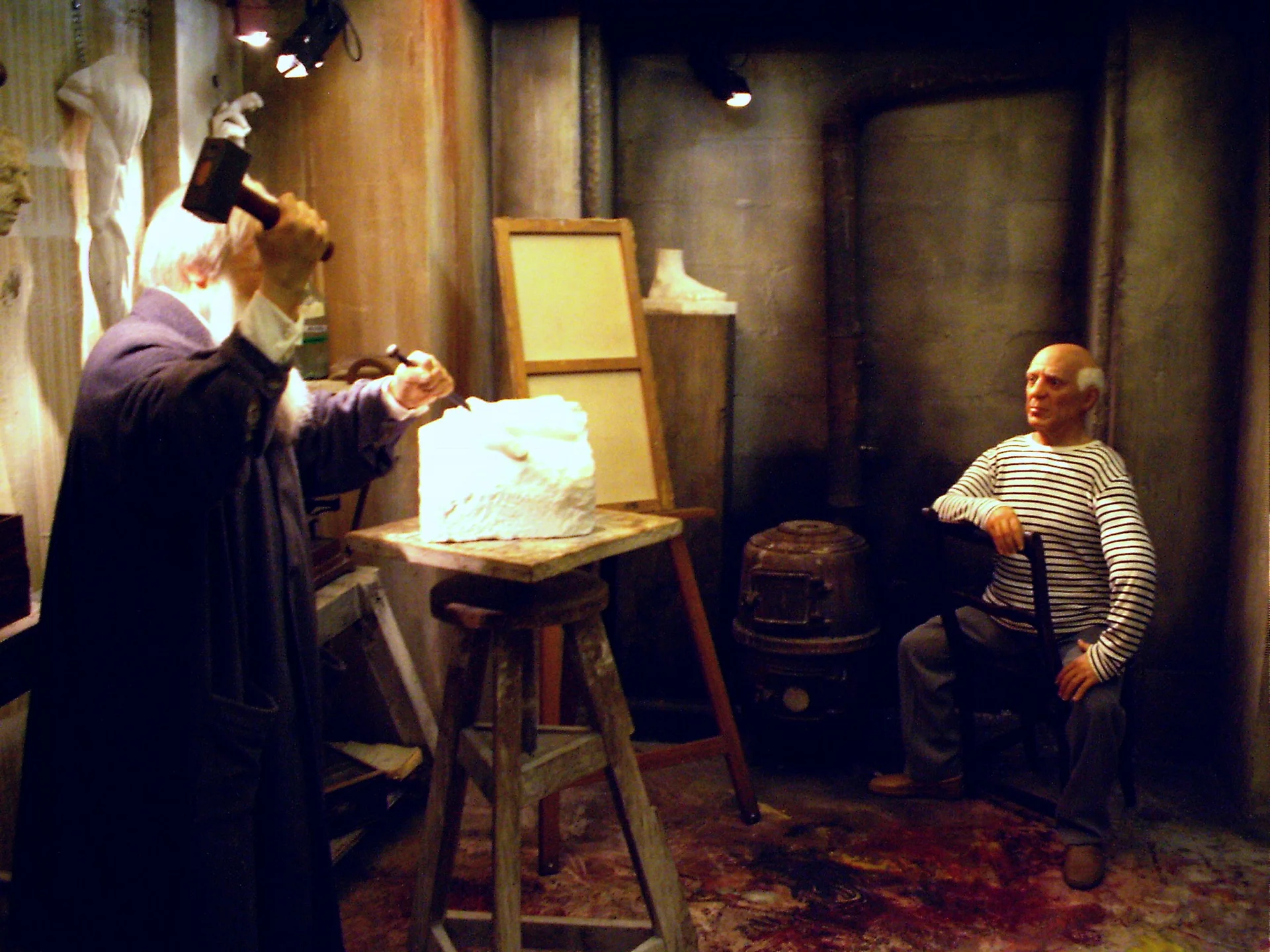
Who has never dreamed of taking a selfie with an international star? The Grévin Museum is packed with statues of historical figures and celebrities from the worlds of music and cinema. Notable examples include Michael Jackson, Simone Veil, and Pablo Picasso.
How are the personalities for the Grévin Museum chosen?
While the artisan sculptors and prop masters of the Grévin Museum have produced over 2,000 wax statues in a little over a century, only 300 are permanently displayed in the museum's rooms. The oldest statues date back to 1889. These are mostly reenactments of historical scenes representing the assassination of Marat during the French Revolution or the St. Bartholomew's Day Massacre during the religious wars.
Since 2001, a specialized commission composed of eleven hand-picked personalities from the media world chooses the new statues for the Grévin Museum. Presided over by Stéphane Bern, this commission, the Académie Grévin, meets twice a year.
In 2022, the Grévin Awards were held for the first time, allowing fans of the institution to vote for one of the future statues.
Secrets of making wax statues
The manufacturing of the Grévin Museum's statues is a true craft. Their creation follows the rules of the art of wax sculpture. In total, the making of a statue requires about fifteen specialized trades, including sculptors, molders, painters, costume designers, decorators, and dental and ocular prosthetists. Every detail of a personality's morphology is scrutinized and reproduced to the millimeter.
An initial meeting is organized with the celebrity, during which the face and body are measured and then modeled in clay. Technological advances have accelerated the reproduction processes. Today, the specialized artisans at the Grévin Museum rely heavily on photos, videos, 3D reproductions, and other computer-generated imagery.
In terms of materials, a single Grévin Museum statue requires over 30 kilos of beeswax and about 22 liters of paint. Additionally, several hundred thousand hairs are needed to reproduce a personality. As a result, the minimum production cost is estimated at approximately $56,130*.
Taking photos of your favorite celebrities at the Grévin Museum
Between the political figures of the 20th century, the greatest athletes of our era, and a collection of French and international stars, the Grévin Museum has plenty to satisfy your curiosity.
The interior is organized into themed rooms where each statue is staged using lighting and sets. Here are a few examples:
-
Étoiles d'Hollywood (Hollywood Stars): Here you will find red carpet stars and major cinema icons like Leonardo DiCaprio or Marilyn Monroe.
-
Idoles de la musique (Music Idols): This is where you find the most popular singers in France, including Edith Piaf, Stromae, and Maître Gims.
-
Légendes du sport (Sports Legends): From Zinedine Zidane to Kylian Mbappé, let yourself be carried away by the exploits of famous champions.
-
Icônes de la mode (Fashion Icons): Meet the greatest French couturiers and designers, from Jean Paul Gaultier to Inès de la Fressange.
-
Rois de l'humour (Kings of Comedy): The program includes, among many others, Franck Dubosc, Kad Merad, and Kev Adams.
-
Grands Chefs (Great Chefs) like Pierre Hermé, Paul Bocuse, and Alain Ducasse.
-
Stars du Petit Écran (TV Stars): The latest addition is the iconic YouTuber and social media star Squeezie.
-
Nouvelles Expériences (New Experiences): Find your favorite television shows and their seasoned presenters, such as Koh-Lanta with the statue of Denis Brogniart.
Grévin Museum: current and upcoming events
For some time, the Grévin Museum has been looking to renew itself, notably by strengthening the immersive dimension of its events.
Discover La Nuit au Musée (Night at the Museum) every first Saturday of the month. These are shows and performances filled with entertainment where actors and artists join the statues of your favorite stars. A set of sound and light effects amplifies the scenography of the museum's spaces, making the characters appear more lifelike.
Furthermore, the Grévin Museum is a great place to visit with family and children, thanks to the addition of a Héros de fiction (Fictional Heroes) area where they can find cartoon characters like Ladybug and Chat Noir or Titeuf.
Opening hours
| Monday | 09:30-18:30 |
|---|---|
| Tuesday | 09:30-18:30 |
| Wednesday | 09:30-18:30 |
| Thursday | 09:30-18:30 |
| Friday | 09:30-18:30 |
| Saturday | 09:30-19:00 |
| Sunday | 09:30-19:00 |
Hours data: © OpenStreetMap contributors
*Information subject to change

The Grévin Museum is a pretty fun visit. You can take selfies with the wax figures, which are really very realistic. However, I find that the choice of personalities represented isn't always very relevant. Also, the entrance price is really too high for what the museum actually offers. There are clearly better things to do in Paris.