
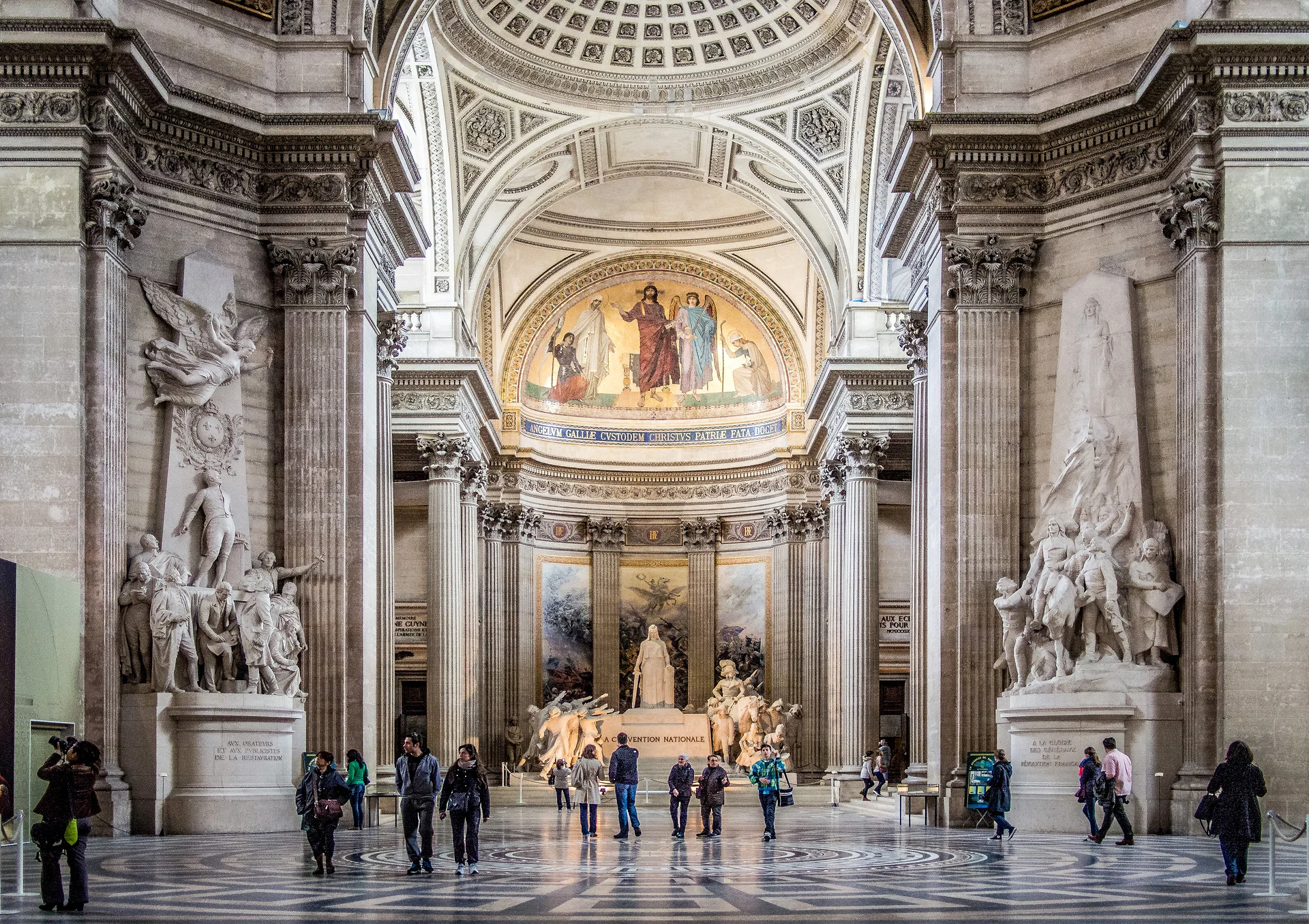
The Pantheon in Paris: where France honors its legends
A brass sphere swings slowly beneath the dome, tracing an invisible arc. With every pass, it drifts by a few millimeters. It is not the pendulum moving, but the Earth rotating beneath your feet. Since 1851, the Foucault pendulum has offered Pantheon visitors this hypnotic scientific demonstration, set in a nearly silent, reverent space.
Why visit the Pantheon?
This colossus of white stone has dominated the Latin Quarter from the top of the montagne Sainte-Geneviève (Saint Genevieve hill) for generations. Originally designed as a church by Jacques-Germain Soufflot on the orders of Louis XV, the building was never consecrated. The Revolution of 1791 transformed it into a national mausoleum, starting a tradition that continues today. Beneath this 80-meter dome rest more than 80 figures who shaped the history of France.
The inscription on the pediment sums it up: "To the great men, the grateful homeland." Voltaire and Rousseau have faced each other here for over two centuries. Victor Hugo has rested here since his 1885 national funeral, which was attended by two million Parisians. Marie Curie, the first woman honored for her own merits, has been interred here since 1995 in a lead-lined coffin to contain radiation.
Architecture: a technical challenge turned masterpiece
Soufflot dreamed of marrying the lightness of Gothic cathedrals with the rigor of ancient temples. The result defies convention. The facade, modeled after the Roman Pantheon, opens into a bright 83-meter-long nave. The dome, weighing 17,000 tons, rests on an innovative structure using the curve of an inverted catenary.
Friendly tip: Head to the colonnade between April and October for a 360-degree view of Paris. The 267 steps are worth the effort. The Eiffel Tower, Notre-Dame, and Montmartre appear in the distance without the crushing crowds of the usual tourist spots.
Frescoes and interior decor
The walls tell the history of France in monumental images. The frescoes by Puvis de Chavannes illustrate the life of Saint Genevieve, the patron saint of Paris. Each side chapel reveals a piece of the national narrative, from Clovis to the heroes of the Revolution. The pediment sculpted by David d'Angers in 1830 depicts the Motherland distributing crowns to the great men.
The crypt: final resting place of the nation builders
The spiral staircase leads to a maze of vaulted galleries. Light filters in through high windows, giving the space a quiet, respectful atmosphere. The tombs are aligned in a symbolic geography.
At the entrance, facing one another, Voltaire and Rousseau embody the Enlightenment. Further in, vault XXIV brings together three literary giants: Victor Hugo, Émile Zola, and Alexandre Dumas. Resistance fighters occupy a central place: Jean Moulin, Simone Veil, and Joséphine Baker. The most recent additions, Missak and Mélinée Manouchian, heroes of the Affiche Rouge (Red Poster) resistance group, joined this republican pantheon in February 2024.
Figures not to miss
- Marie Curie: two-time Nobel Prize winner, the first woman honored here for her scientific work.
- Louis Braille: inventor of the alphabet that bears his name. A tactile device allows visually impaired visitors to touch his bust.
- Soufflot himself: the architect has rested in his life's work since 1829.
The Foucault pendulum: the Earth turns before your eyes
On March 31, 1851, the physicist Léon Foucault suspended a 28-kilogram sphere from a 67-meter steel wire under the dome. The demonstration caused a sensation. The pendulum's plane of oscillation drifts by about 11 degrees per hour. It is a visual and irrefutable proof that our planet rotates on its axis. The original experiment was interrupted by the coup d'état of December 1851. Since 1995, a faithful replica has oscillated once again, mesmerizing visitors several times an hour.
Opening hours
- October 1 to March 31: 10:00 AM to 6:00 PM (last entry 5:15 PM)
- April 1 to September 30: 10:00 AM to 6:30 PM (last entry 5:45 PM)
- Opens at 12:00 PM on the first business Monday of each month
- Closed January 1, May 1, and December 25
*Information subject to change

I have visited the Pantheon twice and I still find the place just as majestic. It is both a journey through French history and a quite moving memorial odyssey that immerses us in an atmosphere of quiet reflection. Being near Victor Hugo, Voltaire, Dumas, and Marie Curie, among others, always leaves an impression of wonder. A nice detail is that the place is not overrun by tourists, which allows it to maintain its sacred feel.