
Where to stay near Iguazu Falls: the 4 areas to know in 2026
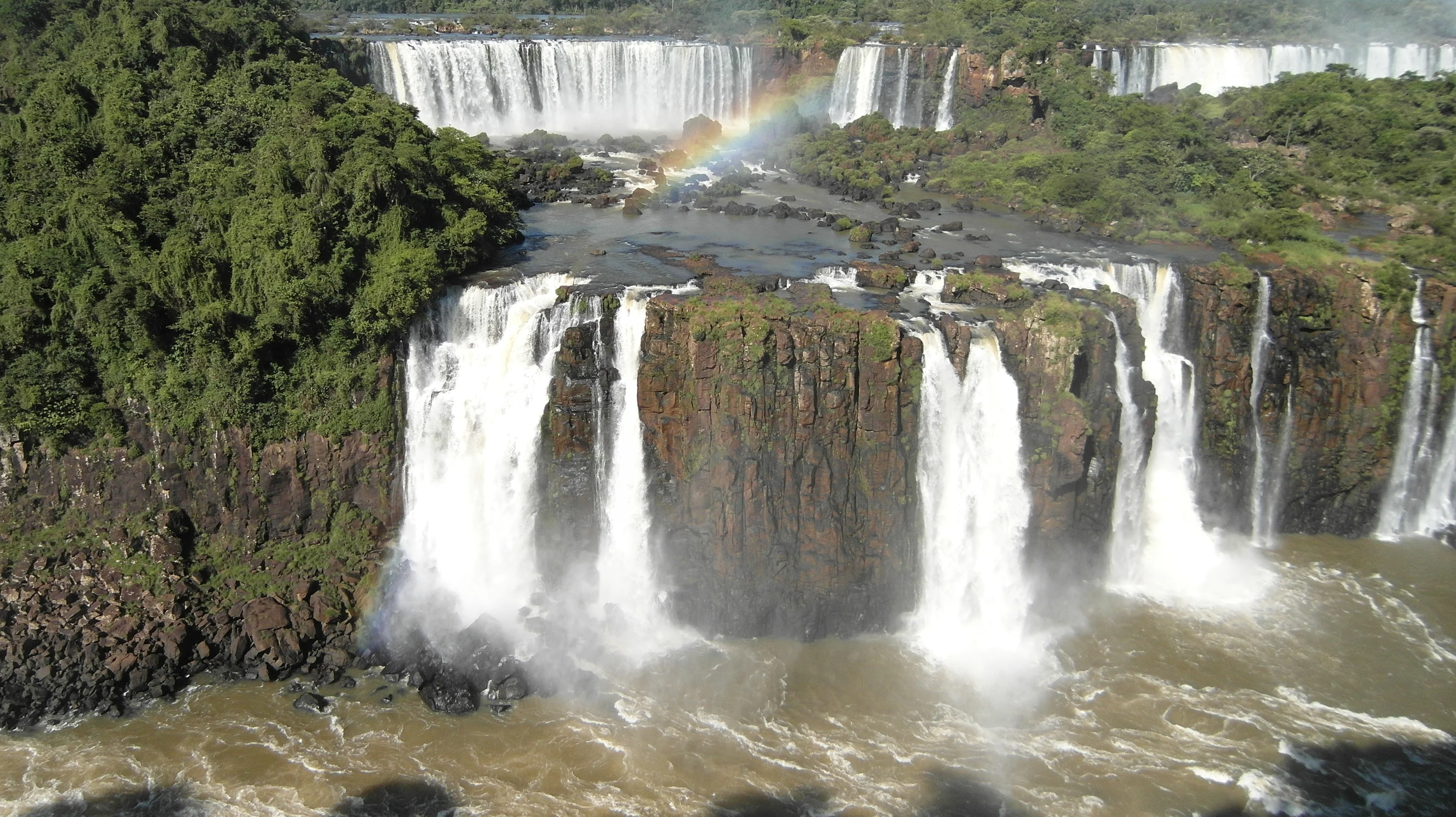
The Iguazú Falls are not a site, they are a border. The river drops between Argentina and Brazil, and each country has made a national park of it, with its own ticket, its own hours and its own viewpoint. On the Argentine side you walk on top of them: boardwalks run above the water and down to its foot, and it takes 6 to 8 hours to cover them all. On the Brazilian side you face them, from a 1.5-kilometre trail. Two towns sit on the banks, one per side: Puerto Iguazú and its 32,038 inhabitants, and Foz do Iguaçu, eight times larger.
Then there is what nobody puts on the poster: the parks close. The Brazilian one at 4 p.m., the Argentine one at 6, and the coaches start pulling in around 10 in the morning. Sleeping in town therefore means arriving with everyone else and leaving before evening. Yet each park holds one hotel, just one, and those two addresses open the hours that are closed to everybody else: dawn, and the late afternoon once the coaches have gone. They stand 800 metres apart, and it takes an international bridge to get from one to the other. This guide sorts the places to stay into 4 areas, from the two hotels inside the parks to the two towns on either bank.
Compare hotel prices near Iguazu Falls
In a hurry? Find the best accommodation deals in 3 clicks.
Compare live deals from Booking, Expedia, Agoda and other partners.
The two ways to stay near Iguazu Falls
The two hotels inside the parks and the two towns are not offering the same deal. Here is what each way of sleeping here gives you, and what it costs.
| What changes | Inside one of the two parks | In one of the two towns |
|---|---|---|
| The hours when you see the falls | An hour's head start on the Argentine side; before and after the public on the Brazilian side | Opening hours, like everyone else |
| The morning journey | None: you step out of your room | 18 kilometres, plus the bridge if you sleep in Brazil |
| The park ticket | Included in the rate on the Brazilian side, to be paid separately on the Argentine side | To be paid, once per bank |
| Dinner | The hotel's table, and that one alone | The town's tables, on foot |
| Choice and price | Two luxury addresses, and no others | Every bracket, from the small family hotel to the chain hotel |
| Switching banks | The bridge, starting from either park | The bridge too, with the bus terminal and the agencies round the corner |
| The other days | The forest and the river | The bird park, the Itaipu dam, both town centres |
| Who it suits | The falls are the reason for the trip | The stay is a long one, or the budget matters |
How long to the entrance, area by area?
The distances are road distances. And the word border is no figure of speech: the falls are watched from two countries, and there is a customs post between the two banks.
| From | Time | How |
|---|---|---|
| Inside the Argentine national park | on site | on foot The boardwalks are 600 metres away, the train station a 10-minute walk. |
| Inside the Brazilian national park, facing the falls | on site | on foot or by bicycle The trail starts in front of the hotel; a free shuttle reaches the gate every 20 minutes. |
| Puerto Iguazú, the Argentine gateway town | 18 km | bus or car A bus every 20 to 30 minutes from the terminal, half an hour on the road. |
| Foz do Iguaçu, the big Brazilian city | the bridge, then 18 km | car or bus Allow 20 to 30 minutes of formalities at the bridge, 45 to 90 during the Brazilian holidays. |
At a glance: our picks by traveller type
Pick the profile that fits you and go straight to the recommended area.
Map of the areas near Iguazu Falls
See how the areas sit relative to one another before choosing your base. Click a name to jump to its description.
Inside the Argentine national park The only address inside the park itself, 600 metres from the falls
Those who want the boardwalks before opening time, and will pay for that hour
The Argentine park is the one where you walk on the falls: three boardwalk circuits, 6 to 8 hours of visiting, and a train that runs up towards the Garganta del Diablo. A single address stands within its grounds, 600 metres from the water, the train station a 10-minute walk away. What it gives fits in one sentence: its guests go in an hour before the public, and therefore walk empty boardwalks. What it costs, too: the park ticket is still to be paid on top of the room, there is no table but its own, and not a street nearby to go out to in the evening, since the park is closed.
It is only by seeing, hearing, and feeling Iguazu Falls up close that you realize the power of all that water.
Where to stay in this area
Gran Meliá Iguazú Luxury
Set in the park's forest, with the falls lined up with the front rooms and the circuits within walking distance. The hour's head start on the public fills nearly every review, well ahead of the pool or breakfast; the rate and the park ticket to be paid separately are the two reservations.
Pros
- An hour inside the park before the public, every morning
- The circuits and the train a 10-minute walk away
- No journey, no queue at the gate
Cons
- The park ticket to pay on top of the room
- One table only, and nothing around once the park closes
Inside the Brazilian national park, facing the falls The other bank: 590 metres from the falls, 800 from the Argentine hotel
Those who want the head-on view, at the hour when the trail is empty
On this side you do not walk on the falls, you face them: a 1.5-kilometre trail follows the bank and ends below the gorge. It takes 2 to 4 hours, which leaves the day free. The park holds a single hotel, 590 metres from the water, and its guests have the trail before opening and after closing, on foot or by bicycle, when the park is empty. The park ticket is included in the rate. Private cars do not drive inside the park: a free shuttle links the hotel to the gate every 20 minutes, from 7 a.m. to midnight. A quirk of geography: the hotel in the Argentine park is 800 metres away, and the international bridge is the only way there.
Where to stay in this area
Hotel das Cataratas, A Belmond Hotel, Iguassu Falls Luxury
A pink colonial house beside the trail, the highest-rated address in the whole area according to the reviews. What travellers tell of it is hardly ever the room: it is the trail at dawn and at dusk, the falls with nobody in front of them, and the noise at night.
Pros
- The trail during closing hours, on foot or by bicycle
- The park ticket included in the rate
- The head-on view of the falls, and the free shuttle to the park gate
Cons
- The highest rates on either bank
- The Argentine park, 800 metres away, requires the international bridge
Puerto Iguazú, the Argentine gateway town The small Argentine town: bus terminal, restaurants, most of the rooms
Those who want to pick their budget and have dinner in town
Puerto Iguazú is a small town of 32,038 inhabitants that lives off the park, and nearly every room on the Argentine side is gathered here, from the little family hotel to the luxury address hidden in the forest. From the terminal, buses serve the park gate all day long. The trade-off is plain: you pay far less than inside the park, you dine away from your hotel, and you go in with everyone else. One of our members, arriving after a 20-hour bus ride from Buenos Aires, draws from it the advice that changes a day here. The bridge to Brazil, lastly, is 12 minutes from the centre.
I recommend going in the morning right when it opens
Where to stay in this area
Loi Suites Iguazu Hotel Luxury
Set back from the town, in a wood crossed by walkways, with a large pool and toucans at breakfast. People come here for the forest without the park's price, and the complaint in the reviews is the distance to the centre.
Iguazu Jungle Lodge Mid-range
Apartments with a kitchen, arranged around a pool a few minutes from the centre, very well rated for the space you get for the price. The format suits families and the two or three-night stays that are the norm here.
Hotel Saint George Mid-range
The classic of the centre, next door to the bus terminal, and the most reviewed establishment in the whole town: the comments repeat year after year, a hotel without surprises, well placed for an early start.
Hotel Jardin De Iguazu Budget
A small, simple hotel in the centre, the first price bracket of this area, the terminal and the restaurants on foot. You sleep here between two days of boardwalks, you do not stay here.
Pros
- Every price bracket, from the small hotel to the luxury address
- The bus terminal, the restaurants and the agencies on foot
- The bridge to Brazil 12 minutes from the centre
Cons
- The park road, morning and evening, every day
- You go in at opening time, like every other visitor
Foz do Iguaçu, the big Brazilian city The largest city on either bank, and its international airport
Those who arrive by plane, or who stay for something other than the falls
With its 258,248 inhabitants, Foz do Iguaçu does not live off the falls alone: the region has its only real city here, and its airport brings in the most people, more than 2.2 million passengers in 2025. You will find the hotel chains, the tables that stay open late, the bird park in front of the national park gate and the Itaipu dam to the north. Since the Brazilian trail asks only 2 to 4 hours, the city serves as a base for those who stay several days and do not come for the water alone. One thing worth knowing if this bank appeals to you: the Argentine falls begin after the bridge, so after a border crossing, then 18 kilometres of road.
 Stay in the city
Where to stay in Foz do Iguaçu
Foz do Iguaçu has its own guide: neighbourhoods, prices, our recommended hotels.
Pros
- The busiest international airport on either bank
- The choice of a real city for its tables and its rooms
- The bird park and the Itaipu dam for the days that follow
Cons
- The bridge and its formalities before the Argentine falls
- A road to the park, whichever bank you choose
Our tips for booking the right place
- Be there at opening, or give up on the quiet: The Argentine park opens at 8 a.m., the Brazilian one at 9 on weekdays and 8.30 at weekends, and one of our members gives the hour that counts: the coaches loaded with tourists start arriving around 10. Early morning is therefore the only window in which the boardwalks can be walked without crossing anyone. Sleeping inside a park opens it without an alarm clock; a room in town calls for the first bus. At the other end of the day, the last entry on the Argentine side falls at 4 p.m., the last access to the circuits at 3.45, and the Garganta train leaves for the last time at 3.30: arriving at 3 means giving up the gorge.
- Check the state of the boardwalks before choosing your bank: The river regularly undoes what is built above it, and that sometimes settles which bank you sleep on. The Argentine boardwalk leading to the Garganta del Diablo, 1,100 metres above the upper Iguazú, was taken down as a precaution on 3 August 2026 ahead of a forecast flood, and it was still closed on 1 November. Nothing new about that: the flood of October 2022 carried off 55 spans and imposed four months of works, the one of October 2023 destroyed 79 out of 99, and the circuit only reopened in July 2024. On the Brazilian side, access to the gorge viewpoint was closed from 11 to 31 October 2026, the time it took for the flow to drop from 8.5 to 6.8 million litres per second. The gorge can be seen from both banks: when it is out of reach on one side, the other becomes the right answer, and that is worth a look before booking a room.
- Switching banks takes longer than the map suggests: The Tancredo Neves bridge, 489 metres opened in 1985, is 7 kilometres from the centre of Foz do Iguaçu and 12 minutes from that of Puerto Iguazú. On paper the two towns are neighbours; in practice, crossing with the formalities takes 20 to 30 minutes in normal times and 45 to 90 minutes during the Brazilian holidays. Add the 18 kilometres of road that then lead to the gate of the park you are heading for. That is why both banks call for two days rather than one, and why the bank you sleep on weighs so much.
- A single day for both banks: 6 to 8 hours of circuits on the Argentine side, 2 to 4 hours of trail on the Brazilian side, and a border in between.
- Arriving at the park in mid-morning: the coaches turn up around 10, and narrow boardwalks cannot be overtaken.
- A room chosen without checking the state of the circuits: the Garganta boardwalk has been carried off or taken down three times since 2022, and the gorge is then seen from the other bank.
FAQ: where to stay near Iguazu Falls
Can you sleep inside the parks?
Argentine side or Brazilian side?
How many nights should you plan?
Is the Garganta del Diablo open?
How do you get there?
What should you know once there?
Hotels available near Iguazu Falls, on the map
Tonight's availability and prices, hotel by hotel, at the distance you choose.
Compare live deals from Booking, Expedia, Agoda and other partners.
 Keep exploring
Everything about Iguazu Falls: reviews, photos, practical info
Comments (0)
No comments yet. Be the first!