
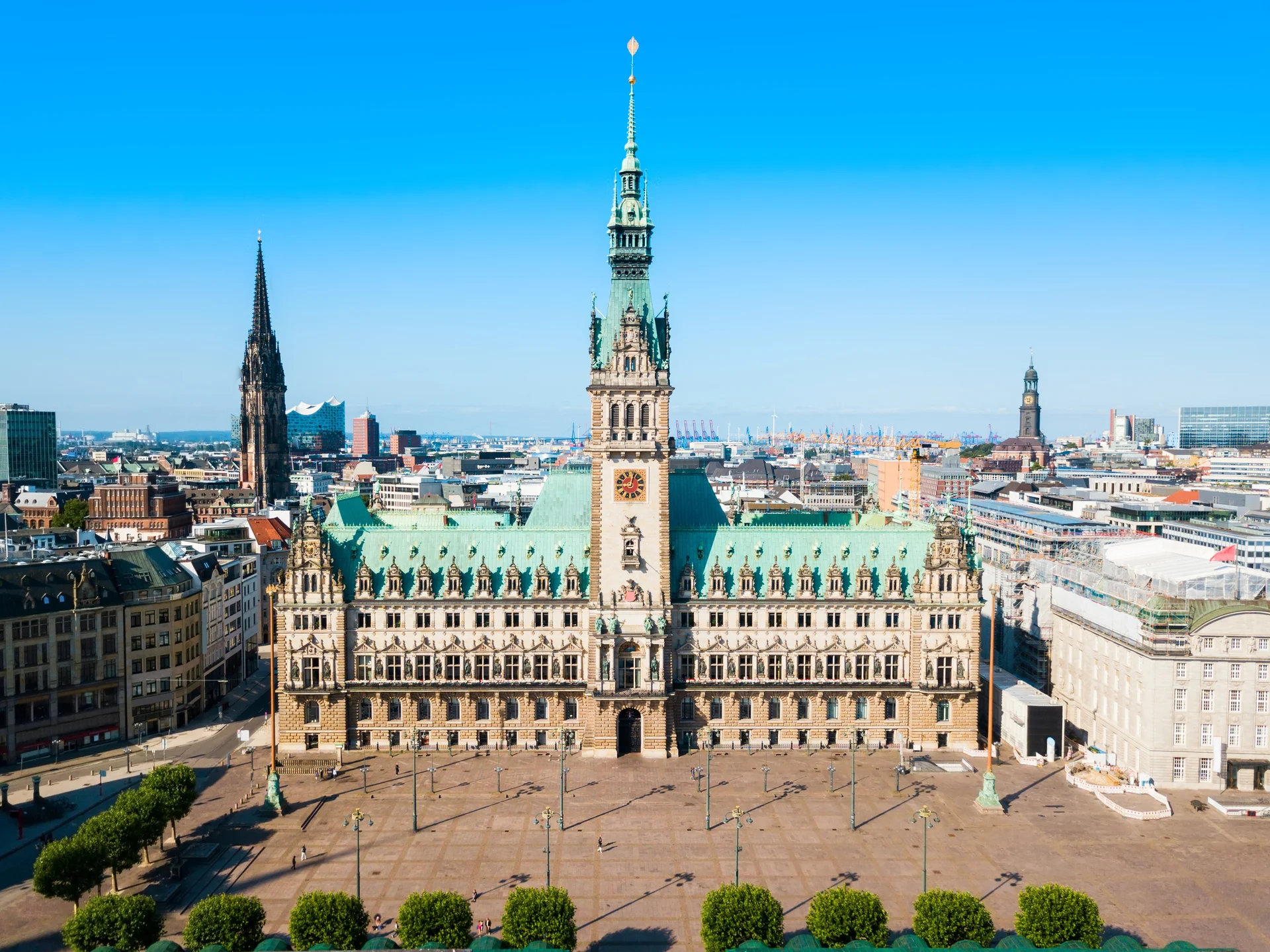
Hamburg City Hall, a neo-Renaissance palace in the heart of the Hanseatic city
Its 112-meter tower pierces the Hamburg sky, and its sandstone facade from Dresden stretches 111 meters of sculpted opulence. The Hamburg City Hall, finished in 1897 after eleven years of massive construction, does more than house the Parliament and the Senate of the state. It stands as a bold statement of pride for a free, reborn, and forever Hanseatic city.
Twenty Holy Roman emperors watch over visitors from the facade, while a golden phoenix adorns the tower shaft, symbolizing the city's resurrection after the Great Fire of 1842.
Why visit the Hamburg City Hall?
This architectural giant embodies the turbulent history of the city on its own. The old city hall was consumed by flames in 1842, marking a turning point in Hamburg urban planning. The reconstruction, led by architect Martin Haller, birthed this neo-Renaissance jewel that cost twenty times the initial budget, a record even for that era. The building rests on nearly 4,000 oak piles, the only way to anchor such a heavy mass into the swampy ground of the city.
With 647 rooms richly adorned with gold leaf, marble, and carved woodwork, the Hamburg City Hall rivals the splendor of the greatest European palaces. Despite the heavy bombing of Operation Gomorrah in 1943, the building survived almost intact, acting as a miraculous witness to Hamburg resilience. Today, it remains the active seat of the city-state government, blending political function with major tourist appeal.
A facade that tells a thousand stories
Look up at the main facade. The twenty statues of Holy Roman emperors recall the imperial status once granted to the city. Among them, Charlemagne and Barbarossa hold the historical document that made the city a free port. The coats of arms of various Hanseatic cities dot the sculpted stone, alongside symbols of the merchant guilds that built local prosperity.
The Phoenix carved on the tower shaft should not be confused with the gilded imperial eagle that crowns the spire. It symbolizes the rebirth of the city from the ashes of 1842, a message of hope carved in stone. Every architectural detail carries meaning, from pediments and columns to ornamental sculptures that tell the epic tale of a commercial power that never yields.
A sumptuous interior: between power and beauty
The courtyard and the Hygieia Fountain
Cross the threshold and enter the courtyard, which is open to the public. The Hygieia Fountain, named after the Greek goddess of health, stands in the center. Built to commemorate the cholera epidemic that hit the city in the late 19th century, it was one of the first drinking water fountains in the city. An ingenious system used its water to cool the rooms of the building through underground passages, a precursor to modern air conditioning.
Reception rooms and seats of power
Guided tours reveal the brilliance of the official rooms. The main hall impresses with its wall frescoes and high, ornate ceilings. On the walls, a unique feature stands out: portraits of Hamburg deputies accompanied by their names and their professional trades. Here, elected officials continue their professional careers and meet only twice a month, on Wednesdays. This is a historical legacy from the days when merchants would walk from the Bourse (Stock Exchange), located just across the street, to handle political affairs in a few steps.
The Kaisersaal (Emperor Hall) lines up portraits of former leaders along its wood-paneled walls. The council chamber hosts contemporary debates, while the Bürgersaal (Citizens Hall) hosts official receptions and state visits in a setting of almost intimidating richness. In 1971, a secret room was discovered by accident, fueling speculation about other hidden passages in this administrative labyrinth.
Friendly tip: guided tours in English depart every hour but can fill up quickly during peak season. Aim for weekday mornings to enjoy a more intimate atmosphere and better lighting for photos in the courtyard.
A lively cultural hub
You do not just visit the Hamburg City Hall; you experience it. Public concerts frequently resonate in the grand foyer, while the restaurant in the basement offers honest food at accessible prices, proving that the prestige of the site does not exclude the public. The Rathausmarkt (City Hall Square), which stretches out in front of the building, hosts festive events, Christmas markets, and civic gatherings throughout the year.
This monument perfectly embodies the Hamburg balance between tradition and modernity, between government function and cultural openness. It remains the undisputed symbol of civic pride for a city that never stops reinventing itself while honoring its prestigious past.
Opening hours
The inner courtyard and the main hall are open to the public.