
Where to stay in Aracaju: the 4 neighborhoods to know in 2026
Photo : ophelie
On the coast between Salvador and Maceió, Aracaju is the state capital nobody puts on an itinerary. Capital of the smallest state in Brazil, drawn in 1855 on a grid of straight streets, set where the Sergipe river meets the Atlantic. Six hundred and sixty-five thousand residents, six kilometres of seafront, two museums that tell the story of a whole state, and beaches that belong first to the families who live here.
Because the clientele comes mostly from the region, rates stay low: $34* at entry level, $57* a well-rated three-star, $113* a four-star right on the sand. So the division below does not start from the monuments but from where the beds are: the seafront first, the old centre third, because it has no hotel to offer.
Compare hotel prices in Aracaju
In a hurry? Find the best accommodation deals in 3 clicks.
Compare live deals from Booking, Expedia, Agoda and other partners.
At a glance: our picks by traveller type
Pick the profile that suits you to head straight to the recommended neighborhood.
The neighborhood map in Aracaju
Get your bearings on the neighborhoods and must-see sights before choosing where to drop your bags. Click a name to jump to its description.
Orla de Atalaia and Coroa do Meio Atalaia beach and the six kilometres of the Orla, the Caranguejo footbridge, Praça dos Arcos, the Aracaju aquarium, Coroa do Meio beach, Atalaia square, the Sergipe art and culture centre, the Riomar shopping centre
for the sea outside the door, for families, for a first visit
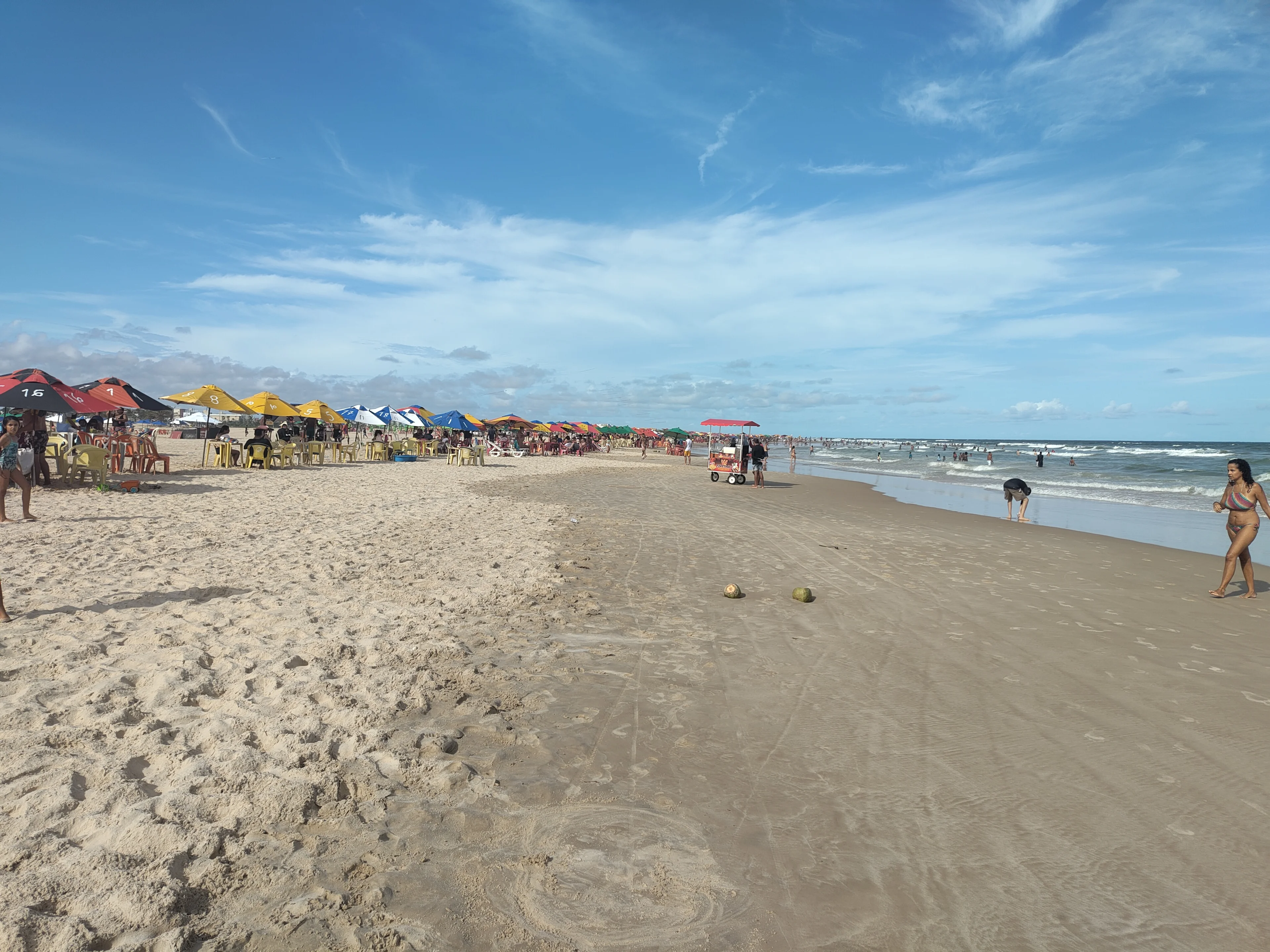
This is where almost everyone sleeps, for one simple reason: the rest of the city has no hotels. The Orla de Atalaia is a six-kilometre promenade, wide, well lit, planted with trees, lined with playgrounds, sports courts and kiosks facing the Atlantic. You recognise it by the Caranguejo footbridge, the giant crab that straddles the avenue, and by the white arches of Praça dos Arcos. The aquarium and the art centre occupy the northern end, on the Coroa do Meio side, where the Orla turns into a district of new apartment blocks. The sea itself is warm and flat, sheltered by a reef line.
Where to stay in this neighborhood
Hotel da Costa By Nobile Mid-range
8.8 from more than two thousand two hundred reviews, with 9.3 for location and 9.1 for staff, 8.8 for cleanliness, 8.7 for comfort and 8.6 for facilities. It faces Praia dos Artistas, halfway along the Orla, two pools and a breakfast that reviewers mention more often than the rooms. Budget $113*.
Celi Connect Hotel Orla Aracaju Budget
The largest review count in this guide: 7.6 from more than five thousand four hundred. Only one of its figures climbs, and it is the right one for what people come here for: 9.1 for location. The others tell the truth about a plain address, cleanliness 7.8, comfort 7.5, facilities 7.2. On the Orla avenue, around $34*.
Pros
- Nearly every hotel in the city, with the sea across the road
- Six kilometres of lit promenade, kiosks and playgrounds
Cons
- Six kilometres from the old centre and its museums
- Loud and packed on Sundays, the big local outing
Jardins, Grageru and 13 de Julho Sementeiras park and its walkways, the Shopping Jardins mall, the Sergipe Memorial, Cajueiros park, Tiradentes university, the João Hora de Oliveira stadium
for the best score in this guide, for a week in town, for the rates
Inland, Aracaju becomes a city of wide avenues and recent towers, the one where people work and do their shopping. Big Sementeiras park is its lung: tree-lined paths, walking tracks and a lake, five minutes from the two malls. The Sergipe Memorial and the university sit in the same area, and this is where the two best-rated addresses in this guide are. One thing is missing, and it counts: the sea is not within walking distance.
Where to stay in this neighborhood
NB Hoteis Mid-range
The best score in this guide: 9.0 from more than two thousand one hundred reviews, with 9.3 for staff, 9.2 for location, 9.1 for cleanliness as for comfort, 9.0 for facilities and 8.6 for value. Seven scores above 8.5: that evenness is rare. Two hundred metres from Shopping Jardins, around $68*.
ibis Aracaju Budget
8.8 from more than one thousand six hundred reviews, with 9.3 for staff, 8.9 for cleanliness, 8.8 for comfort as for location and 8.2 for value. A chain, so no surprises, and the breakfast comes up often in the reviews. Avenida Adélia Franco, in Grageru, around $57*.
Pros
- The two best scores in this guide, 9.0 and 8.8
- The city's big park and two malls on foot
Cons
- No sea: allow a quarter of an hour by car to the Orla
- Nothing old, and few reasons to walk around after dark
Centro: the two museums and the markets The Museu da Gente Sergipana, the Museu do Homem Sergipano, the metropolitan cathedral, the Palácio Museu Olímpio Campos, the Ponte do Imperador and its street museum, Praça Fausto Cardoso, the municipal market and the Antonio Franco market, the church of São Salvador, the Galdino Bicho museum, Teófilo Dantas park, Praça Tobias Barreto, and three kilometres north the old railway station and the zoo
for the two museums, for the markets, for the June forró
Here is the reason to come, and it has nothing to do with the beach. The Museu da Gente Sergipana occupies a former school on Rua Itabaianinha and tells a whole state through sound, gesture and cooking: it is the one place in Aracaju our reviews call superb. A few streets away, the Museu do Homem Sergipano completes the visit, and its restaurant is worth the trip as much as its rooms. Around them, the 1855 grid fits into twenty blocks: the cathedral, the governor's palace turned museum, the Ponte do Imperador reaching out over the river, and the two covered markets where mangaba fruit and crab are sold.
Pros
- Two museums, the cathedral and the markets within twenty blocks
- The main stage of the June forró, on the market square
Cons
- No address worth listing: this guide names none here
- Everything shuts early, and the evening happens on the Orla
The south: Aruana, Robalo and Mosqueiro Aruana beach, Robalo beach, Mosqueiro beach and Refúgio beach, the Crôa do Goré sandbank on the Vaza-Barris river
for the dunes, for the river, for the quiet
Head down the coast and the city fades out. Apartment blocks give way to dunes and low scrub, the kiosks thin out, and the beaches of Aruana and then Robalo become long strips of sand with nobody on them midweek. At the end, Mosqueiro is no longer a district but a fishing village caught up by the city, and this is where the boats leave for the Crôa do Goré, a sandbank in the middle of the Vaza-Barris river where you eat with your feet in the water. Twenty-five kilometres separate this stretch of coast from the centre: here a car is not a luxury.
Where to stay in this neighborhood
Aruanã Eco Praia Hotel Mid-range
8.7 from more than seven hundred reviews, with 8.9 for staff as for location, 8.7 for cleanliness, 8.6 for comfort as for facilities, and 7.9 for value, its only low mark. It sits between the dunes and the beach, garden and pool, away from everything. Budget $79*.
Pros
- Empty beaches midweek, dunes and low scrub
- The boats for the Crôa do Goré leave from here
Cons
- Twenty-five kilometres from the centre, and one address worth listing
- Without a car you depend on buses and taxis
Our tips for booking the right place
- The museum that turns the programme upside down: People come to Aracaju for the beach and leave talking about a museum. The Museu da Gente Sergipana, in the centre, takes an hour and a half and is walked through like a house: voices in the walls, recipes projected onto a table, the trades and festivals of the whole state. It is the one place in town our reviews call superb, and it explains what you will later see in the markets. The Museu do Homem Sergipano extends the visit a few streets away, a city bus is enough, and its restaurant is worth staying for lunch.
- Sunday on the beach is a local outing, not a postcard: Worth knowing before booking opposite the Orla: on Sundays, Atalaia beach fills with families from here, and the day has its own rules. Plastic chairs under rented parasols, every bar's sound system drowning out its neighbour, fried food and beer by the litre, children in the water until dusk. It is lively, it is generous and it is not peaceful. Anyone after empty sand takes a bus south; anyone who came to see Brazil on a Sunday stays exactly where they are.
- June: the forró takes over the market square, and so does the rain: The June festivals are the great event of Sergipe, and in Aracaju they run for most of the month: neighbourhood stages to begin with, then the bulk of the programme on the central market square, in the Centro, in the final week. Dozens of forró bands, from 4 to 28 June, and rooms that go early. One thing to weigh, though: June also falls in the rainy season, which runs from March to July. The city does not stop for that, but you dance under tarpaulins.
- A city on a grid, and six kilometres that cannot be walked: Aracaju was drawn in one go in 1855, on a grid, and you can feel it: in the Centro, everything is at right angles and everything is done on foot, museums, markets and cathedral included. But the city grew southwards, and the distance between the old centre and the Orla de Atalaia is six kilometres, along an avenue with nothing to see. Buses cover it, taxis too, walking does not. That is the trade-off of the stay: sleep facing the sea and take a bus to the museums, or the other way round, which is not possible since the centre has no hotel.
- Looking for an address in the Centro: the only two listings near Praça Fausto Cardoso have six reviews between them, and this guide keeps neither.
- Expecting a postcard beach on the Orla de Atalaia: it is a city beach, edged by an avenue, and it is judged on its atmosphere.
- Assuming Abais beach is in Aracaju: it is forty-five kilometres south, in another municipality, and needs half a day.
- Booking in Mosqueiro without a car: twenty-five kilometres separate that stretch of coast from the centre, and buses are rare in the evening.
FAQ: where to stay in Aracaju
Which neighbourhood should you stay in in Aracaju?
How much does a night in Aracaju cost?
How many days do you need in Aracaju?
Are the beaches of Aracaju worth the trip?
When is the best time to come?
What can you see in Aracaju in one day?
 Keep exploring
Things to do in Aracaju
Keep exploring
Things to do in Aracaju
Comments (0)
No comments yet. Be the first!