
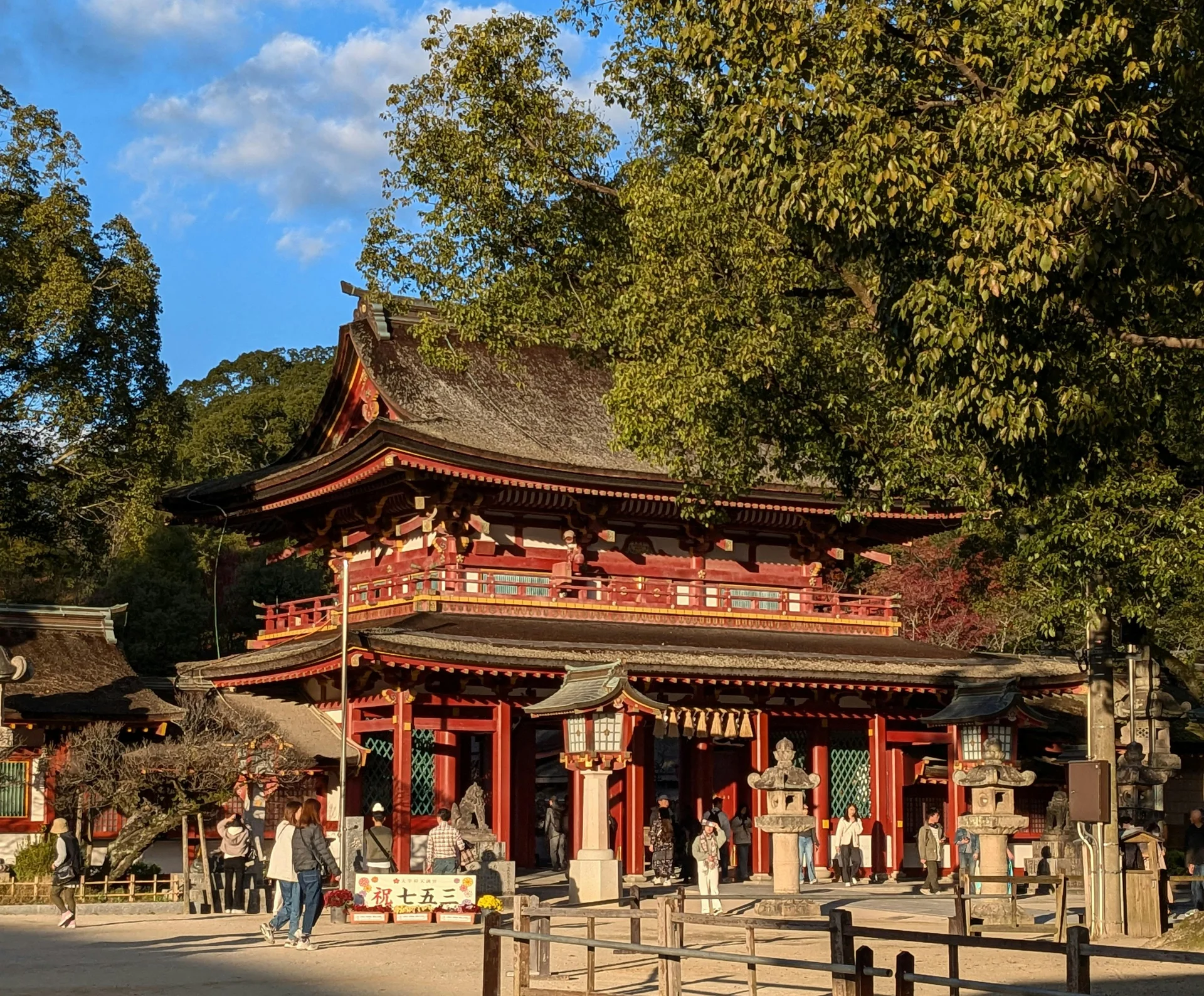
Dazaifu Tenmangu: The shrine of a god born from human injustice
He died in exile in 903, condemned by his political rivals. Shortly after his death, a series of disasters struck the imperial court. Epidemics, fires, and suspicious deaths followed. Japan concluded that the spirit of Sugawara no Michizane, a poet and scholar who had been unjustly banished, was seeking revenge. To appease him, he was deified. On the site of his grave in Dazaifu, the country built one of its most significant places of worship.
Why visit Dazaifu Tenmangu?
This shrine serves as the head shrine for some 12,000 Tenmangu sites spread across Japan, all dedicated to Tenjin-sama, the deity of learning, culture, and the arts. Millions of Japanese students visit each year to pray before their entrance exams. The religious aspect is not just a relic of the past. In January, school-related wishes written on wooden plaques typically cover the shrine structures.
Visiting is free and provides access to remarkable grounds. You will find a pond shaped like the kanji for heart, three arched bridges representing the past, present, and future, camphor trees that are over a millennium old with trunks reaching ten meters in circumference, and the main hall built in 1591 directly over the grave of Michizane.
The renovation of the honden: A historic occasion with contemporary architecture
Since May 2023, the honden (main hall), which is a designated Important Cultural Property, has been undergoing its first major renovation in 124 years. The work is in preparation for the 1125th anniversary of the death of Michizane, which will be marked in 2027. This date is significant because the number 25 is sacred in Dazaifu, and a major festival has been held every 25 years since the death of Tenjin-sama.
During the construction, a temporary hall designed by Sou Fujimoto, the Japanese architect who created the main pavilion for the World Expo in Osaka 2025, hosted visitors and prayers. This building is covered by a forest of plants and trees on its roof, including plum trees raised by the shrine gardeners. It is beautiful, unexpected, and a significant piece of architecture in its own right.
The temporary hall was built only for the duration of the works. It is ephemeral architecture that no later visitor will be able to see.
Friendly tip: Do not miss the sacred ox statues scattered across the shrine grounds. There are eleven in total. According to tradition, rubbing their heads transfers their wisdom to you. It is also a fun way to explore the various parts of the estate beyond the main hall.
Plum trees and the legend of the Tobiume
Michizane was passionate about plum trees. He had planted them in his garden in Kyoto. Upon leaving for exile, he said goodbye to them by composing a poem. According to legend, he missed one of these trees so much that it flew through the night to join him in Dazaifu. This plum tree, the Tobiume (flying plum tree), still grows to the right of the main hall. It blooms first, ahead of all the others, every year.
Other botanical highlights on the grounds include:
- Late January to early March: The blooming of 6,000 plum trees representing 200 varieties, one of the most renowned ume flower displays in Japan.
- Early June: The blooming of 30,000 irises of 55 species in the Shobu-ike pond, located to the east of the grounds.
- Mid-November to early December: Late autumn colors, which are extended by the warm climate of Fukuoka.
- The Omotesando: The approach path, which is 250 meters long, is lined with shops offering umegae-mochi, grilled rice cakes filled with red bean paste. You will also find a Starbucks designed by architect Kengo Kuma, featuring a facade made entirely of natural wood.
What makes Dazaifu a special visit
- Access to the grounds is completely free. It is one of the most important shrines in Japan without an entrance fee.
- The temporary hall by Sou Fujimoto, a rare piece of ephemeral architecture, was taken down in 2026: the restored honden is once again the heart of the visit.
- Easily accessible from Fukuoka in less than 45 minutes by train.
- An exceptional natural environment with camphor trees over 1,500 years old and thousands of plum trees.
Points to anticipate
- The facade of the original honden was hidden by construction for three years. Work is not finished everywhere: check on the site before you travel.
- Crowds can be very heavy on weekends, during plum blossom season, and throughout exam periods.
- The Omotesando is very commercial, making it difficult to avoid crowds between the station and the first torii gate.
Indicative prices for the Dazaifu Tenmangu museum
Access to the shrine grounds is free. Only the adjacent museum requires a ticket.
| Ticket type | Indicative price |
|---|---|
| Dazaifu Tenmangu Museum only | 500 JPY |
| Dazaifu Tenmangu Museum + Kyushu National Museum + Kanko Historical Museum | 1,000 JPY |
| Kanko Historical Museum only | 200 JPY |
Indicative prices are subject to change
Opening hours
December through mid-March: 6:30 AM to 6:30 PM.
Late March: 6:00 AM to 6:30 PM.
April to May and early September: 6:00 AM to 7:00 PM.
June through August: 6:00 AM to 7:30 PM.
Late September through November: 6:30 AM to 7:00 PM.
How long for this activity
*Information subject to change

A shrine dedicated to the arts and literature (with local events and festivals that will surprise you). A very green place that you can visit just like a large park. I also recommend visiting the museum. You might expect something fairly small. But no, you discover a good number of historical objects and some superb armor.