
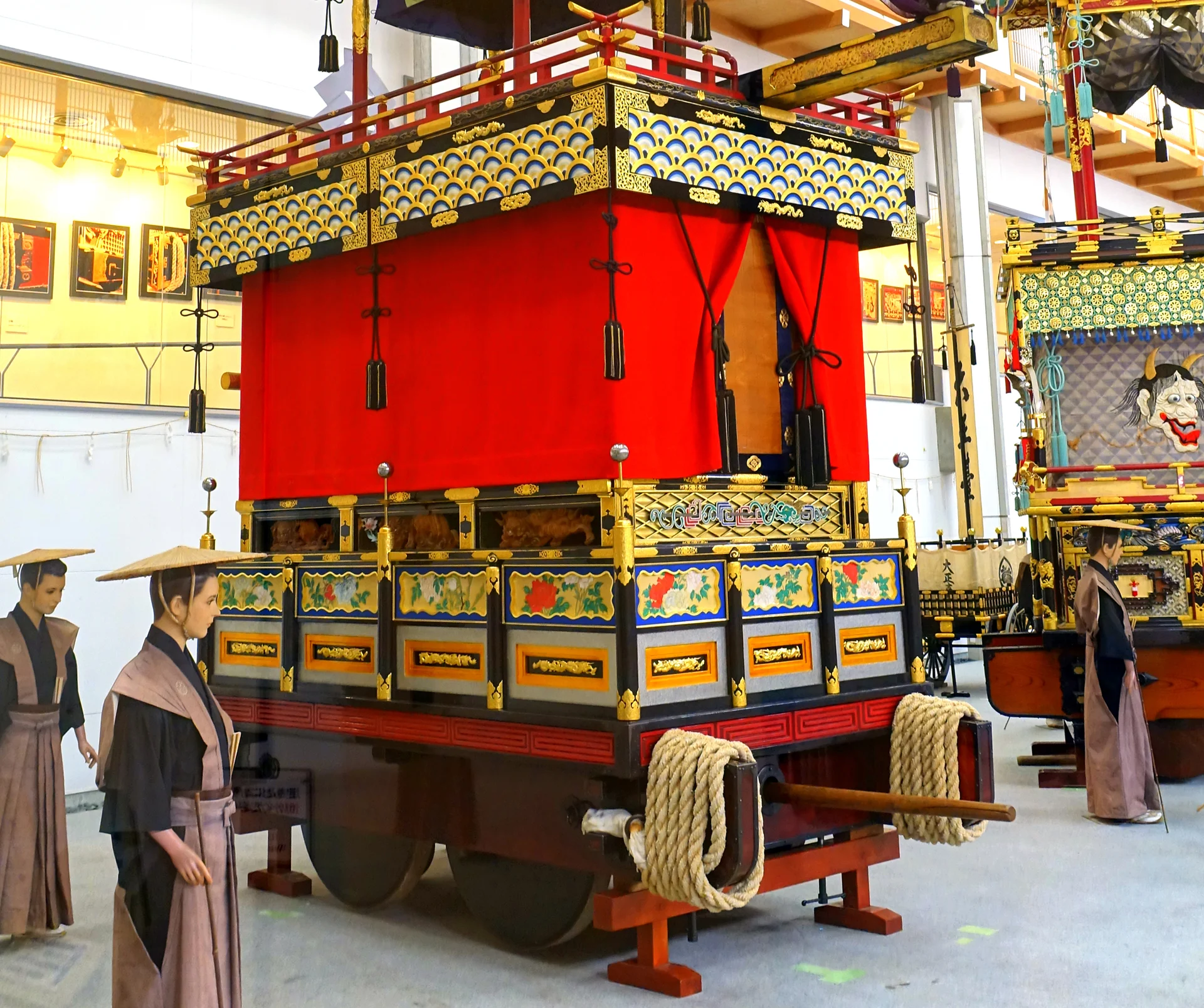
Takayama Yatai Kaikan: The floats of Japan's most beautiful festival, year-round
Four stories of black lacquer and gold, topped with silk puppets frozen in their final performance. In this grand hall with thirty-foot ceilings, the floats from the Takayama Autumn Festival stand behind glass, as impressive as they are during the October processions.
Why visit the Takayama Yatai Kaikan?
The Takayama festival only occurs four days a year: April 14-15 in the spring and October 9-10 in the autumn. Each edition draws 200,000 visitors who crowd the narrow streets of the old town. For those unable to time their trip with these specific dates, the Takayama Yatai Kaikan offers a rare alternative: the chance to see the original floats, which have been paraded for three centuries, in a quiet setting ideal for studying the intricate details.
The Takayama festival has been on the UNESCO Intangible Cultural Heritage list since 2016. The eleven floats of the autumn festival are all designated as Important Cultural Properties of Japan. The museum displays four at a time, rotating the exhibits three times a year in March, July, and November.
The art of yatai: three centuries of accumulated skill
The displayed floats date back to the 17th and 18th centuries. Their construction involved every trade in the Hida region, which has been famous for its master carpenters since the Nara period. Woodcarvers, lacquer artists, blacksmiths, and embroiderers worked in friendly competition between the city neighborhoods. The result is an accumulation of techniques: phoenix and dragon carvings on gilded wood, scarlet lacquer panels, mother-of-pearl inlays, embossed metal ornaments, and embroidered silk drapes.
The Hoteitai and its karakuri puppets
Among the floats on display, the Hoteitai is the most spectacular. It carries three mechanical puppets made of wood, silk, and brocade: Hotei, the pot-bellied god of fortune, and two child acrobats. During the festival, these dolls perform flips on trapeze bars before jumping onto the god's shoulders. The mechanism requires 36 silk strings and the coordination of 9 puppeteers hidden inside the float. The provided audio guide details the operation of these automatons.
The largest mikoshi in Japan
The hall also displays an octagonal mikoshi (portable shrine) weighing 2.5 tons. This portable sanctuary once required 80 bearers to carry it through the streets. Its massive frame and gilded ornaments earn it the title of the largest mikoshi in the country.
The Sakurayama Nikkokan: An unexpected bonus
Your admission ticket includes access to the Sakurayama Nikkokan, located in the adjacent building. This hall presents a 1/10th scale model of the Toshogu Shrine of Nikko, built for the shogun Tokugawa Ieyasu. The work took 33 artisans 15 years to complete during the Taisho era. The 28 buildings are reproduced with obsessive precision: the Yomeimon gate, the Three Monkeys pavilion, and the five-story pagoda. A historical link connects this to Takayama: Hidari Jingoro, the legendary sculptor said to have crafted the Nikko ornaments, reportedly hailed from this region.
Pro tip: The entrance to the Nikkokan looks like a closed door and there is no staff checking tickets at that specific point. Push the door open. The museum is indeed open and included with your admission.
Before or after your visit: the shrine and the yatai gura
The museum sits within the grounds of the Sakurayama Hachiman-gu shrine, the spiritual heart of the autumn festival. A walk through the paths lined with stone lanterns is worth a few minutes. On clear days, the red of the torii gates contrasts with the green of the Japanese cedars.
As you head back toward the city center, watch the facades of the houses. Some hide yatai gura, the tall-doored warehouses where the city's other floats sleep. These narrow sheds with thick walls maintain the darkness, temperature, and humidity necessary to preserve the lacquered wood. If a door is slightly ajar, you might catch a glimpse of a float waiting for the next festival.

Every year in October, there is a local festival called the Takayama Matsuri. It is one of the most famous in Japan. But if you are not there at that time, you can still enjoy the atmosphere. This gallery actually exhibits the floats that parade during the festival. They are colorful and spectacular. A really beautiful visit!