
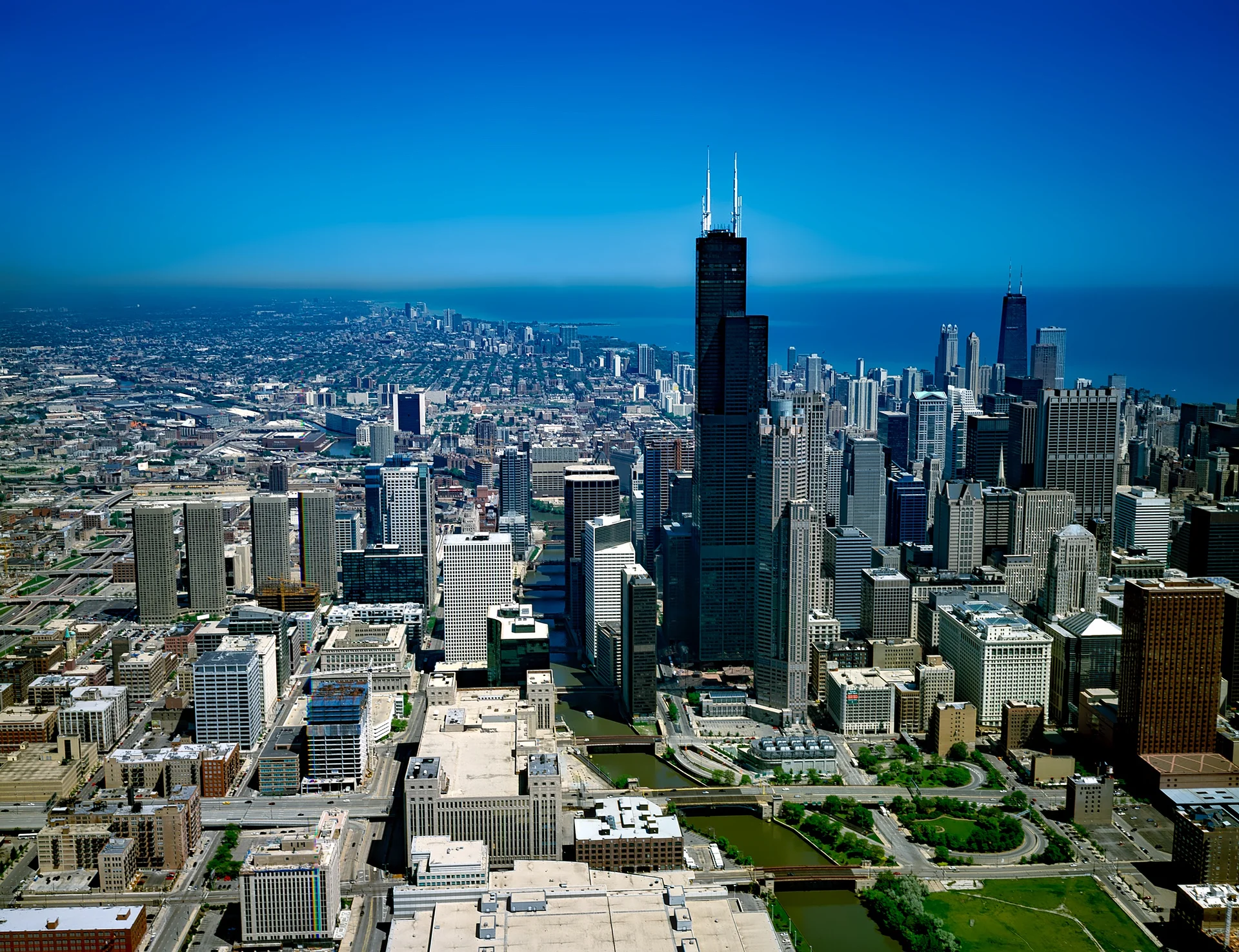
The Willis Tower, when Chicago reinvented the art of touching the sky
The elevator takes exactly 60 seconds to reach the 103rd floor. During this minute, an onboard screen matches the cabin speed, pointing out city landmarks as you pass them. Then the doors open, and Chicago sprawls out beneath your feet: the perfect grid of streets, the deep blue of Lake Michigan, and skyscrapers reduced to the size of matchboxes.
On a clear day, your view stretches across four states.
Why visit the Willis Tower?
When the tower was completed in 1973, it snatched the title of world's tallest building from the Empire State Building, which had held it for 40 years. It kept that record for a quarter-century. This was no developer's whim. It was born from a very practical need. Sears, Roebuck and Company, then the world's largest retailer, needed to consolidate its 350,000 employees under one roof.
Engineer Fazlur Rahman Khan, from the firm Skidmore, Owings & Merrill, devised a novel structural system for the task, the bundled tube, consisting of nine square steel tubes assembled in a 3x3 matrix.
This invention reduced the amount of steel required to just 33 pounds per square foot, compared to 42 for the Empire State Building. The idea arrived during lunch at the Chicago Club. Architect Bruce Graham grabbed a pack of cigarettes, pulled several out to different heights, and asked Khan if this was what he was proposing. The stepped silhouette of the tower, with its successive setbacks, was born.
The Skydeck and The Ledge: the void beneath your feet
The highest observatory in the United States
The Skydeck occupies the 103rd floor, 412 meters above the ground. It is the highest public vantage point in the country, nine floors higher than the 360 Chicago observation deck at the former Hancock Center. On a clear day, the view extends about 80 kilometers and covers Illinois, Indiana, Wisconsin, and Michigan.
Before boarding the elevator, an interactive museum exhibit traces the history of Chicago through its architecture, food, neighborhoods, and music scene. This recent addition, unveiled during the $500 million renovation completed in 2022, turns the wait into a discovery and is worth the time.
Walking into the void on the 103rd floor
The Ledge consists of four fully glass-enclosed balconies that extend 1.3 meters beyond the facade. Three layers of half-inch glass, bonded into a single panel, separate your feet from the void. Each box weighs 3.4 tons. The time allotted per group is 60 to 90 seconds, but you can jump back in line as many times as you like. A tip: turn off your camera flash to avoid reflections on the glass.
Friendly tip: time slots fill up quickly in the summer. Book your tickets online and aim for the 9:00 a.m. opening on weekdays for minimal wait times. A night visit, when the skyline sparkles, offers a completely different atmosphere and much shorter lines.
Catalog: the tower also has its feet on the ground
The renovation led by Blackstone was not limited to the Skydeck. At the base of the tower, Catalog features 300,000 square feet of restaurants and shops across five levels. The name pays homage to the Sears mail-order catalog, which revolutionized American commerce at the start of the 20th century. You will find Shake Shack, Tortazo by chef Rick Bayless, Do-Rite Donuts, Sweetgreen, and a food hall managed by Urbanspace.
At the top of Catalog, a 30,000-square-foot landscaped terrace is open to the public. Three beehives house 60,000 bees. The space hosts summer concerts and offers a unique perspective on the base of the tower, where the 110 floors shoot vertically straight above your head.
Opening hours
The last entry is 30 minutes before closing.
Hours are reduced from October to March, running from 10:00 AM to 8:00 PM.
The Catalog shopping center is generally open from 7:00 AM to 11:00 PM (hours vary by individual store).
*Information subject to change

Est-ce que cela donne le vertige ?
Est-ce qu'on voit l'extérieur à travers des baies vitrées allant du sol au plafond, ou à travers des fenêtres ?