
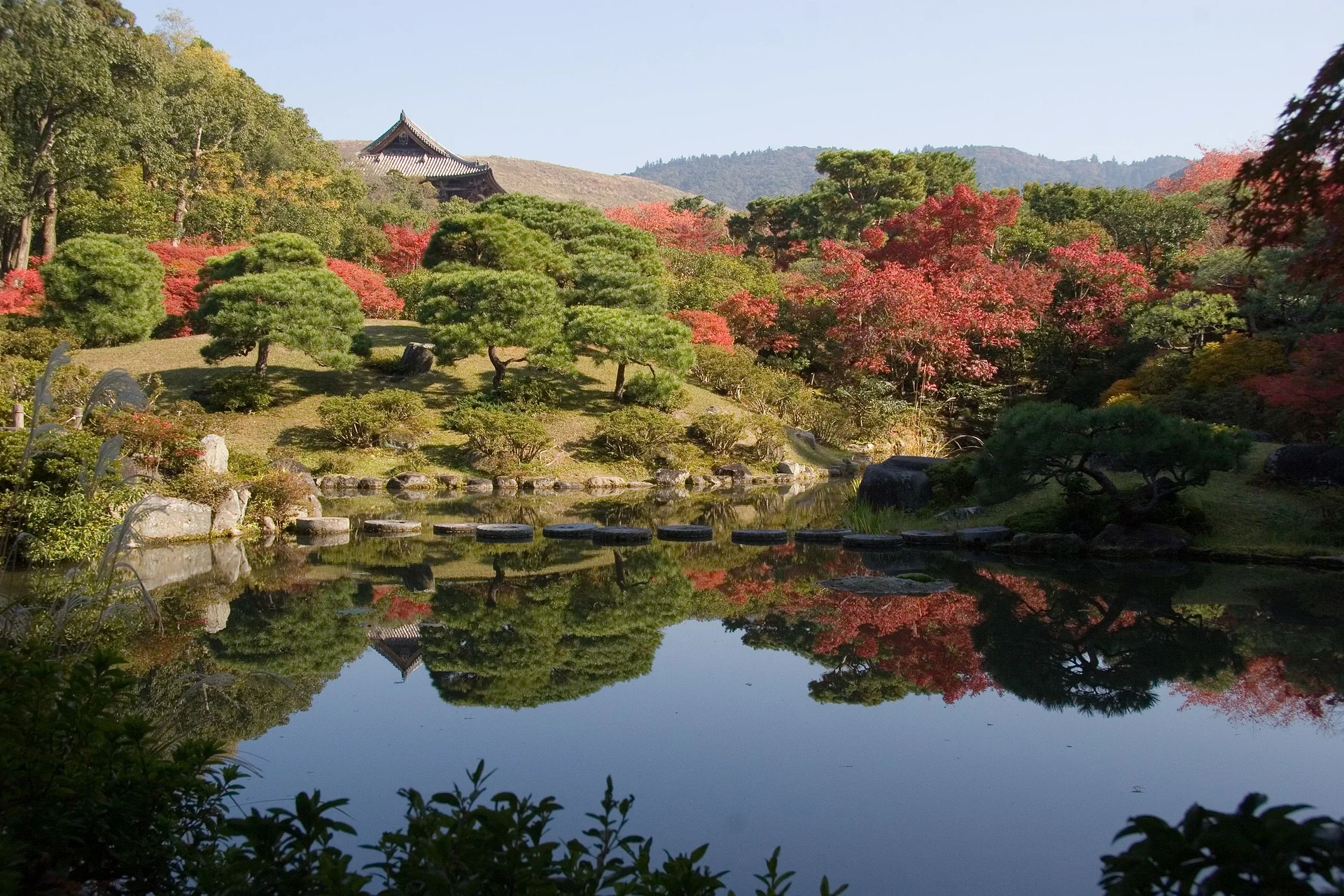
Isuien, the only stroll garden in Nara where temples frame the view
Your eyes follow the central pond, drift toward the trees, and then, without warning, the roof of the great gate of Todai-ji rises on the horizon, framed by the canopy as if placed there by design. This is no accident. It is shakkei, the art of borrowed scenery, brought here to its most accomplished form.
Why visit Isuien Garden?
Just steps away from the chaos of the deer park, behind a quiet side street you would not find by chance, lies a 1.35 hectare (about 3.3 acre) garden that many visitors to Nara leave without seeing. It is the only kaiyushiki teien (stroll garden) in the city, designated since 1975 as a site of exceptional scenic beauty.
Its history is itself a form of borrowed landscape. Two gardens created in different eras by different merchants were merged in 1939 by Jyunsaku Nakamura to form a single site, later expanded in 1958 by the Neiraku Art Museum, which his family had established.
Two gardens, two atmospheres
Maeniwa, the front garden
The western section, which is the oldest, dates back to the 17th century. The paths are narrow, lined with moss and the sound of trickling water. Low-hanging branches create a dense, almost private enclosure. The atmosphere is intentionally meditative, much like the tea gardens of the Edo period.
Kotei, the rear garden
The eastern section, completed in 1899, changes the register entirely. The space opens onto a large pond. It is from the surroundings of the Hyoshintei tea pavilion, on the west side of the basin, that the shakkei effect is most powerful. The Wakakusa, Kasuga and Mikasa mountains form a continuous backdrop with the roof of the Nandaimon gate of Todai-ji. Trees from the Himuro Shrine to the south and Todai-ji to the north erase the intervening space, rendering the scene perfectly unified.
Pro tip: Find a spot for a few minutes facing the Kotei pond, with your back to the path. The best framing is from the northwest bank, near the Hyoshintei pavilion. In autumn, the red maples enhance the composition, and it is, in our view, one of the most masterfully executed views in the entire Kansai region.
The Neiraku Art Museum, included in your ticket
At the entrance to the site, the Neiraku Art Museum displays over 2,000 pieces: ancient Chinese bronzes, Korean Yi dynasty ceramics, mirrors, seals, and in season, paintings by the master Tanomura Chikuden (1777-1835), some of which are classified as Important Cultural Properties of Japan. Access is included with your admission.
The collections cannot all be exhibited at once. The museum rotates its displays regularly, which means two visits just a few months apart will reveal different works.
The tea houses
Four tea pavilions dot the site:
- Sanshutei, in the front garden, offers light meals, matcha, and traditional sweets. It is the only dining area in the garden and is open during visiting hours.
- Hyoshintei, Seishuan and Teishuken are historical pavilions that punctuate the stroll.
What makes the difference
- The shakkei of the Kotei is a rare demonstration of Japanese landscape composition mastery
- The Neiraku Art Museum is included at no extra cost, a serious Asian collection often ignored by visitors
- English-speaking volunteer guides are often present at the entrance
- Very few crowds compared to the major neighboring temples, even in high season
Things to keep in mind
- The stepping stones are uneven, making the path difficult for those with limited mobility, and wheelchairs cannot enter
- The garden closes for the last third of September for maintenance, so check exact dates before planning
- No parking on site
Indicative ticket prices (garden + Neiraku Art Museum)
| Category | Price |
|---|---|
| Adult | 1,200 JPY (about $8) |
| High school / University student | 500 JPY (about $3.50) |
| Middle / Elementary school student | 300 JPY (about $2) |
| Visitors with disabilities | 500 JPY (about $3.50) (caregiver free) |
| Groups (15 people or more) | 1,000 JPY (about $7) / person |
Prices are subject to change.
Opening hours
How long for this activity
*Information subject to change

A vast natural space that you reach via a path that feels almost secret. I recommend going in the morning to enjoy the calm and the clarity of the water. You will find all the charm of a traditional Japanese garden here. Another plus is the view of the landmarks, especially Todaiji, nearby. A perfect place to soak up the serene atmosphere of Nara.