
Visiting Place Stanislas
In Nancy, you will find a magnificent 18th-century square that is a designated UNESCO World Heritage site. While its footprint is modest compared to other grand plazas in France, it remains unique for a host of reasons.
A history dating to the 18th century
During the 17th century, a vast esplanade separated the old town from the new town built by Charles III. Because the old town remained ringed by its original fortifications, moving between the two districts was chaotic and difficult.
In 1751, Duke Stanislas Leszczynski, the father-in-law of Louis XV, ordered the construction of the square. It was intended to honor his son-in-law and to help the locals grow accustomed to their future sovereign.
Understanding the symbolic power of the site, Stanislas aimed to consolidate administrative offices and entertainment venues within this central hub of the city.
Connecting the old town and the new town, but where?
The project faced several hurdles in finding a permanent location. The looming threat of war led military commanders to demand that Nancy remain as heavily fortified as possible, but when an alternative site was proposed, the city merchants fought it tooth and nail.
Eventually, a compromise was reached, though Stanislas took some creative liberties with the plan. The project was initially entrusted to Jean-Nicolas Jennesson, but his design was considered too conventional, leading to his replacement by Emmanuel Héré. Construction began in March 1752 and lasted three and a half years.
A square that defines Nancy
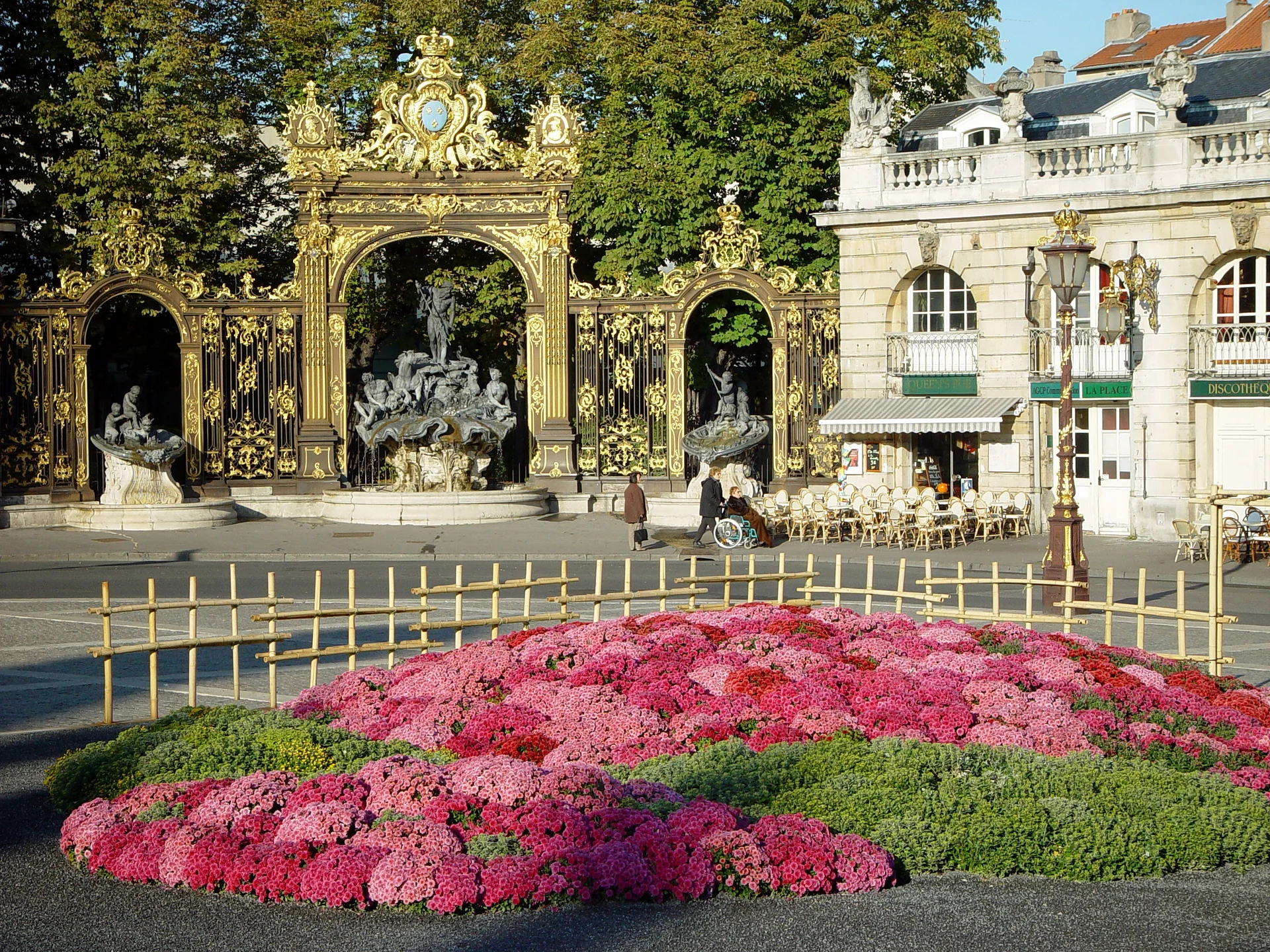
The architecture and layout of the square are striking. It is framed by six wrought-iron gates embellished with gold leaf, its center features a statue of Duke Stanislas dating back nearly two centuries, and a triumphal arch separates it from the Place de la Carrière.
The square is also lined with notable buildings such as the Hôtel de Ville (City Hall), the Grand Hôtel de la Reine, the Pavillon Jacquet, the Opéra-théâtre (Opera House), and the Musée des Beaux-Arts (Museum of Fine Arts).
It is, without a doubt, one of the most beautiful pedestrian squares in France.

I was taken by surprise by the massive size of this square, which is a real crossroads surrounded by lovely golden gates. Two impressive fountains complete the ornamentation. With the city hall, the Museum of Fine Arts, and the Opera, the architectural ensemble is magnificent. It is the ideal spot to have a drink on a terrace. In the extension of the square, do not miss the Arc de Triomphe and the Parc de la Pépinière.