
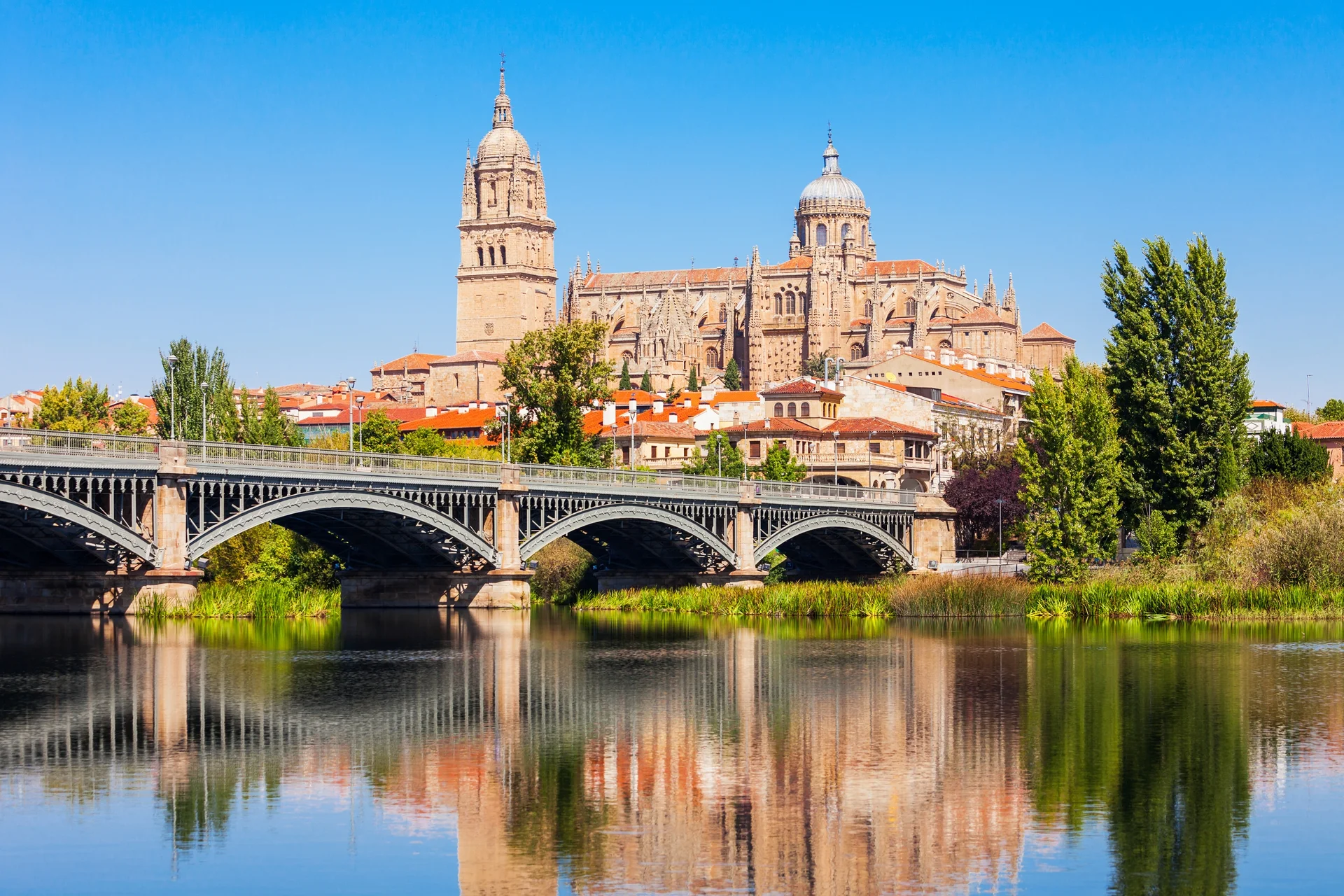
Salamanca Cathedral: 900 years of architecture, and an astronaut in stone
On the western facade of the Catedral Nueva, among the stone angels and saints, an unexpected figure has been watching passersby since 1992: an astronaut in a full spacesuit, carved during an exterior restoration by a playful master stonemason.
It is perhaps the best introduction to a landmark that refuses to be frozen in time.
Why visit Salamanca Cathedral?
Salamanca actually contains two fused cathedrals: the old 12th-century Romanesque Catedral Vieja, and the late Gothic Catedral Nueva, which broke ground in 1512 at the request of the Catholic Monarchs. Construction wrapped up in 1733, making it one of the final grand expressions of Spanish Gothic architecture. The site's real charm lies in this seamless coexistence, allowing you to walk right from one nave into the other without leaving the building.
Designated as a World Heritage site by UNESCO as part of Salamanca's historic center, the cathedral pulls in roughly 350,000 visitors a year. It remains an active spiritual hub, hosting 495 Eucharistic celebrations, 72 weddings, and 36 free concerts in 2024 alone.
The Catedral Vieja and its Byzantine altarpiece
The Romanesque section holds the oldest masterpieces. Its Torre del Gallo, topped by a signature scale-tiled cupola, remains the defining silhouette of the city skyline. Inside, the main altarpiece by the painter Nicolás Florentino (15th century) strikes you with its dense storytelling. Exactly 53 panels unfold the life of Christ and the Virgin, capped by a Last Judgment awash in ocher and lapis lazuli.
The Gothic cloister is worth slowing down for. The Capilla de Talavera preserves one of the rare instances of the Mozarabic rite still performed in Spain. Light cuts through at an angle, casting patterns across the stone slabs that medieval pilgrims might have taken for signs from above.
The Catedral Nueva: late Gothic on a grand scale
The central nave of the Catedral Nueva overwhelms with its sheer verticality. Fan vaults soar to 33 meters, and clustered piers resembling petrified tree trunks absorb the colored light pouring through flamboyant stained glass. An 18th-century Baroque organ, ranking among the largest in Spain, looms over the transept.
In October 2024, a contemporary piece joined the permanent collections: "Jesus as the cornerstone of humanity", a massive 5-meter canvas featuring 109 figures, hung in the epistle nave. Its presence deliberately clashes with the historic surroundings, and that is precisely the point.
Friendly tip: The tower tour via the Ieronimus experience just added a brand-new space: the bajo cubierta, meaning the hidden zone between the vaults and the roof of the Catedral Nueva, which is now open to the public. An immersive videomapping show plays across the stone vaults with spatialized sound. It is the big addition of 2025, and well worth pairing with the standard visit.
Ieronimus: climbing the towers
Accessing the cathedral towers and rooftops through the Ieronimus route stands out as one of the most striking experiences in Salamanca. You enter through the Torre Mocha, wander through exhibition rooms set up in former jail cells and a caretaker's apartment, and finally step out onto the terraces 110 meters up. From there, the city stretches out in every direction, showing off the ocher rooftops, the Tormes River, and the university in the distance.
Look out for these highlights during the climb:
- The Sala del Alcaide, featuring Renaissance instruments and musical scores, opening a window back into the Catedral Vieja
- The walkway suspended between the two cathedrals, bringing you right past the dome of the Torre del Gallo
- The new bajo cubierta space with its light and sound installation projected across the Gothic vaults
- The upper terrace, which operates as the absolute best viewpoint in the city
Night tours also run on Fridays and Saturdays, featuring guided routes with sound and light effects that offer a completely different atmosphere from the daytime visit.
Standout highlights
- Two cathedrals for the price of one admission, packing nine centuries of history into a single spot
- The altarpiece in the Catedral Vieja, ranking among the most narrative-driven in Spain
- The expanded Ieronimus route featuring the hidden attic space between the vaults and roof
- The Churrigueresque facade, a sculptural tour de force best viewed at sunset
- Reasonable ticket prices compared to other major historic sites in Spain
Things to keep in mind
- The Ieronimus climb involves narrow, steep stairs, making it tough for visitors with limited mobility
- Heavy crowds during peak summer months (July and August) mean you should book tickets online at least a day ahead
- Certain areas may close temporarily during religious services and ceremonies
Estimated admission prices
| Category | Rate |
|---|---|
| Standard admission (Catedrales) | $12* |
| Reduced rate I (seniors 65+, students, large families) | $11* |
| Reduced rate II (ages 7-16, school groups) | $7.90* |
| Reduced rate III (job seekers, children from large families) | $6.80* |
| Groups (min. 20 people with an official guide) | $7.90*/pers. |
| Free | Diocese residents, children under 7, visitors with 65%+ disability rating |
| Ieronimus, individual daytime tour | $4.50* |
| Ieronimus, group daytime tour (min. 20 people) | $4*/pers. |
| Ieronimus, guided night tour | $12* |
| Ieronimus, children under 10 | Free |
Prices are subject to change. Cathedral admission and Ieronimus access require separate tickets, which can be purchased individually or online through the official websites.
Opening hours
Salamanca Cathedral (cultural visit):
Mon to Sat 10:00 AM to 8:00 PM (last entry 7:15 PM)
Sun 10:00 AM to 6:00 PM (last entry 5:15 PM)
Ieronimus (tours):
Jan-Feb 10:00 AM to 6:00 PM (last entry 5:00 PM)
Mar-Dec 10:00 AM to 8:00 PM (last entry 7:00 PM).
Ieronimus night tours: Fri and Sat (hours vary by season).
Closed Dec 25 and Jan 1.
How long for this activity
*Information subject to change

I discovered the Salamanca Cathedral during a bike trip. I didn't go inside, but it really left an impression on me just from the outside.
The architecture is impressive, with so many details to look at on the facade.
Arriving by bike, you discover it little by little, which really adds to the wow factor.
I also loved wandering through the old cobblestone streets of Salamanca and looking for the famous little sculptures (especially the famous frog) visible on some of the facades.