
Morocco as it was, captured on glass and paper: the photography museum of the medina
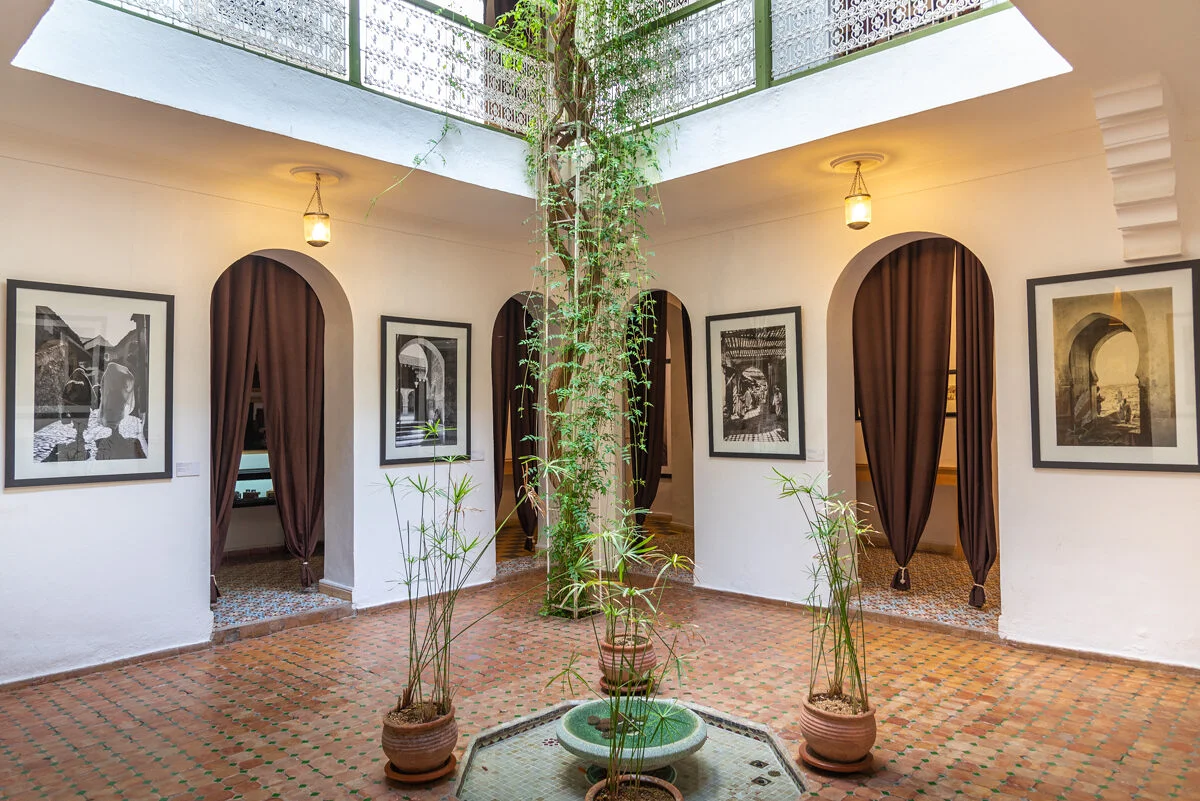
A 19th-century funduq (traditional inn), a courtyard built of rammed earth, and light filtering down from the open sky. Before you even look at your first photograph, the building tells its own story. Patrick Menac'h, a collector from Paris, and Hamid Mergani, a local enthusiast from Marrakech, had the idea to bring their personal archives together here, inside this restored caravanserai in the medina.
Why visit the Maison de la Photographie?
Opened in 2009 near the Medersa Ben Youssef, the collection now holds over 10,000 pieces including original photographs, glass plates, autochromes, postcards, newspapers, and documentary films, all covering the period from 1879 to 1960. Regular donations, such as those from Daniel Chicault or Ana Muller, have significantly expanded the archives over the years.
What makes this place valuable is the documentary ambition behind it. It is not about celebrating the big names of world photography. It is about showing Morocco exactly as it was seen by anonymous photographers, librarians from Tangier, Hungarian ethnologists, or Belgian documentarians, all of whom were captivated by the country's extraordinary human diversity.
A three-story journey through time
Ground floor: portraits and origins
The rooms surrounding the courtyard are generally dedicated to portraits. You will find the oldest shots in the collection here, including a rare piece: a portrait of Hamidou Laambre, a sub-Saharan servant photographed in 1885 by a librarian from Tanger (Tangier) named Arevalo. You will also see faces of tattooed women from mountain tribes, notables from Fes, and farmers from the High Atlas.
First floor: daily life and master photographers
This is where the collection gains depth. The works of Hungarian photographer Nicolas Muller, active in the 1940s, sit alongside those of Belgian photographer Charles Henneghien, whose series on 1960s Morocco possess a striking documentary power. Thematic exhibitions change every six to twelve months, which is why regular visitors keep coming back.
Between floors: the 1956 documentary
In a small room off the staircase, a film plays on a loop. It is Daniel Chicault's documentary on the High Atlas, shot in 1956. You only need a few minutes to understand just how little certain mountain landscapes have changed. We recommend you do not walk past it without stopping.
Pro tip: Your entry ticket also grants access to the Musée de la Musique de Marrakech (Marrakech Music Museum). Tickets are only available on-site, payable by cash or credit card. Online booking is not an option. The crowds are much thinner here than at the Jardin Majorelle. Even at 11 a.m. on a Wednesday, you might find yourself with the rooms all to yourself.
The rooftop: one of the best views in the medina
The climb to the terrace holds one final surprise. The rooftop cafe, perched among the highest points in the medina, offers a 360-degree panorama of terracotta rooftops, minarets, and, on a clear day, the snow-capped peaks of the Haut Atlas (High Atlas). Order a mint tea or a fruit juice and watch the labyrinthine alleys below. It is a simple moment, but one that sticks with you.
What sets this museum apart
- A rare and cohesive photographic archive focused on the human side of Morocco from 1879 to 1960
- A historic building where the architecture is part of the experience
- Much less crowded than the major attractions of the medina
- Terrace with a panoramic view of the rooftops and the High Atlas
- The combined ticket with the Music Museum is a real bonus
Points to keep in mind
- No online ticketing: payment must be made on-site
- The location is tricky to find on foot in the medina alleys: have your GPS ready or be prepared to ask for directions
- The captions are brief; information folders available in the rooms help, but they require you to take the time to read them
Opening hours
How long for this activity
*Information subject to change

Located in a restored riad, this museum offers a superb panorama of the history of Marrakech.
Here, black and white prints cover the walls of the beautiful building.
The photos show the evolution of the city, admire the medina at the beginning of the 20th century.
I especially loved the portraits of the locals, in short a wonderful place.