
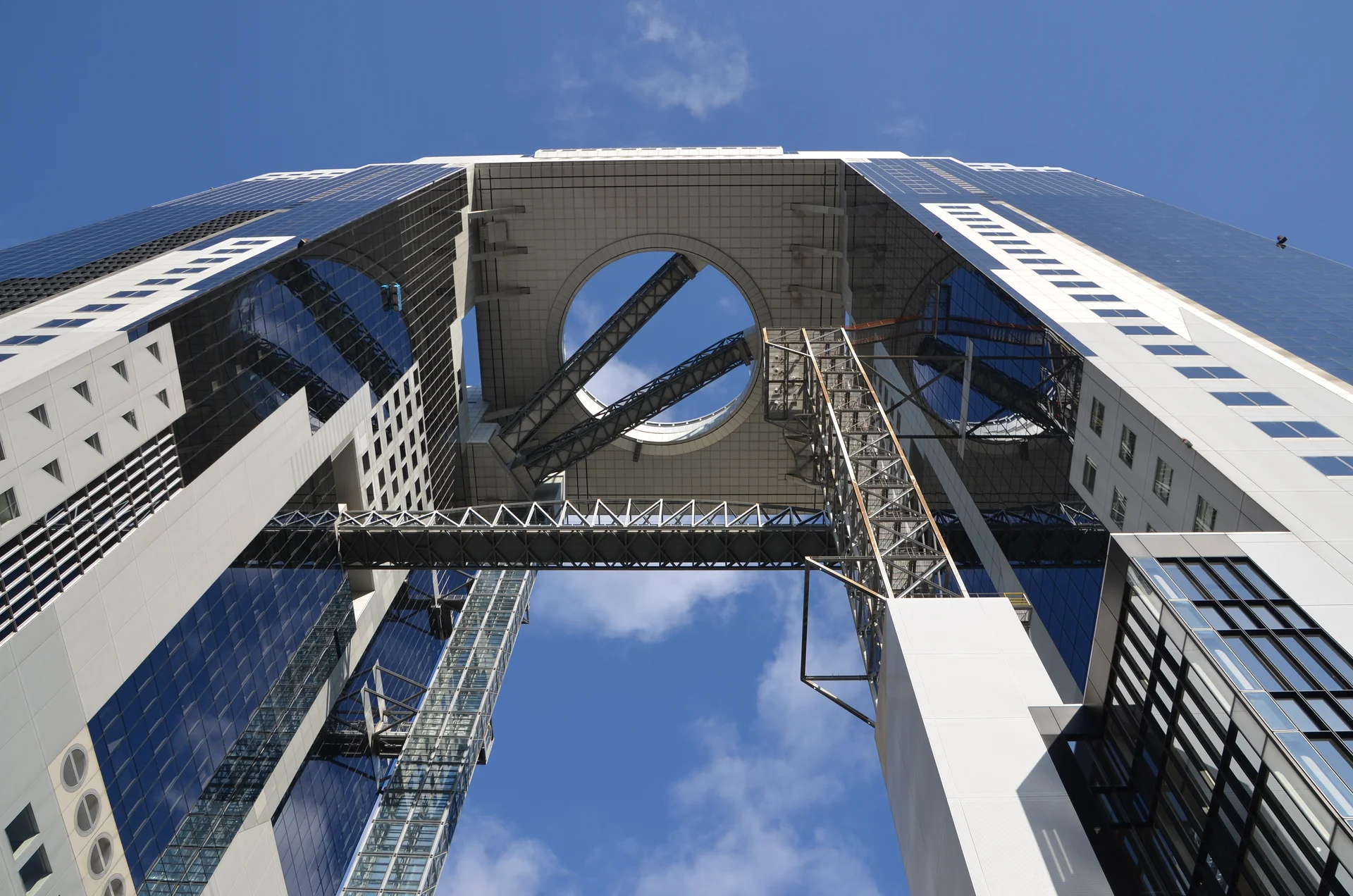
Umeda Sky Building, where Osaka touches the sky while staying grounded
The wind whips against your face at 173 meters (567 feet) up, and the city of Osaka spreads out to the horizon under an open sky. No glass, no walls. The roof terrace of the Kuchu Teien Observatory is one of the few open-air observation decks atop a Japanese skyscraper. This raw, airy sensation is exactly what separates the Umeda Sky Building from every other viewpoint in the city.
Why visit the Umeda Sky Building?
Designed by architect Hiroshi Hara and completed in 1993, this 40-story double skyscraper was conceived as the centerpiece of a futuristic district dubbed Shin Umeda City. The original project called for four towers connected to one another, but budget constraints following the economic bubble limited the plan to two.
The result is striking. In 2008, the British newspaper The Times ranked it among the 20 most remarkable buildings in the world, alongside the Taj Mahal and the Sagrada Familia.
The building draws approximately 2.5 million visitors annually. Its architecture, open-air observatory, and retro basement make it a multifaceted experience that goes well beyond a simple urban panorama.
The ascent: a show in itself
The experience begins at the 3rd floor, the starting point for the climb to the top. A glass elevator propels visitors to the 35th floor. From there, a transparent escalator suspended in the air connects the two towers between the 35th and 39th floors. The tubular glass structure literally floats above a central void, offering a plunging view of the ground far below. Those with a fear of heights will want to grip the handrail tightly, while everyone else will be reaching for their phones.
At the 39th floor, the ticket office grants access to the final two levels and the roof. The 40th floor houses an indoor glass-enclosed space featuring the Cafe SKY 40, where you can sip coffee roasted on-site while facing a 35-meter (115-foot) glass counter. The mirrored ceiling creates a dizzying reflection effect that many visitors use for memorable photos.
The rooftop and the Lumi Sky Walk
The 360-degree view
The circular roof, completely exposed to the elements, offers a full panorama of Osaka. On a clear day, your view stretches to the Rokko mountains to the west, Osaka Bay to the south, and the peaks of Mount Ikoma to the east. The floor is embedded with phosphorescent stones that illuminate under black light once night falls, turning the circular path into a sort of Milky Way beneath your feet.
Sunset: the prime time
Regulars know that the best time to visit is 30 to 45 minutes before sunset. The sky shifts to a deep blue, the city lights turn on gradually, and the transition between day and night offers the best of both worlds. The Japanese call this moment the magic hour. Arriving early ensures you can snag a spot along the circular railing, especially on weekends.
Friendly tip: hats and umbrellas are prohibited on the roof due to the wind. Bring an extra layer, even in summer. The breeze at this altitude can be surprising. The Osaka e-Pass provides free entry before 3:00 PM and a 10% discount after that, making it one of the best ways to get value from the pass.
Takimi Koji: a trip back in time at the basement level
Under the towers, a different world awaits. Takimi Koji is an underground street that recreates an Osaka alleyway from the 1920s and 1930s with obsessive attention to detail. You will find irregular cobblestones, tile roofs, soft-lit lanterns, vintage advertising posters, round mailboxes, and even a Midget three-wheeled truck parked in a corner. About 20 restaurants line these lanes, serving local specialties like kushikatsu (deep-fried skewers), okonomiyaki (savory pancakes), or katsudon (pork cutlet bowls).
The area works particularly well in the evening, when the low lighting and retro Japanese music emphasize the atmosphere. It is an ideal complement to the observatory visit, and entry is free.
The museum and gardens
On the 27th floor of the west tower, the Koji Kinutani Tenku Art Museum displays works by Japanese painter Koji Kinutani through 3D and virtual reality installations. A combined ticket with the observatory costs 2,500 JPY instead of 3,300, saving 800 JPY.
At the base of the towers, the Shin Satoyama gardens recreate a Japanese countryside landscape with miniature rice paddies, vegetable patches, and shaded paths. The contrast between this fragment of nature and the futuristic lines of the building summarizes Hara's intent well, which is to make dense city life and natural tranquility coexist.
Opening hours
| Monday | 09:30-22:30 |
|---|---|
| Tuesday | 09:30-22:30 |
| Wednesday | 09:30-22:30 |
| Thursday | 09:30-22:30 |
| Friday | 09:30-22:30 |
| Saturday | 09:30-22:30 |
| Sunday | 09:30-22:30 |
Last admission at 10:00 PM. Special closure on January 1st from 6:00 AM to 8:00 AM. The rooftop may close without notice in the event of strong winds or thunderstorms.
*Information subject to change

Magnificent structure, a pleasant moment despite my fear of heights!
Ranked among the most beautiful towers in the world by the Times, you can see why. Partially free (up to the 40th floor, I believe).