
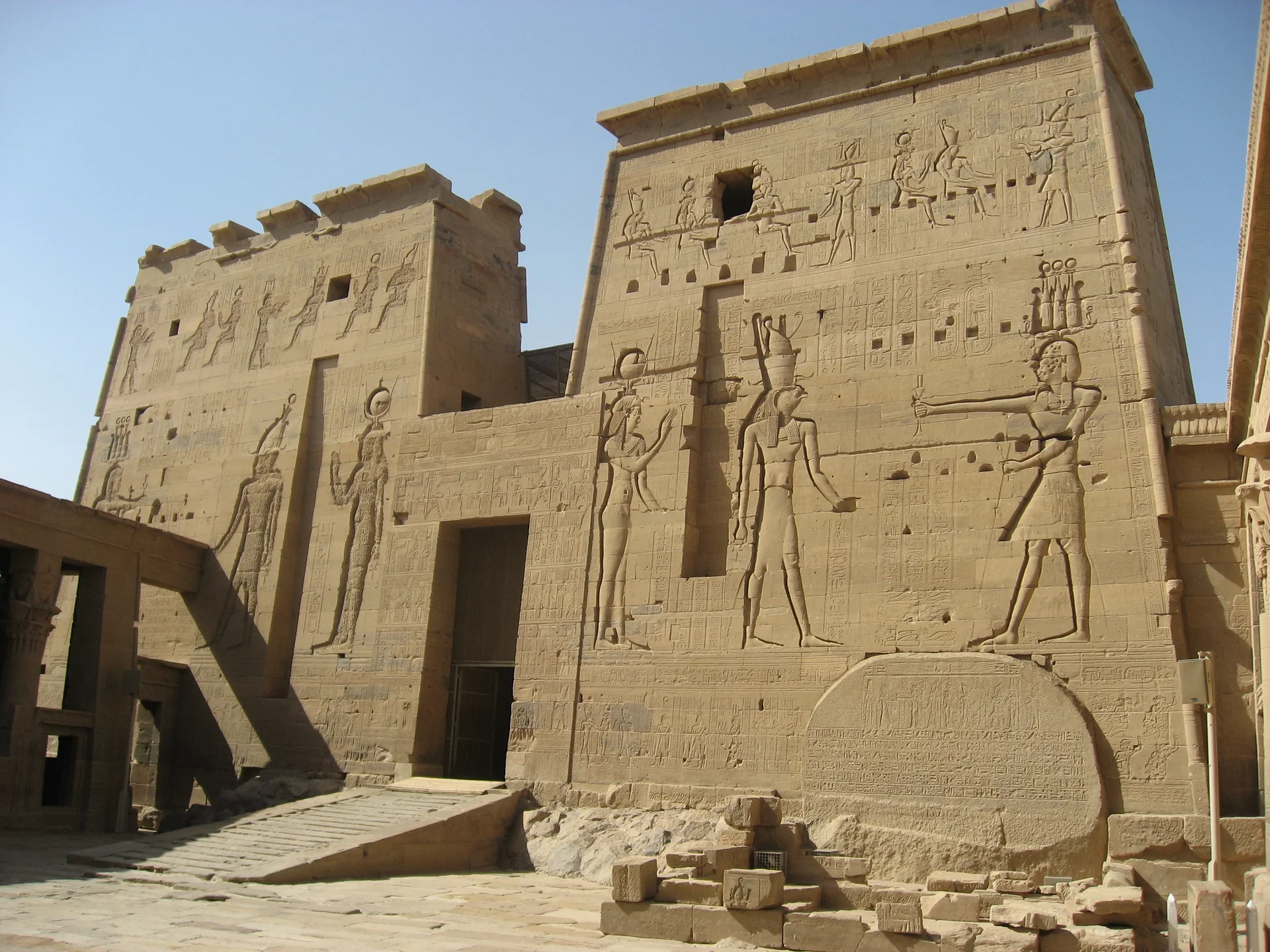
Visiting Philae Temple
Often called the Temple of Isis, the sanctuary on the island of Philae was partly built under the reign of Nectanebo I, one of the final pharaohs. Its history is one of resilience against the odds. It faced constant challenges, including a closure order from Emperor Justinian in 530 AD. Later converted into a Coptic church, it was eventually submerged by the waters of the Aswan High Dam. Faced with permanent destruction, the structure was dismantled in 1974 and relocated to the neighboring island of Agilkia. This rescue mission allows visitors today to admire one of the jewels of the 4th century BC. This invaluable treasure of Ancient Egypt is located near Aswan and includes a complex of monuments, some of which date back to the Greco-Roman period.
The Final Hieroglyphs
The site is accessible only by water taxi, but the magic of Philae Temple begins the moment you step onto a felucca. Dense vegetation at the water line provides a green frame for the sanctuary. A staircase leads to a vast paved esplanade, designed as a processional path lined with impressive rows of columns. The capitals, some in the form of papyrus stalks, enhance the architectural beauty. The carvings primarily depict the legendary love story between Isis and Osiris.
The entrance features a first pylon with carvings of the goddess alongside Hathor and Horus. It leads to the birth house where the birth of Horus was once celebrated. At the second pylon, you can spot Ptolemy VI. In the pronaos, the space directly in front of the temple, original paintings still cling to the ceiling. It opens into several chambers, including a large hypostyle hall and the naos, where bas-reliefs show the king offering gifts to Hathor. It was in this major religious center that the final hieroglyphs were carved.
Further on stands the superb Kiosk of Trajan. It is remarkably well-preserved, featuring fourteen columns topped with ornate capitals. You can distinguish the cartouche of Emperor Trajan and carvings of Hathor, as well as scenes of ritual dance. It serves as an ode to joy, marking the location where ceremonies took place whenever Isis left or returned to the island. The remains of the Pavilion of Nectanebo, the temple dedicated to Hathor, and the Gate of Hadrian complete a site that is both historically significant and deeply symbolic.

The Philae Temple is located in the area around Aswan. The dam is actually not far away, either. It was our final stop during our trip to Egypt.
Our guide surprised us with a night visit, with soft lighting. It gives this magnificent temple, situated in the middle of the water, a very special atmosphere. You arrive by boat.
In all objectivity, Philae is neither the biggest nor the most beautiful nor the most impressive in the country, but its location on the island gives it immense charm.