
Visiting Borobudur
Borobudur sits on the island of Java in Indonesia. Tucked into the Kedu plain, the area is framed by the Menoreh mountain range and the volcano Merapi. These peaks served as a spiritual sanctuary for Buddhist monks for centuries, leading to a high density of temples in the region. Among them is the largest Buddhist monument on the planet, the Borobudur temple, built in the 9th century during the Sailendra dynasty. After being abandoned around 1100 and left to be reclaimed by volcanic ash and jungle growth, the temple was rediscovered in the early 19th century by Java governor Thomas Stamford Raffles.
The world's largest Buddhist temple
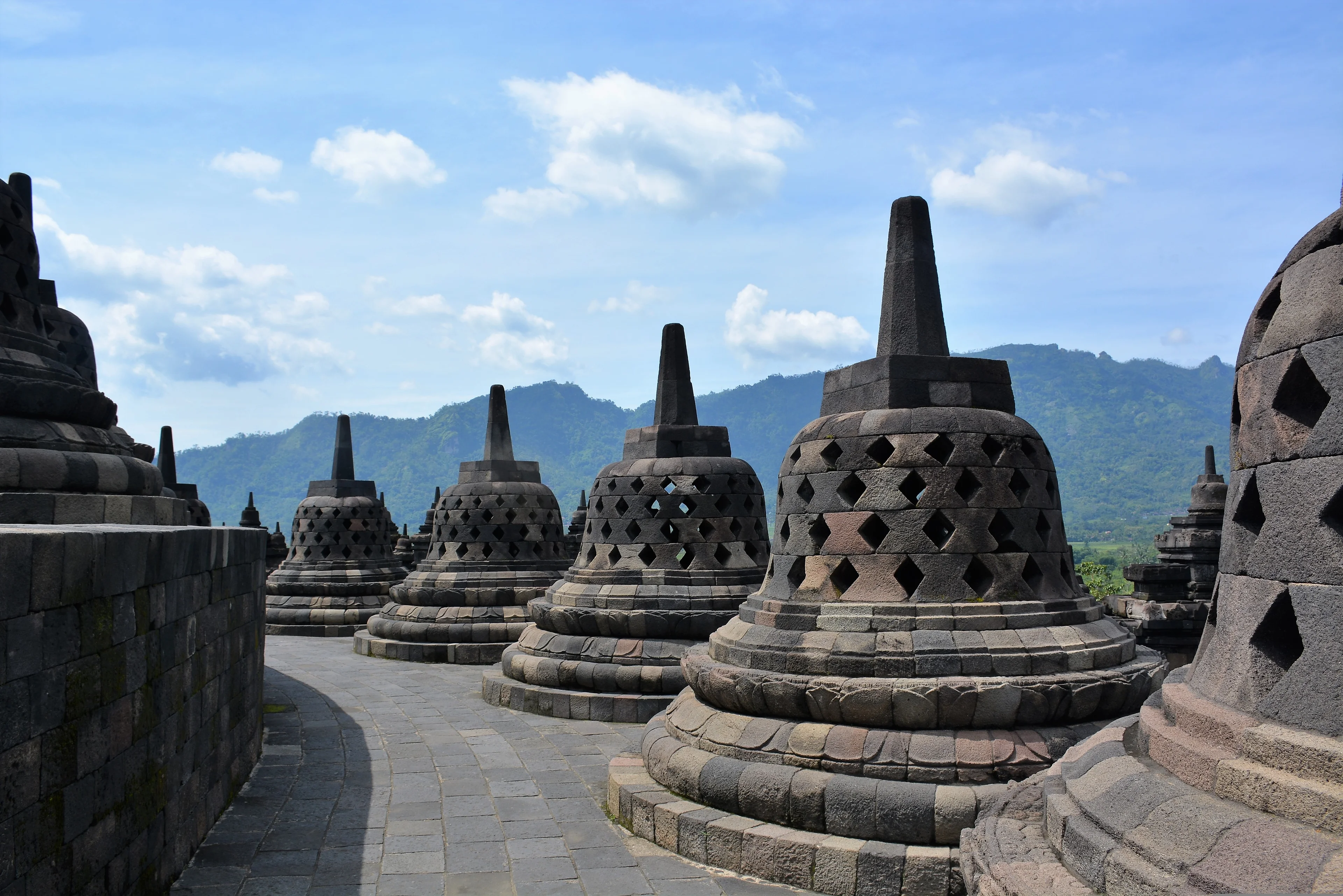
Starting in the 1970s, the Indonesian government and Unesco teamed up for a major restoration project to save the structure from collapse. It was named a World Heritage site in 1991. The temple is essentially a massive stupa, a bell-shaped Buddhist monument measuring 123 meters long and 43 meters high. From above, the layout forms a mandala, a visual representation of Buddhist cosmology. Its construction involved moving nearly 1,600,000 blocks of volcanic stone.
The structure consists of nine platforms, with six square bases topped by three circular ones. The highest level holds a large stupa, surrounded by 72 smaller stupas. The temple walls are covered in detailed reliefs telling the story of Buddha. There are 2,670 relief panels in total. Of these, 1,460 are narrative, documenting the transformation of Prince Siddharta into Buddha and the spiritual journey of the pilgrim Sudhana toward ultimate truth. The temple was originally home to 504 statues of Buddha, though 43 have been lost and at least 300 have been damaged.
The sacred valley of Borobudur
The Borobudur temple is only part of the story, as the entire Kedu plain was a hub for ancient religious life. The valley is lush and fertile, filled with rice paddies and palm trees, and the surrounding mountains have long held deep significance. Nearby, you will find two other notable sites: the Mendut temple and the Pawon temple. The Mendut temple houses three well-preserved statues of Buddha and serves as a center for learning Buddhist precepts. The Pawon temple commemorates the moment Siddharta reached supreme wisdom.
Each year between May and June, during the full moon, processions are held to celebrate Vesak, a sacred day marking the birth, enlightenment and death of the Buddha, which is a public holiday in Indonesia. Pilgrims begin their journey at the Mendut temple, continue through Pawon, and finish at the Borobudur temple.
When to go
The best time to visit Borobudur is during the dry season, which runs from May or June through October.
How to get there
From the bus terminal in Yogyakarta, you can take a local bus or a taxi to reach Borobudur. Alternatively, you can book a private excursion through a tour operator.
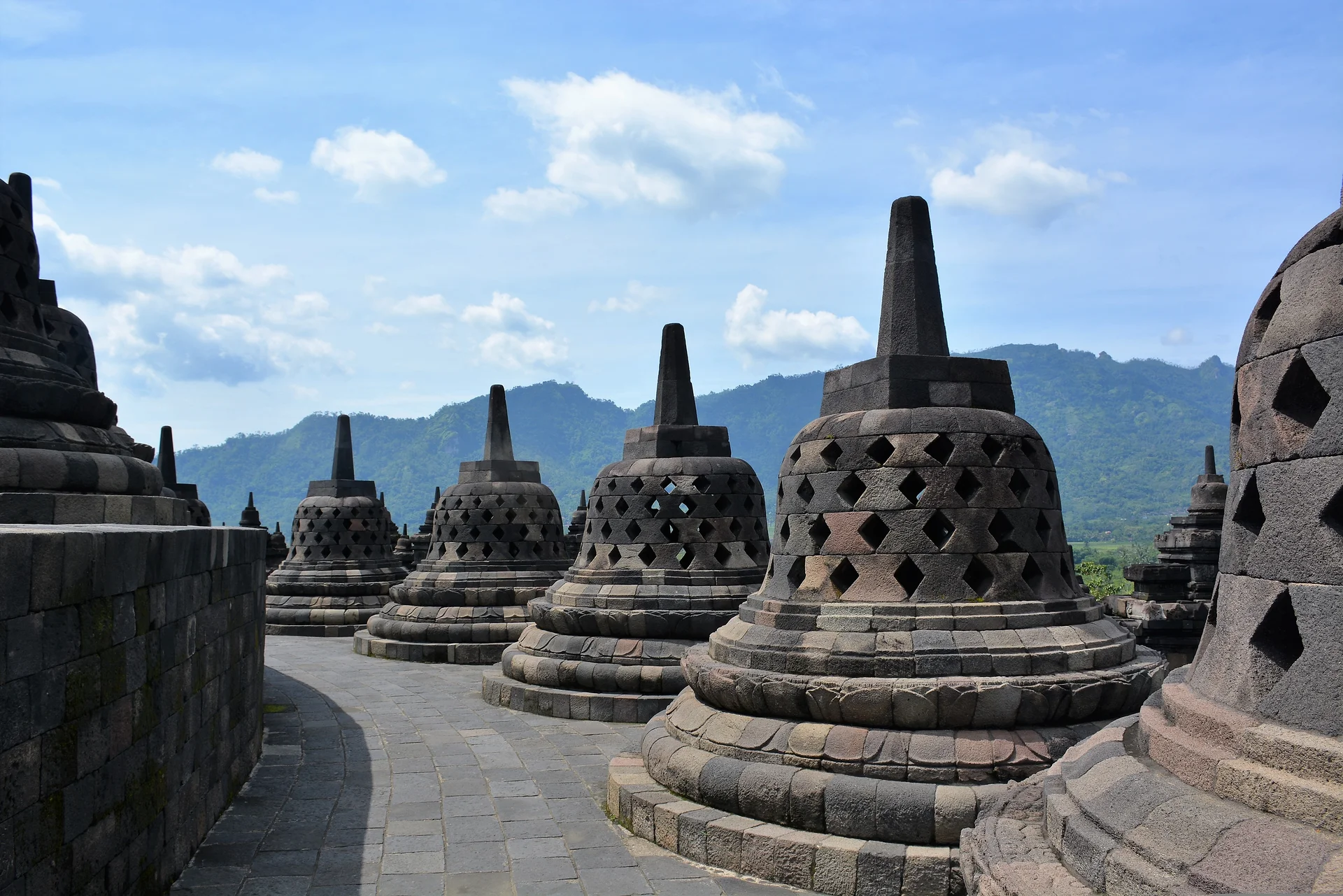
I went to Borobudur without really knowing what to expect, and I was pleasantly surprised.
To start, you will find the largest Buddhist temple in the world there. Plan for at least half a day to walk around it, look at its statues and bas-reliefs, climb its steps, and check out the different viewpoints.
Also, the natural environment of this city is lush and splendid, with rivers, mountains, a volcano, and terraced rice paddies.