
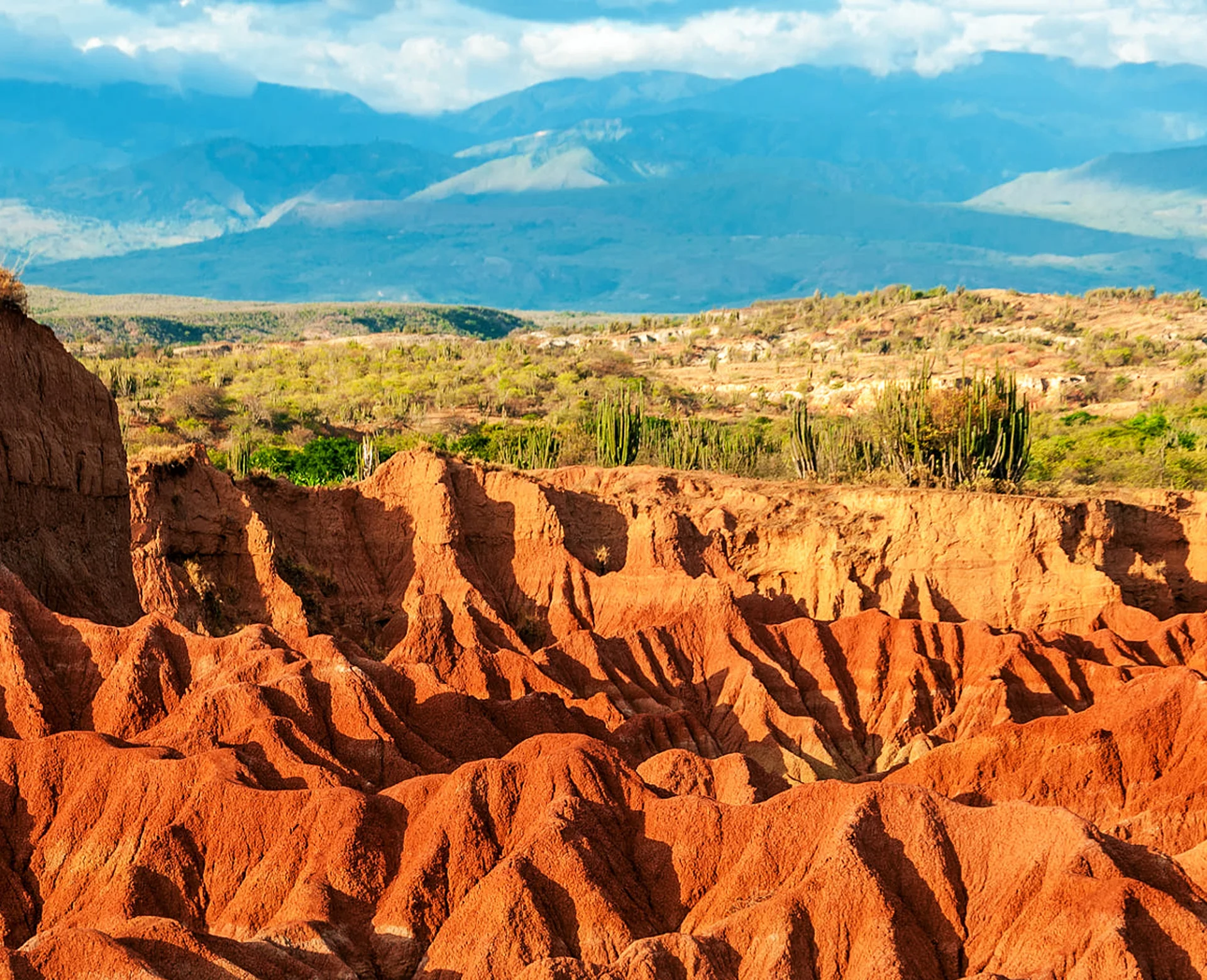
Exploring the Tatacoa Desert and its red mineral landscape
Under the relentless sun of the Huila department, the Tatacoa Desert reveals its ancient secrets in a setting that feels otherworldly. These 330 square kilometers of rock formations sculpted by erosion turn every step into a trip through time, moving between glowing canyons and stellar observatories.
Why does Tatacoa fascinate explorers and scientists?
It is technically not a desert but a tropical dry forest, a remnant of an ecosystem that once resembled the Amazon. Dried out by the uplift of the Eastern Andes, the Tatacoa has become the second most arid zone in Colombia.
Its mineral-rich soil tells the story of millions of years of geological evolution. With more than 600 fossils discovered, including the most significant concentration of prehistoric primates on the continent, this natural laboratory has been attracting paleontologists and geologists from around the world for a century.
The two contrasting faces of this Martian laboratory
The Tatacoa is split into two zones with distinct personalities. El Cuzco, the red desert, unfolds its copper-colored labyrinths dotted with giant candelabra cacti. Its rock formations evoke the landscapes of the American Southwest with their spires and miniature canyons. Eight kilometers away, Los Hoyos reveals a silver-gray universe where natural pools with refreshing waters hide.
On the trail of the giants of the past
Trails wind between geological formations and paleontological sites. While walking the Sendero de los Fantasmas (Path of the Ghosts), hikers find fossils naturally surfacing, silent witnesses to a lost tropical biodiversity. The Valle de los Xilopalos (Valley of the Fossilized Woods) reveals its petrified wood, fragments of a forest fossilized for millions of years.
Friendly tip: Plan your visit to the red desert for the golden hour, one hour before sunset. The rock formations ignite in an incandescent red that turns the landscape into a mineral fire. It is the magic moment when photographers capture the most striking shots.
Under the starry dome, a window to the universe
When night falls on the Tatacoa, another show begins. The total absence of light pollution makes this place one of the best natural observatories in the world for stargazing. The Tatacoa Astronomical Observatory reveals 88 constellations visible to the naked eye every night. Equipped with latest-generation telescopes, it allows for observing Saturn, Jupiter, and the Milky Way in striking detail.
Stellar swimming in the mineral oasis
After hikes in the crushing heat (temperatures regularly hit 40°C or 104°F), the El Oasis natural pools offer a refreshing break. These basins fed by groundwater are one of the few permanent water sources in the desert. The sharp contrast between the crystal-clear water and the surrounding rock formations creates an unreal atmosphere, like an oasis on a distant planet.
Opening hours
| Monday | 19:00-22:00 |
|---|---|
| Tuesday | 19:00-22:00 |
| Wednesday | 19:00-22:00 |
| Thursday | 19:00-22:00 |
| Friday | 19:00-22:00 |
| Saturday | 19:00-22:00 |
| Sunday | 19:00-22:00 |
Access to the Tatacoa Desert is free 24 hours a day, and the observatory is open every evening.
*Information subject to change