
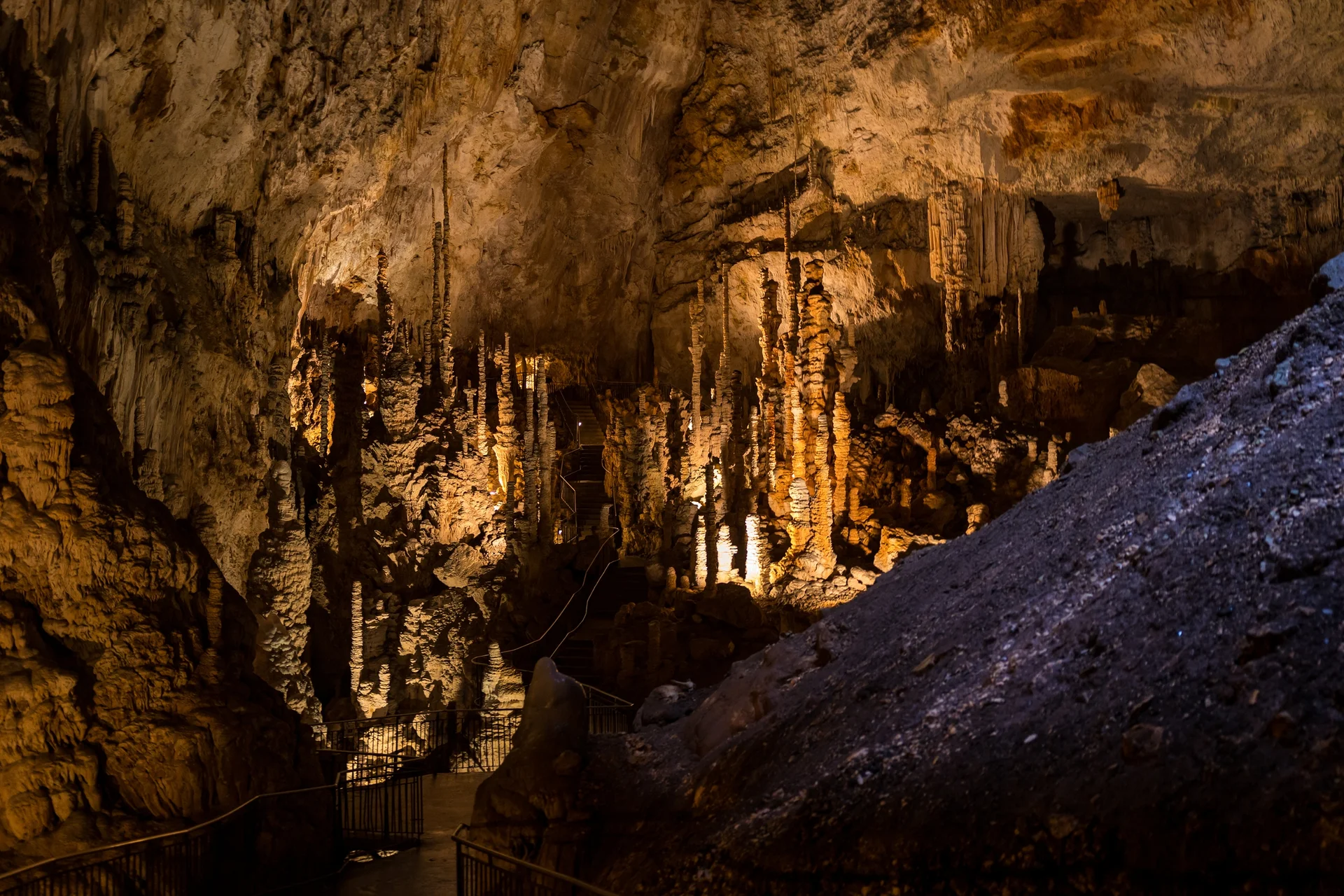
Aven d'Orgnac, an underground cathedral shaped over 100 million years
It is 53 °F inside. Outside, the thermometer reads 95 °F beneath the holm oaks of the Ardèche plateau, but here, 121 meters underground, the air is crisp and nearly humid. Silence settles in. The initial lighting reveals ceilings so high that you can barely make out the top. On August 19, 1935, speleologist Robert de Joly felt this exact vertigo while descending the 50 meters of the natural shaft, armed with nothing more than a simple torch.
Why visit Aven d'Orgnac?
Awarded the Grand Site de France label by the French Ministry of Ecological Transition (ministère de la Transition Écologique), Aven d'Orgnac is not just another cave. The cavern stands out for its colossal scale and the density of its formations, shaped drop by drop over hundreds of thousands of years. The underground network stretches across nearly 5 km, with a section opened to the public in 1939.
Above ground, the Cité de la Préhistoire, a museum certified as a Museum of France (Musée de France), traces 350,000 years of human occupation in southern Ardèche.
The site therefore combines two visits into a single ticket: a geological dive underground and an open-air archaeological journey. Few places in France offer this dual perspective on deep time, located just 30 minutes from Vallon-Pont-d'Arc and the Grotte Chauvet 2.
Three chambers, three atmospheres
The De Joly Chamber: a collision of scale
The first chamber bears the name of its discoverer. It stretches 250 meters long and 125 meters wide, beneath ceilings reaching 30 meters. Across its 7,000 m² of surface area, the formations compete in variety. The Pine Cone, an iconic stalagmite, stands over 11 meters tall.
Right next to it, the Leaning Tower, dated to 350,000 years via uranium-thorium dating, tilts slightly. The giant palms, born from water droplets bursting on the rock, unfold their calcite petals. The urn containing Robert de Joly's heart rests here, in accordance with his final wishes.
The Chaos Chamber: the patient work of water
Further down, collapsed blocks from the ceiling tell the geological history of the site. Some stalagmites growing on these blocks are only 15,000 years old, which remains considerable on a human scale. Translucent draperies hang from the walls, sometimes mere millimeters thin. Their shades range from pure white to brownish ocher depending on the mineral composition of the water that shaped them.
The Red Chambers: a lit finale
The tour ends in the original gallery, carved about 6 million years ago by an underground river. Massive pillars frame the space. A sound and light show highlights the volumes and colors of the rock. This is the most contemplative moment of the visit before taking the elevator back up.
Friendly tip: opt for morning slots in the summer when crowds are smaller. On rainy days, visitor numbers spike, so book your tickets online to skip the ticket window line. Also remember to bring a sweater, even in the middle of August, as the constant 53 °F feels quite brisk after the outdoor heat.
The Cité de la Préhistoire and surface activities
The ticket includes admission to the Cité de la Préhistoire, a museum space displaying authentic artifacts unearthed in Ardèche and northern Gard. Touch screens, life-size scene reconstructions, taxidermy animals, and videos punctuate the self-guided tour. Depending on the season, workshops let you try friction fire-starting, flintknapping, or spear-thrower target practice. Kids take to it immediately.
- Includes two distinct experiences in one ticket
- Exceptional scale in the main chamber
- Interactive museum suitable for families
For the more athletic, the site also offers guided caving activities. The Panoramic Descent replicates the original entrance: a 50-metre rappel down the natural shaft where De Joly first set foot. The Underground Vertigo, a via cordata 40 meters off the ground in the cave's ceiling, ends with a 30-metre zipline. These activities must be booked year-round through the site's speleology guide.
Finally, the Maubois Trail, accessible for free from the parking lot, offers a 30-minute to one-hour walk through the holm oak forest. Informational signs line the route and shed light on the geological history of the Ronze plateau. The shaded picnic area and children's playground round out an experience designed for a full day out.
Opening hours
- February: Reception desk open 1:45 PM to 6:00 PM, cave tours depart at 2:00 PM, 3:30 PM, and 5:00 PM.
- March: Reception desk open 9:45 AM to 12:30 PM and 1:45 PM to 6:00 PM, cave tours depart at 10:00 AM, 11:30 AM, 2:00 PM, 3:30 PM, and 5:00 PM.
- April through June and September: Reception desk open 9:45 AM to 5:30 PM, Cité de la Préhistoire (Prehistory Museum) open 10:00 AM to 7:00 PM, cave tours depart every 30 minutes from 10:00 AM to 12:00 PM and 1:30 PM to 5:30 PM.
- July and August: Reception desk open 9:30 AM to 7:00 PM, Cité de la Préhistoire open 10:00 AM to 7:00 PM, regular cave tour departures from 9:45 AM to 6:00 PM. Daily English language tours are available.
- October through November 15: Reception desk open 10:00 AM to 6:00 PM, cave tours depart from 10:00 AM to 12:00 PM and 2:00 PM to 4:30 PM.
*Information subject to change

Just breathtaking! When you visit a cave, you feel so small in front of these rock formations that have been growing for thousands of years. You will see magnificent formations here, like real forests. Unique panoramas. A heads up: dress warmly and wear good shoes, there are plenty of stairs to climb! Lots of activities are offered, designed for all types of visitors.