
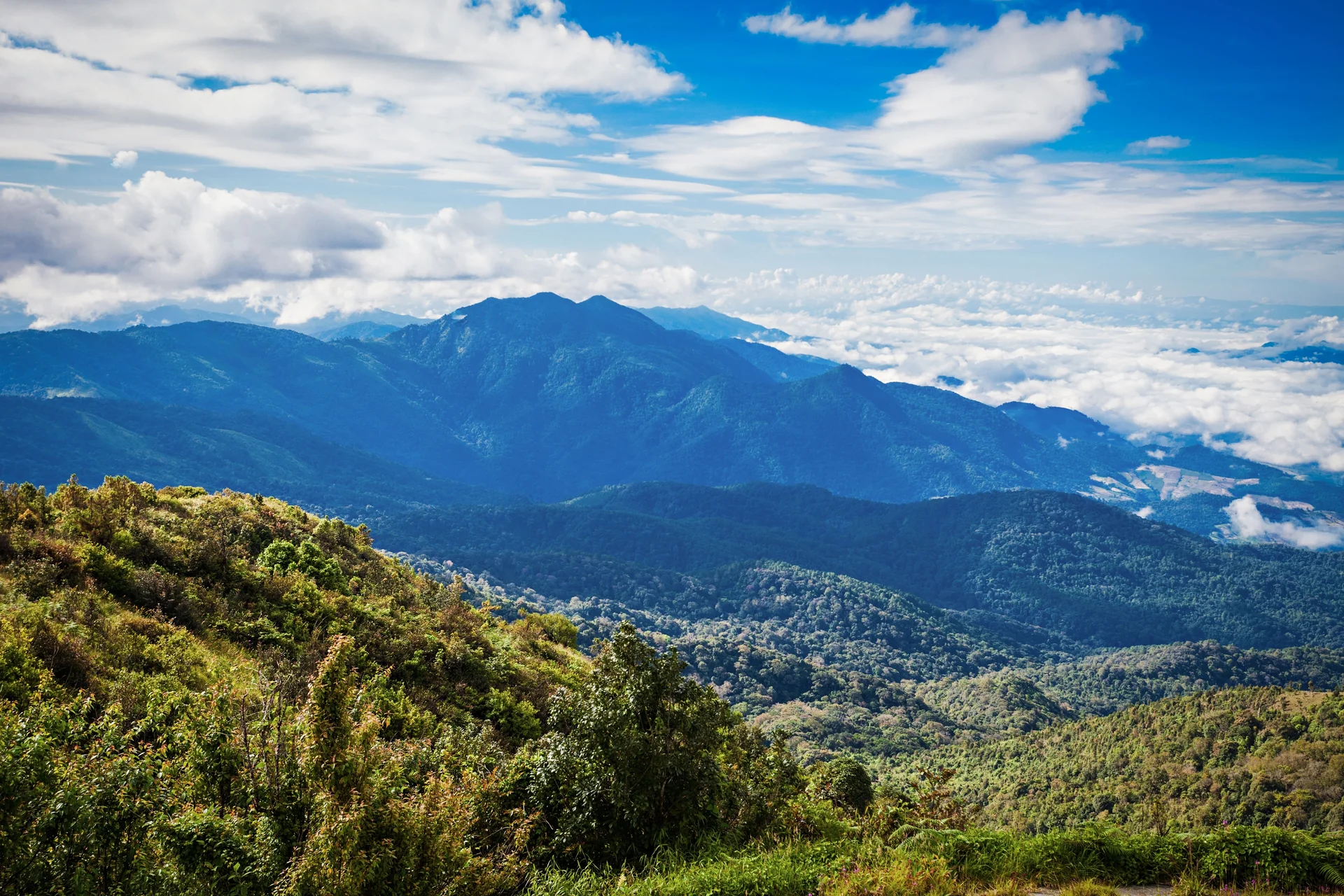
Doi Inthanon, the roof of Thailand at 2,565 meters of mist and moss
It is 6 a.m., and the road winds upward from Chom Thong in the dark. After an hour of switchbacks, the dashboard thermometer reads 8 °C (46 °F). Outside, the air bites at your cheeks.
Welcome to the highest peak in Thailand, where the tropical forest gives way to a cloud forest carpeted in sphagnum moss, where rhododendrons bloom at altitude, and where more than 500 species of birds have been identified.
Why visit Doi Inthanon National Park?
The mountain is named after King Inthawichayanon, the seventh sovereign of Chiang Mai and the last semi-independent ruler of the Lanna Kingdom. Passionate about forest preservation, he requested before his death in 1897 that his ashes be laid to rest on the summit, then called Doi Luang.
The national park was officially established in 1972 and covers 482 km² (186 square miles) of rugged terrain, ranging from teak forests and pine groves to waterfalls and terraced rice paddies cultivated by Karen and Hmong communities who have lived here for generations.
What strikes you immediately is the scale of the landscapes. Within a few miles, you transition from humid heat to dry cold, from bright rice fields to a canopy so dense that sunlight barely penetrates. The elevation gain from the park entrance to the summit exceeds 1,700 meters (5,577 feet), and every level offers a distinct ecosystem.
Three trails, three moods
The Ang Ka Nature Trail: the enchanted summit forest
A few steps from the sign marking the country's highest point, a 360-meter (1,181-foot) wooden boardwalk leads into a forest of almost unreal green. Sphagnum moss covers every branch, every trunk twisted by the wind. Moisture is constant, temperatures hover between 9 and 15 °C (48 to 59 °F) year-round, and mist drifts between the tree ferns.
The loop takes twenty minutes to walk, and no guide is required. It is the most accessible trail in the park, suitable for everyone.
The Kew Mae Pan Trail: the panoramic ridge
This 2.5 km (1.5-mile) loop trail follows a ridge open to the western valleys. On clear days early in the morning, a sea of clouds covers the plain below. The route is managed by the local Hmong community, and a guide accompanies each group for 200 THB (about $5.50). Expect a two to three-hour hike on easy to moderate terrain. The trail only opens from November to late May, closing every year from June 1 to October 31 for forest regeneration.
The Pha Dok Siew Trail: waterfalls and villages
Less frequented, this trek descends through the jungle to roaring waterfalls and passes through a small Karen village. White-handed gibbons live near the trail. Seeing them is rare, but their calls often echo through the canopy in the early morning. A local guide is required here as well.
Royal pagodas and spectacular waterfalls
The two twin pagodas, built by the Royal Thai Air Force in honor of King Bhumibol and Queen Sirikit, stand slightly below the summit. Their gardens are well-tended, and the view stretches far to the west. Sunsets there are remarkable. Access costs 100 THB (about $2.75) per person, separate from the park entrance fee. An escalator provides access to the structures from the parking lot.
As for waterfalls, Wachirathan impresses with the power of its 80-meter (262-foot) cascade, visible from a viewing platform. The spray drenches visitors from several meters away. Further out, Mae Ya and its 260-meter (853-foot) drop are worth the detour if your schedule allows. You must head back toward Chom Thong and turn off, then walk 600 meters (1,968 feet) from the parking lot.
Pro tip: prioritize a weekday. Weekends and especially Thai public holidays cause traffic jams inside the park. During the New Year alone, up to 12,000 visitors crowd the summit. On weekdays, the experience is completely different.
Birdwatching on the roof of the country
With more than 500 species recorded, Doi Inthanon holds the national record. Some cannot be seen anywhere else in Thailand, such as the green-tailed sunbird, the ashy-throated warbler, or the collared grosbeak. At the summit, near the small cafe next to the trail, squirrels and birds approach within inches of the tables. The best time for birdwatching is from March to July, when migrants arrive and the breeding season is in full swing.
Opening hours
*Information subject to change

Doi Inthanon National Park is a place we really loved. You feel completely cut off from the world, surrounded by nature. The views are unbeatable all along the route, and the ride up in the truck is a cool experience in itself, already a total change of scenery. The air is cooler, the atmosphere is peaceful, and the landscapes are magnificent. An incredible nature break that I recommend without hesitation.