
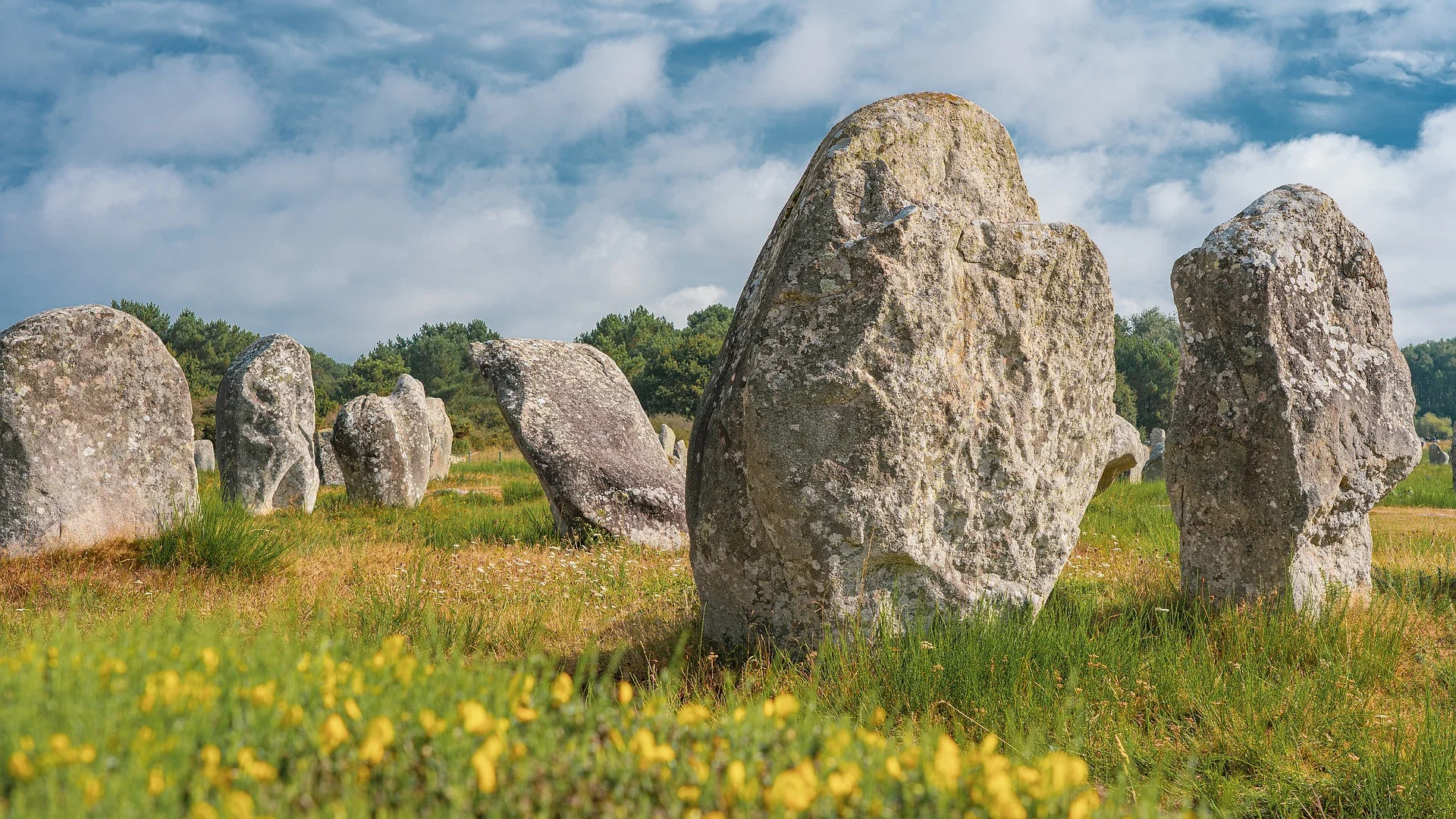
The Carnac Stones, 3,000 standing stones facing the Atlantic
At dawn, when mist hugs the moorland and the granite turns pink under the first light, the Carnac Stones look like a silent crowd frozen for seven millennia. The air smells of damp heather, and the ground crunches under your boots. You find yourself alone facing rows of stones that run toward the horizon, without a single text or inscription to explain why they are there.
Why visit the Carnac Stones?
More than 3,000 menhirs stand here over nearly four kilometers, forming the most vast megalithic site of this type in the world. Erected between 5,000 and 3,300 BCE, these stones are older than the pyramids of Egypt and predate Stonehenge by about a century. Since July 12, 2025, the site has been listed as a UNESCO World Heritage site, the first Breton property to earn this status.
Despite decades of excavations and theories, no one knows for sure why these Neolithic populations aligned thousands of granite blocks with such precision. Whether it was a solar temple, an agricultural calendar, or a processional path to a sacred space, the mystery remains, and that is exactly what makes the visit so striking.
Three sites, three atmospheres
Le Ménec: the gateway
The journey begins in front of the Maison des Mégalithes (House of Megaliths), the primary visitor and interpretation center. Across from the building lies the Le Ménec site, the most representative of the group: 1,100 menhirs spread across 11 rows stretching over a kilometer. The stones are arranged in decreasing order of height, a detail best viewed from the terrace roof of the visitor center. The site ends in a semi-circular enclosure, barely visible beneath the vegetation.
Kermario: the giants
Located 1.5 km to the east along the Route des Alignements (D196 road), Kermario is the most photographed spot. Its menhirs reach several meters in height, and their density is impressive. An old stone mill, the Moulin de Kermaux (Kermaux Mill), serves as an observation tower. Climb the steps to take in the alignment from above. Just to the south, the Tumulus de Kercado (Kercado Burial Mound) is one of the few that you can still enter.
Kerlescan and the Géant du Manio
More low-key, the Kerlescan site features a more compact grouping with a better-preserved enclosure. About 300 meters away, in a clearing, stands the Géant du Manio (Manio Giant): an isolated menhir 6.50 meters tall, the largest in the area. The place is quiet and often empty of tour groups. Here, you can hear the birds singing and the wind in the pines.
Pro tip: From April to September, access inside the fenced sites is only possible via guided tour. However, from October to March, you can walk freely between the menhirs. The best approach is to arrive early in the morning during the off-season, when the low-angled light sculpts every stone and visitors are few and far between.
Before or after the alignments
The Musée de Préhistoire de Carnac (Carnac Museum of Prehistory), housed in a former rectory in the town center, holds more than 6,600 objects related to megalithic culture. It is one of the most important French collections on the subject and an excellent starting point to add context to what you see in the field. A few minutes walk away, the Tumulus Saint-Michel (Saint-Michel Burial Mound), topped by a chapel, offers a 360-degree panoramic view of the Quiberon Bay and the surrounding countryside.
To continue your megalithic exploration, the sites de Locmariaquer (Locmariaquer sites) are about a 15-minute drive away. There you can see the Grand Menhir Brisé (Great Broken Menhir), the largest known stele in Europe, and the Table des Marchands (Merchants' Table), a dolmen with enigmatic carvings on its slabs.
Opening hours
*Information subject to change

This site has a really unique atmosphere, almost mystical. I opted for a guided tour that I found super interesting and thorough. I think it is the way to go. Don't hesitate to walk around the area, the landscapes are spectacular.