
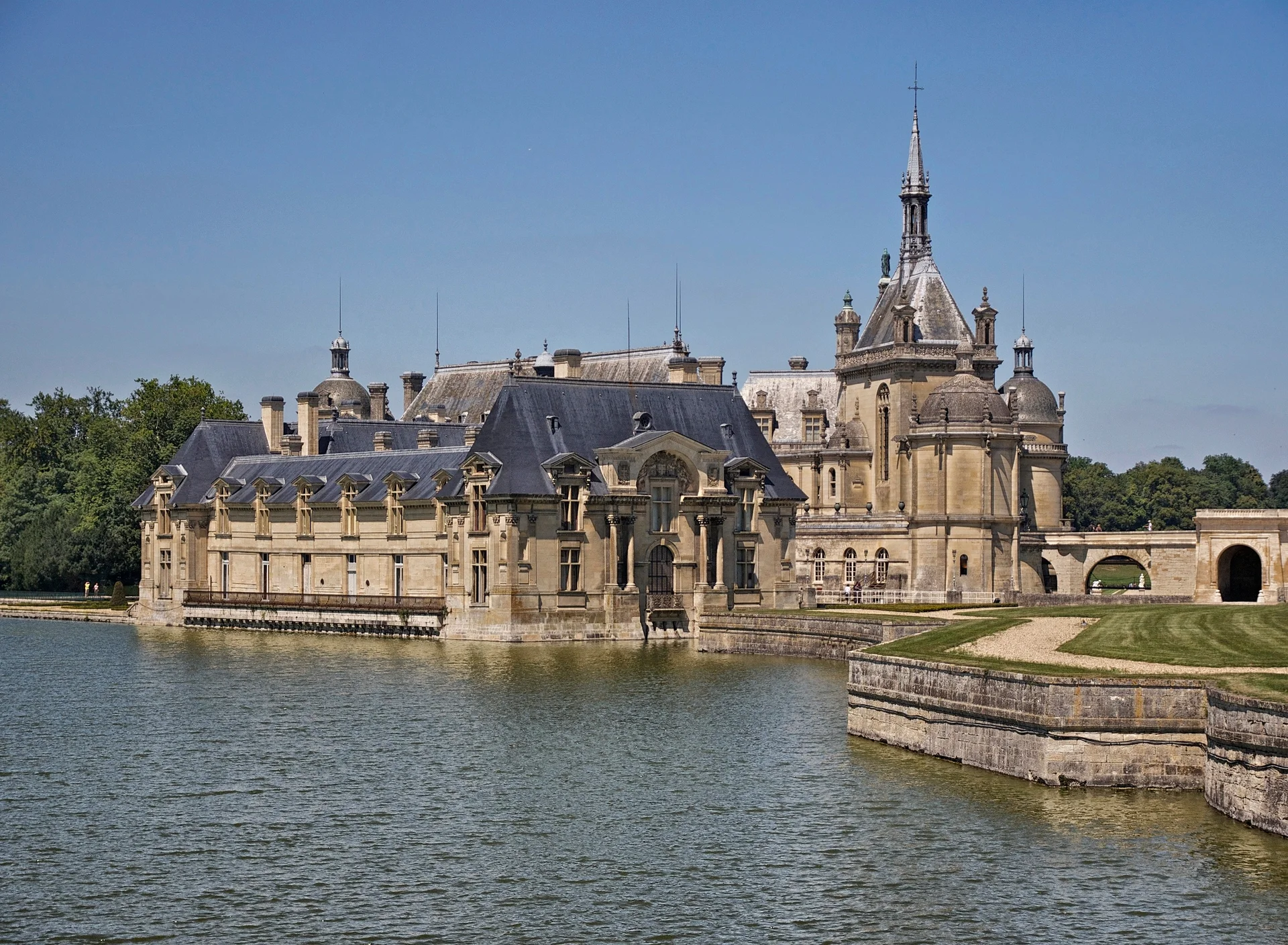
Chantilly Castle, the forgotten rival to Versailles
Towers reflect in the moat like a mirage hovering on the water. Located 25 miles north of Paris, this 284-acre estate houses the second-largest collection of antique paintings in France after the Louvre Museum, gardens designed by Le Nôtre, and the largest princely stables in Europe. The entire experience feels significantly more intimate than its neighbor at Chantilly Castle.
Why visit Chantilly Castle?
The history of the site reads like a novel. A medieval fortress transformed into a Renaissance residence by Anne de Montmorency, a companion-in-arms to King Francis I, the estate later passed to the princes of Condé. It was Louis II de Bourbon-Condé, known as the Grand Condé and a cousin to Louis XIV, who gave the estate its grandeur in the 17th century. Driven by princely rivalry, the canal at Chantilly was intentionally built to outshine the waterworks at Versailles.
Destroyed during the French Revolution, the Grand Château was entirely rebuilt starting in 1876 by Henri d'Orléans, Duke of Aumale, son of the last king of France. A compulsive collector, he amassed a colossal collection of art here. Upon his death, he bequeathed everything to the Institut de France (Institute of France) with one strict condition: no artwork may ever leave Chantilly or be loaned out. What you see here exists nowhere else.
The Musée Condé and its elusive masterpieces
More than 800 paintings, 2,500 drawings, and 30,000 books make up the collections. You will find works by Raphael, Botticelli, Poussin, Ingres, and Delacroix, hung according to the layout dictated by the Duke in the 19th century. The rooms have barely changed since the museum opened in 1898. This presentation, frozen in time and far from modern museum curation, carries a distinct charm. You are visiting a collector's cabinet just as much as a museum.
Among the pieces to look for:
- The Three Graces by Raphael and the Portrait of Simonetta Vespucci by Piero di Cosimo
- The Cabinet of Books, which holds the illuminated manuscript of the Très Riches Heures du Duc de Berry, a 15th-century masterpiece rarely shown to the public
- The Grande Singerie (Great Monkey Room), a salon decorated by Christophe Huet around 1737, where monkeys dressed in the livery of the Condé family parody the activities of their masters. The six painted panels represent the five senses, the four continents, and the arts
The gardens: four centuries of landscaping in one park
The formal French garden
Designed by André Le Nôtre even before his work at Versailles, it features intricate embroidery flowerbeds, reflective pools, and a Grand Canal stretching over half a mile. The low light of late afternoon is particularly striking here, when golden reflections dance across the still water.
The English garden and the Hameau
Created in the 18th century, it offers a striking contrast to the geometric rigor of the French garden. You will find the Temple of Venus, the Island of Love, and the Hameau (Hamlet), a group of seven rustic cottages built before those of Marie-Antoinette at Versailles. One of them now houses a restaurant where you can taste the famous Chantilly cream.
The Great Stables and the legend of Vatel
Built between 1719 and 1740 by architect Jean Aubert, the Great Stables stretch 610 feet in length. Their patron, Louis IV Henri de Bourbon-Condé, was convinced he would be reincarnated as a horse and wanted to ensure his future accommodations were up to standard. They now host the Horse Museum and regular equestrian shows, with 27 horses and 10 ponies in residence.
Historical anecdotes
Chantilly is also the site of the tragic fate of François Vatel, the master of ceremonies for the Grand Condé. In April 1671, during a banquet for 2,000 guests in honor of Louis XIV, the delivery of fresh seafood was delayed. Fearing dishonor, Vatel took his own life at dawn. The fish carts arrived shortly thereafter.
Does Chantilly cream come from Chantilly Castle?
As for the invention of the Chantilly cream often attributed to the estate, historians are clear: sweetened whipped cream existed in Europe as early as the 16th century, well before the castle became associated with the name.
Pro tip: Book a timed ticket online to save 10 percent and skip the line. Aim for a weekday and arrive at opening time, as the rooms of the Musée Condé fill up quickly after 11 a.m., especially on weekends. Plan to spend the entire day to enjoy the estate without feeling rushed.
Opening hours
*Information subject to change

Less crowded with tourists than Versailles, this site remains one of my favorites for a day trip outside of Paris. While the architecture of the castle is not very impressive, the setting with the water bordering the building and the French-style gardens are sublime. I went for a pleasant horseback ride there. No need to be a good rider, because the horses, used to the route, steer themselves. I then had lunch at the estate's restaurant, the Auberge du Jeu de Paume. It is quite expensive, but the dishes and desserts are good. You can obviously try the homemade Chantilly!