
Pointe-a-Calliere, where Montreal took root
Beneath the cobblestones of Old Montreal, four centuries of history await. The triangular Eperon building stands on the Place Royale, exactly where Paul de Chomedey de Maisonneuve and Jeanne Mance landed in 1642. As you descend into the underground galleries, time slips away. The stone walls of the ancient foundations tell countless stories, from indigenous occupation to the builders of New France.
The only major archaeology museum in Canada
Opened in 1992 to celebrate the 350th anniversary of Montreal, Pointe-a-Calliere owes its existence to excavations conducted in the 1980s that revealed remarkable architectural ruins. These discoveries helped build one of the most important archaeological collections in the country, documenting human presence dating back over 1,000 years.
The museum occupies a national archaeological and historic site, protected for its role in the birth of Montreal. Seven pavilions connected by underground tunnels now form a spectacular museum complex that extends well beyond the main building. The architecture of the Eperon, designed by Dan Hanganu and Provencher Roy, evokes the former Royal Insurance Company building that stood here in the 19th century.
An underground journey through the ages
The Generations MTL multimedia show
In a projection room unlike any other, stadium seating overlooks authentic archaeological ruins. On this stone stage, the Generations MTL show projects the history of Montreal through six characters who recount their city and their ancestors. Technological prowess fades behind the emotion as the ancient walls come to life, the stones speak, and four centuries unfold in twenty gripping minutes.
The archaeological galleries
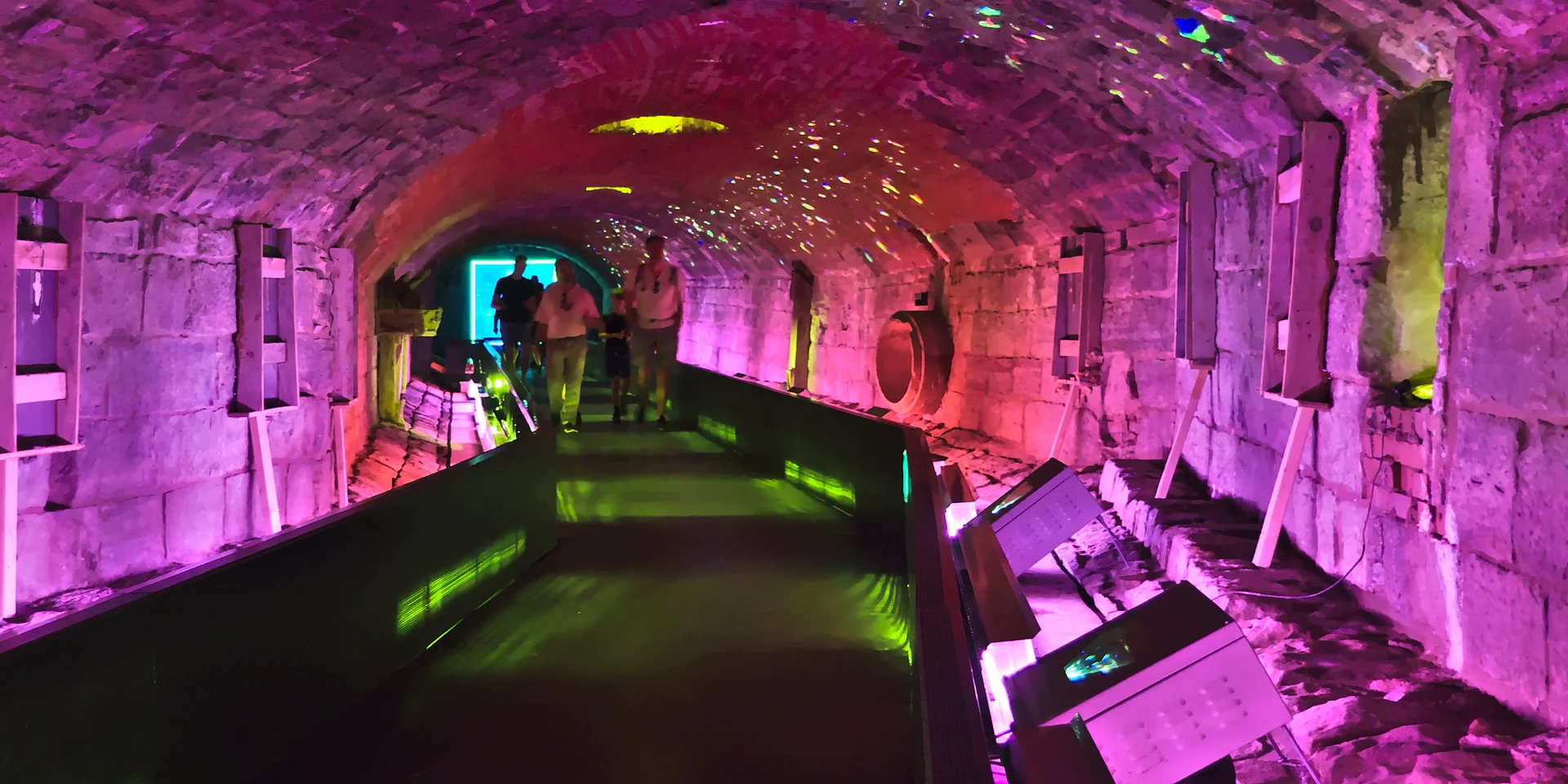
The underground circuit winds through the foundations of the first Catholic cemetery, the William collector sewer dating from 1832, and the remains of the Fort de Ville-Marie. Each section reveals artifacts in situ, including shards of indigenous pottery, clay pipes, glass bottles, and antique coins. Digital and interactive installations punctuate the path, allowing you to visualize how these spaces functioned at different points in time.
The permanent exhibition tells the story of the meeting between indigenous peoples and European settlers, the evolution of the city under French and then British regimes, and the development of Old Montreal up to the present day. The museum design succeeds in making archaeology accessible and fascinating for everyone.
Exhibits for the whole family
Beyond the permanent collections, the museum presents several major international temporary exhibitions every year. From great civilizations to pirates and medieval knights, the programming is always changing.
For younger visitors, Archeo-adventure offers a unique experience. Kids take on the role of archaeologists in a simulated dig, working through a construction site, a field tent, and a lab. The Pirates or Privateers exhibition invites junior sailors to board the D'Iberville ship for an immersive adventure set during the era of New France.
Pro tip: Arrive as soon as it opens on a weekday to enjoy the museum in a calm atmosphere. The multimedia show is more intense in a less crowded room, and you will have plenty of time to observe the details of the ruins without the crowds. The ticket office closes 30 minutes before the museum, so plan accordingly.
Highlights
- The Generations MTL show projected onto authentic ruins
- The foundations of the Fort de Ville-Marie, displayed under an impressive glass floor
- The exhibition on the Great Peace of Montreal of 1701, a historic treaty with the First Nations
- The walk through the William collector sewer, a true underground stone cathedral
- The panoramic view of the Saint Lawrence River from the terrace of the Bistro L'Arrivage
- Indigenous artifacts illustrating 4,500 years of territorial occupation

I found the visit to this museum really very interesting. It traces the entire history of the city of Montreal, from its creation. You can discover archaeological remains in the excavations. There are also a huge number of reconstructions. The museum also traces the evolution of the city over time.