
Buttes-Chaumont Park, when Paris invented its own mountain
Under your feet lies gypsum. It was mined for generations, eventually transforming this corner of the 19th arrondissement into an open wound in the urban landscape.
In 1863, Napoleon III and his prefect Haussmann commissioned engineer Jean-Charles Alphand to build a park here. The result, opened in 1867, is a masterclass in landscape design that Paris has not replicated since.
Why visit Buttes-Chaumont Park?
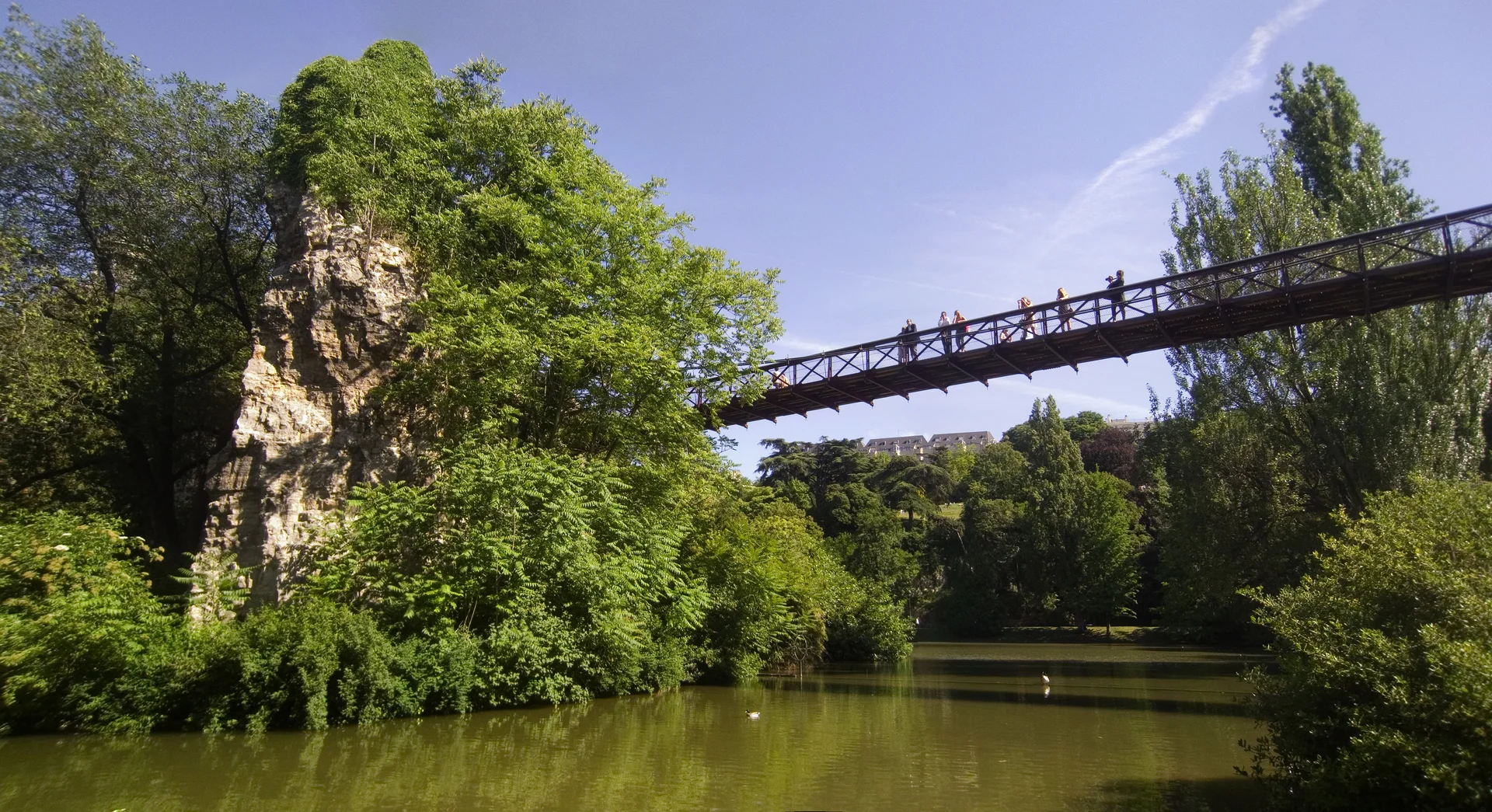
Spanning 25 hectares (about 62 acres), this is the steepest and largest of the gardens run by the City of Paris, leaving aside the two bois and the state-owned gardens. Sheer cliffs, a 1.5-hectare (about 3.7-acre) artificial lake, a stalactite-filled grotto, waterfalls, and a suspension bridge designed by Gustave Eiffel: everything was fabricated from scratch to create an illusion of wild nature that still works beautifully. About 6 million visitors come here every year.
What strikes you just steps past the gate is the relative silence that settles over you. The city noise is muffled by the hills and the thick foliage. The effect is almost instantaneous, and it is precisely what Parisians come here for, just a few metro stops from the center.
A park built over a void
The subsoil of Buttes-Chaumont is like Swiss cheese. For decades, quarrymen extracted gypsum, the mineral that becomes plaster when heated. The material was even shipped to the United States, to the point that the neighborhood was known as Quartier Amérique. When the park was created over these exhausted quarries, builders had to constantly compensate for subsidence and water infiltration into the rock.
This inherent fragility explains the significant work ongoing since 2023, and the large-scale project now being prepared. Building on gypsum means building on terrain that requires constant maintenance, no matter how spectacular the scenery.
The lake returns, the cliffs wait
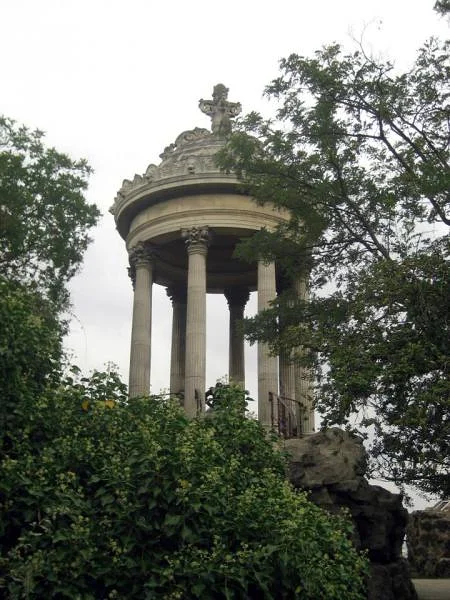
Good news for visitors since 2024: the lake is full again. Drained in late 2023 for the first time in thirty years to remove 1,800 cubic meters of accumulated silt, it was refilled in the spring of 2024. Mallards, black-headed gulls, and gray herons have returned to their routines. The reflection of the Temple de la Sibylle (Temple of the Sibyl) on the calm water is back.
However, access to the central island remains closed, as do the belvedere, the chemin des Aiguilles, part of the grotto path and the small waterfall. Soil instability requires safety restrictions that will last for several more years, but the works affect only 5 % of the site: 95 % of the park stays open. The consolidation work is planned over several years: twelve million euros have already been invested and a first envelope of six million is committed to the works and studies.
Friendly tip: To admire the Temple de la Sibylle despite the island closure, walk along the south shore of the lake near the brick bridge. From there, the view of the rocky island and the kiosk is the most unobstructed. In the morning, when the light is still low, the reflection in the water is particularly striking.
Life in the park: what you actually do here
Usage varies throughout the day. At dawn, runners claim the 5 kilometers (about 3 miles) of paths and their serious elevation changes. During the day, families and groups of friends take over the rolling meadows for picnics that can last for hours. In the evening, the vibe shifts around Rosa Bonheur, the park's iconic guinguette (open-air tavern), where the terrace often spills onto the grass in summer.
We have a special affection for this park precisely because it attracts few tourists outside of warm days. This is Paris without the pretense, Paris as it lives. On weekdays, outside of the summer season, you can find rare tranquility here.
Prioritize seeing:
- The suspension bridge designed by Gustave Eiffel, 65 meters (about 213 feet) long and hanging 8 meters (about 26 feet) above the lake, offering an unbeatable vantage point over the entire site.
- The notable trees: an Oriental plane tree planted in 1862, a cedar of Lebanon from 1880, two ginkgo bilobas, and a sophora with branches spectacularly twisted toward the water.
- The Pavillon Puebla, a Belle Epoque bar-restaurant perched in the greenery, ideal in the late afternoon for a drink on the terrace above the treetops.
- The Guignol puppet shows (featuring Guignol Anatole and the Guignol de Paris) on Wednesdays, Saturdays, Sundays, and holidays.
- The biodiversity trail with 28 points of interest, available on Paris.fr, perfect for turning a stroll into a genuine naturalist exploration.
Why it is worth it
- Admission is completely free, every day of the year.
- More than 40 metres of elevation change, a unique topography that contrasts sharply with flat French-style gardens.
- The lake was refilled in 2024: aquatic wildlife and temple reflections are back.
- Authentic Parisian atmosphere: joggers, families, picnickers, and the guinguette coexist naturally.
- Remarkable biodiversity: gray herons, grey wagtails, and rose-ringed parakeets nest on the site.
Current points of caution
- The island and its belvedere, the Temple de la Sibylle, the chemin des Aiguilles and the small waterfall remain inaccessible for safety reasons.
- Part of the circular path around the lake is also closed.
- The central section of the park, including the Temple de la Sibylle, is already closed for a renovation that will run for several years.
- Very crowded on sunny weekends starting at 1:00 PM. Prefer mornings or weekdays.
Opening hours
May to September: 7:00 AM to 10:00 PM, except from July 16 to September 6 when the park closes at 11:59 PM for summer night openings.
October to April: 7:00 AM to 8:00 PM.
How long for this activity
*Information subject to change

I have always enjoyed walking in the Buttes-Chaumont Park. Even if the 19th arrondissement is far from being the most pleasant place to live in the capital, this park is a real breath of fresh air. I think there is something for everyone here: families, groups of friends, joggers, etc. It gets very crowded in the summer, but hey, it is only natural that everyone wants to enjoy it.