
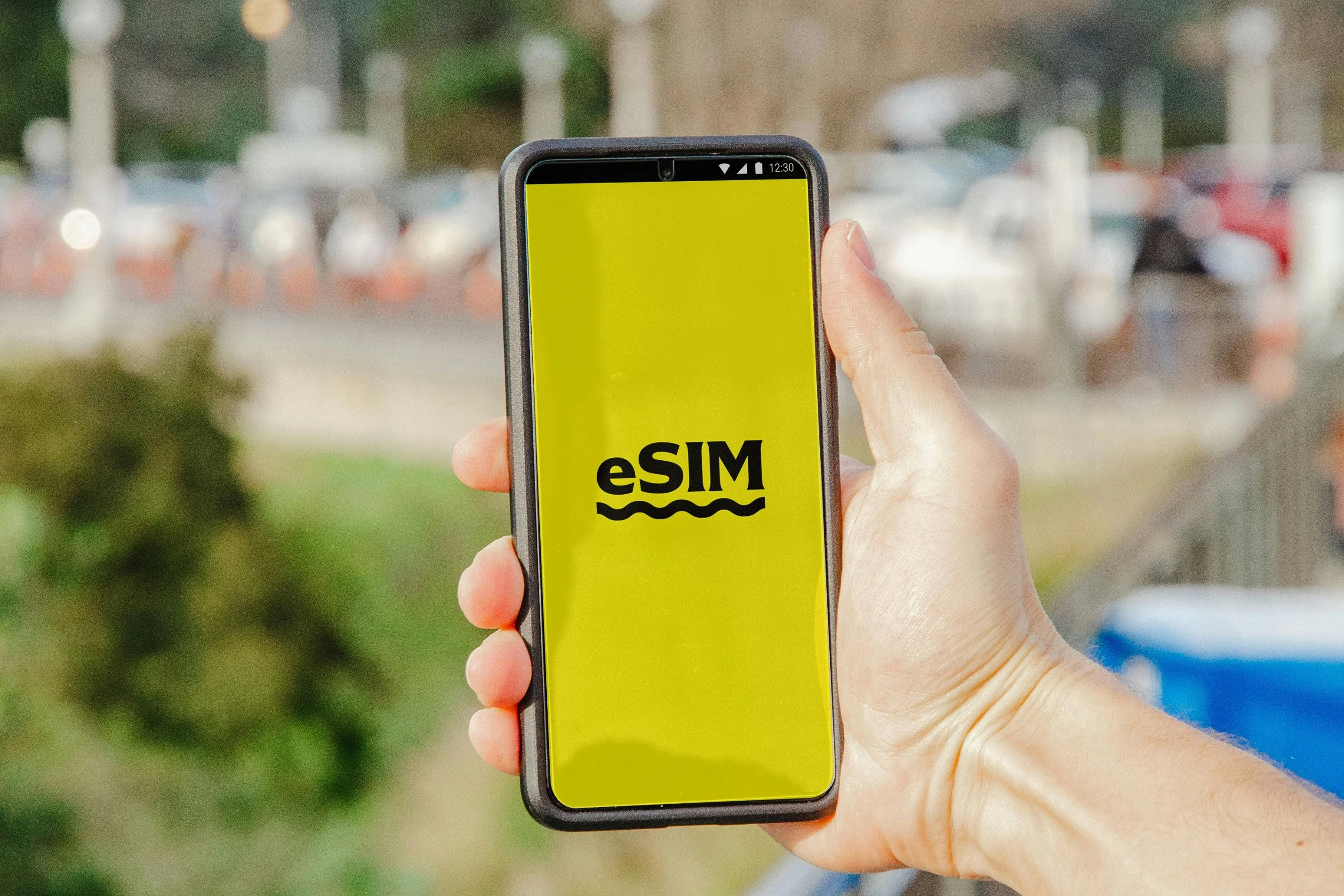





Essential facts about travel eSIMs before you buy
You have seen our rankings. Before you purchase, you likely still have questions. How does it actually work? Is it compatible with your phone? Most importantly, is it truly better than roaming or a local SIM card bought at the airport?
This guide answers those questions. No fluff, no marketing jargon. Just clear, tested, and verified answers to help you travel connected and worry-free.
What is a travel eSIM, really?
An eSIM is a 100 percent digital SIM card. No plastic chip to insert, no tray to open with a paperclip, and no waiting in line at an airport kiosk.
The chip is already built into your smartphone. You purchase a data plan online, receive a QR code, scan it, and you are all set. Your phone connects to the local network as soon as you land.
The key takeaway: The eSIM works in parallel with your regular SIM card. You keep your home number active on one side and use the eSIM data on the other. Both coexist in the same phone thanks to Dual SIM technology.
Why choose an eSIM over other options?
eSIM vs operator roaming
If you travel within the European Union, your home plan likely includes roaming. You use your data as you would at home, at no extra cost. In theory.
In practice, your provider often imposes a roaming data cap, usually much lower than your domestic allowance. With a plan that includes 100 GB at home, you might only have 15 or 20 GB available in Europe. Beyond that, you pay overage fees or face reduced speeds.
More importantly, several popular European destinations are not covered by standard roaming agreements: Switzerland, Turkey, Albania, Montenegro, and Serbia are often excluded. Outside the EU, roaming costs can easily exceed €10 (about $11) per day.
What roaming does well:
- Nothing to install or configure
- Free in EU/EEA within your data limit
- Calls and texts often included in Europe
Where the eSIM does better:
- Outside the EU, the eSIM costs 5 to 20 times less than roaming
- No bill shock: it is prepaid
- Much more generous data packages, sometimes unlimited
- Roaming does not cover Switzerland, Turkey, or non-EU Balkan states
eSIM vs local SIM
Buying a physical SIM card upon arrival remains a valid option in some cases. In Southeast Asia, for example, local plans are often very cheap and sometimes include calling and texting.
The problem is the lost time. You have to find the right shop, wait in line, present your passport, and sometimes fill out registration forms. If you remove your home SIM to insert the local one, you temporarily lose access to your regular phone number.
When a local SIM is still relevant:
- Long stays in a single country, especially in Asia or Africa
- Need for a local number to call landlines
- Sometimes unbeatable prices for very large data volumes
When the eSIM wins:
- Multi-country travel: no need to buy a new SIM at every border
- Zero time lost: everything is installed before departure
- Your home SIM stays in place, so your number remains reachable
- No risk of losing a tiny nano-SIM card
eSIM vs hotel WiFi or pocket WiFi
Relying on hotel WiFi means accepting that you will have no connection on the street. No GPS while walking, no translator at restaurants, and no calling an Uber at the airport.
Pocket WiFi solves this, but it is an extra device to rent, charge, and carry. The eSIM does all that directly from your phone, with no extra hardware.
Is my phone eSIM compatible?
This is the first thing to verify. The good news is that most smartphones released after 2019 are compatible. However, not all are, and regional variants or carrier-locked phones can cause issues.
How to check in 30 seconds
On iPhone: Go to Settings, then Cellular. If you see an option to "Add eSIM" or "Add Cellular Plan," your phone is compatible.
On Android: Go to Settings, then Connections or Network and Internet, then SIM Manager. If an "Add eSIM" option appears, you are good to go.
Universal method: Dial *#06# on your phone. If an EID number appears alongside your IMEI, your device supports eSIMs.
Common eSIM-compatible models
| Brand | Compatible models |
|---|---|
| Apple | iPhone XR, XS, and all newer models |
| Samsung | Galaxy S20 and newer, Galaxy Z Flip/Fold, Note 20 |
| Pixel 3 and all newer models | |
| Others | Certain recent Xiaomi, OnePlus, Huawei, Motorola, and Honor models |
Beware of carrier locks: Even if your model is on the list, a phone locked by your carrier might prevent the installation of a third-party eSIM. Ensure your device is unlocked before purchasing an eSIM plan.
How to install a travel eSIM
Installation takes between 2 and 5 minutes. You do not need to be a tech expert. Here is the standard process used by almost all providers.
- Purchase your plan on the provider website or app from your couch a few days before departure
- Receive your QR code by email or directly in the app
- Scan the QR code from your phone settings while connected to WiFi
- Name your eSIM profile for easy identification, for example "Japan Trip" or "USA Data"
- Configure the data line: in your Dual SIM settings, select the eSIM as the default line for mobile data
For most providers, the eSIM activates only at your destination when it connects to a local network. You can install it days before your flight without starting the countdown.
Good to know: An eSIM QR code is single-use. Once scanned, it cannot be reused. Do not delete it before confirming your eSIM works at your destination.
Will I remain reachable on my regular number?
Yes. This is one of the biggest advantages of an eSIM over a local SIM. Your home SIM card stays active in your phone. The eSIM only handles the internet connection.
Practically, your phone runs two lines in parallel:
| Function | Your home SIM | Your travel eSIM |
|---|---|---|
| Mobile data / Internet | Disabled abroad | Active |
| Incoming calls | Active | Not available (data only) |
| Incoming texts | Active | Not available (data only) |
| WhatsApp, iMessage, FaceTime | Work via eSIM data | |
| SMS 2FA codes | Received normally | Not applicable |
WhatsApp remains linked to your home number. iMessage and FaceTime do, too. Installing an eSIM does not change your messaging apps. Friends and family reach you exactly as they usually do.
Be aware: Receiving classic calls or SMS on your home SIM while abroad may trigger incoming roaming fees, depending on your carrier and destination. Check your plan terms before leaving, and tell your contacts to use WhatsApp or FaceTime to reach you.
What is included: data, calls, or texts?
The vast majority of travel eSIMs are data-only plans. No classic calls, no SMS. This is not a problem for most travelers, as WhatsApp, Telegram, FaceTime, and Skype work perfectly over data.
Some providers offer plans that include a local number with calls and texts. This is the case for certain Airalo Global or SimLocal offers. This type of plan is useful if you need to call a restaurant, a hotel, or a local landline that is not on WhatsApp.
For most tourist trips, a data-only plan covers all your needs: GPS, messaging, social media, real-time translation, and transport bookings.
How much does it cost?
The price depends on three factors: the destination, the data volume, and the plan duration. Here are realistic price ranges to give you an idea.
| Trip type | Estimated eSIM budget | Example |
|---|---|---|
| Weekend or short trip, 3 to 7 days, moderate use | €4 to €15 ($4 to $16) | 1 to 5 GB, single-country plan |
| 2 to 3-week vacation, heavy use | €15 to €45 ($16 to $49) | 10 to 20 GB or unlimited data |
| One-month stay with unlimited data | €30 to €60 ($32 to $65) | 30-day unlimited plan |
| Multi-country tour or long trip | €50 to €100+ ($54 to $108+) | Regional or global plan |
In comparison, roaming outside the EU with a home carrier can easily reach €10 to €15 ($11 to $16) per day. Over two weeks, the savings with an eSIM are significant.
Prices also vary by geography. Southeast Asia is generally very affordable. The United States, Japan, and Australia are slightly pricier. Global plans covering over 100 countries offer convenience but at a higher cost per gigabyte than single-country plans.
Validity duration: the detail that changes everything
All eSIM plans have a validity period. However, the start point of that countdown varies by provider, and it is a criterion to watch closely.
Two models to know
Countdown starts upon activation: This is the case for the majority of providers. The eSIM activates when it connects to the first local network at your destination. If you install it a week before leaving, the clock does not start yet.
Countdown starts upon purchase: Rarer, but it happens. In this case, a 14-day plan purchased 5 days before departure only leaves you with 9 days on location. Avoid this if you like to plan ahead.
Plan durations generally range from 1 to 30 days. Some providers like SimWeGo offer long validity periods, up to 365 days, which is attractive for frequent travelers.
Our advice: Always choose a plan duration slightly longer than your trip. A delayed flight, an extended layover, or a change of plans can easily cause you to exceed the scheduled date.
Plan exhausted or data left over: what happens?
If you run out of data before the trip ends
The connection stops. No overage fees, no extra charges. That is the benefit of prepaid. However, you are left without internet until you take action.
The solution depends on the provider:
- Top-up available via app with Airalo, Ubigi, Nomad, and SimWeGo, without reinstalling
- Purchase of a new plan required with Holafly, as topping up an expired plan is not possible
- Some providers only allow top-ups while the plan is still active, so do not wait too long
If you have data left over
In most cases, unused data is lost when the plan expires. This is the rule at Holafly, Airalo, and most other providers.
There are some exceptions. Roamless does not expire unused data. Some long-term global plans also retain remaining credit. But these are the minority.
The upside: you will never be charged beyond the initial price. No hidden subscriptions, no automatic renewals. You pay once, and that is it.
How to compare eSIM offers
The market is exploding and providers are multiplying. Here are the concrete criteria that make the difference between a good experience and a nightmare abroad.
Signs of trust:
- Trustpilot rating above 4.5/5 with a significant volume of verified reviews
- Human customer support available 24/7, ideally via WhatsApp
- Transparent refund policy with a reasonable timeframe for compatibility issues
- Hotspot allowed and clearly mentioned: essential if you travel with family or need to connect a second device
- Possibility to top up from the app without reinstalling a new eSIM
- Real-time data tracking directly in the app
Warning signs:
- "Unlimited data" without fair use mention: most "unlimited" plans drastically reduce speed after 3 to 5 GB per day. Fine for GPS and messaging, but too slow for streaming or video calls
- Tethering prohibited or limited: a real hindrance if you travel as a couple or family and plan to share data with a second phone or tablet
- 100 percent chatbot support: if you have activation issues abroad, the inability to reach a human is very frustrating
- High refund fees: some providers charge up to 30 percent in fees on refunds
- Validity starting upon purchase: invisible erosion of your plan before even leaving
- No data tracking in the app: impossible to know where you stand with your data allowance
Special cases and pitfalls to know
Traveling in Europe: is an eSIM really useful?
Within the EU and EEA, free roaming covers most of your needs. But there are cases where an eSIM remains the better option.
First, your roaming data cap is limited. Even with a generous home plan, you will often only get 15 or 20 GB in Europe. If you consume a lot of data, that may be insufficient, especially for two-week trips or longer.
Second, several highly popular European destinations are not part of the EU/EEA: Switzerland, Turkey, Albania, Montenegro, and Serbia. In these countries, your home carrier will charge you full roaming prices.
Countries with internet censorship: China, Turkey, Iran
In these destinations, common apps like Google, WhatsApp, Instagram, or YouTube are blocked by local authorities. Having a data connection is not enough: you need a VPN to bypass restrictions.
Some providers integrate a solution directly. Saily includes NordVPN in its offer. Holafly includes a VPN specifically for China. If your provider offers nothing, remember to install a VPN on your phone before leaving. Once you are there, it may be too late to download one.
Turkey: a special case in 2025-2026
Turkish authorities have restricted access to certain international eSIM providers. Travelers have reported being unable to activate or download their eSIM once arrived in the country. The solution: activate your eSIM before entering Turkey, preferably while still at home, and verify that your provider app works before departure.
Multi-country travel
If your itinerary crosses several countries, a regional or global eSIM simplifies things considerably. No need to buy a new plan at every border. One single eSIM covers your entire route, from Cambodia to Vietnam, Spain to Portugal, or Peru to Colombia.
The trade-off: regional and global plans cost a bit more per gigabyte than single-country plans. That is the price of convenience. If you stay for a long time in one country, a local plan will be more economical.
Checklist before you leave
A summary of everything to do, ideally a few days before your flight.
- Verify the compatibility of your phone and confirm it is unlocked
- Purchase your eSIM plan from home, on WiFi, and keep the QR code handy
- Install the eSIM by following the provider instructions, without deleting the QR code afterward
- Disable data roaming on your home SIM to avoid double billing
- Configure the eSIM as the default data line in your Dual SIM settings
- Download offline maps on Google Maps or Maps.me, just in case
- Install a VPN if you are going to China, Turkey, or any country that censors the internet
- Tell your contacts to reach you via WhatsApp or FaceTime rather than classic calls