
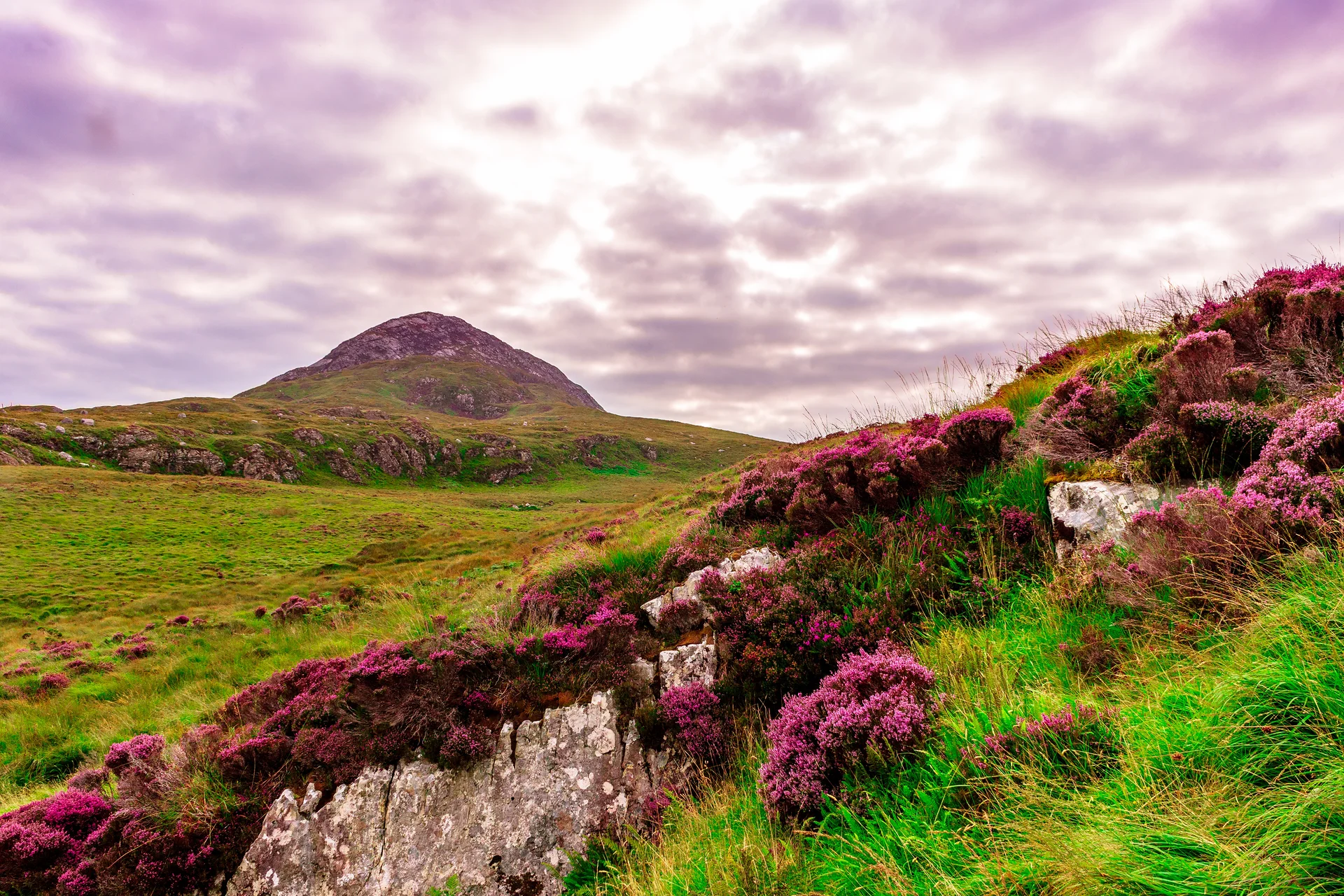
Connemara National Park, where Ireland refuses to be tamed
The wind hits hard, the mist settles in, and suddenly the sky breaks open, casting a low light that turns the peat bog into a tapestry of gold and copper. Five minutes later, it is raining again.
This is Connemara: 2,000 hectares (about 4,942 acres) of mountains, heath, and bogs where the weather changes faster than you can put on a rain jacket, and where every break of sun feels like a hard-won reward.
Why visit Connemara National Park?
Opened to the public in 1980, the park sits on land that once belonged to the Kylemore Abbey estate, the industrial school in Letterfrack, and Richard "Humanity Dick" Martin, one of the founders of the British Society for the Prevention of Cruelty to Animals in the early 19th century. This history left its mark on the landscape: collapsed stone walls, old hand-dug peat banks, and the faint outlines of forgotten pastures.
The park now protects an Atlantic blanket bog ecosystem, one of the most threatened habitats in Europe. Carnivorous plants like butterwort and sundew thrive here, making up for the lack of nutrients in the acidic soil. In summer, purple heather covers the hillsides, giving the landscape that signature violet hue you see on postcards.
The trails: four loops, four vibes
For families and casual walkers
- The Ellis Wood Nature Trail, a 500-meter (about 0.3 miles) loop through the woods, crosses a small forest at the base of Diamond Hill. You will see wildflowers, a quiet stream, and occasionally a waterfall.
- The Sruffaunboy Trail, 1.5 kilometers (about 0.9 miles) on flat ground, offers a solid first look at the park with views over Barnaderg Bay.
Both take less than an hour to complete, and the first is accessible with a stroller.
The lower Diamond Hill loop
The blue trail covers 2.8 kilometers (about 1.7 miles) on gravel paths and wooden boardwalks. The elevation gain is modest, and the panoramas of the lakes and the islands of Renvyle are impressive. Expect 45 minutes to an hour for this circuit, a great choice if the weather turns or if you want to save your energy.
The full ascent of Diamond Hill
The red trail extends the lower loop to the summit of Diamond Hill, at 442 meters (about 1,450 feet). The mountain gets its name from its diamond shape and the quartzite that sparkles in the sun on its slopes. The climb gets tougher in the final kilometer. The stone steps give way to steeper, rocky terrain where you will need to use your hands in some spots. The wind at the summit is often powerful, even in summer.
The reward is a 360-degree panorama. To the west, the islands of Inishbofin and Inishturk float on the Atlantic. To the southeast, the Twelve Bens mountain range lines up its ridges. On a clear day, you can spot Kylemore Abbey nestled against its lake. Plan for 2.5 to 3 hours for the full upper loop.
Pro tip: Arrive before 10 a.m. during peak season. The free parking lot fills up quickly by mid-morning. Above all, never trust the sky when you head out. Always carry a waterproof layer and wear hiking shoes, even if the sun is shining in Letterfrack. At the summit, conditions can be completely different.
What the park hides off the trails
The Visitor Centre, housed in former farm buildings, offers a free exhibition on the formation of bogs and the geology of Connemara since the last ice age. A 20-minute film covers the history of the local biodiversity and conservation efforts. It is worth a quick stop before you lace up your boots.
Since 2024, the park has also housed the Connemara Pony Heritage Centre, dedicated to preserving the Connemara pony, a native breed known for its gray coat and toughness. You will regularly see these ponies roaming free along the trails, alongside sheep, donkeys, and sometimes red deer. Birdwatchers can spot kestrels, meadow pipits, and peregrine falcons.
Opening hours
Connemara National Park is open year-round, seven days a week. The park closes during orange or red weather alerts issued by local authorities.
Visitor Centre: 9:00 AM to 5:30 PM, closed December 25 and 26.
*Information subject to change

Connemara National Park is a spot that offers plenty of hikes right in the heart of nature. The natural, unspoiled landscapes are pretty majestic. You will feel like you are the only person in the world. Just remember to check the weather before you head out. The walk is much less pleasant when it is raining.